

Parashat Chukat
Did Moshe Doubt the Miracle? The Ramban on Parashat Chukat
The famous story of Mei Merivah takes on new meaning through the Ramban's eyes, offering a thought-provoking lesson for the Shabbat table.
- Yonatan HaLevi
- | Updated
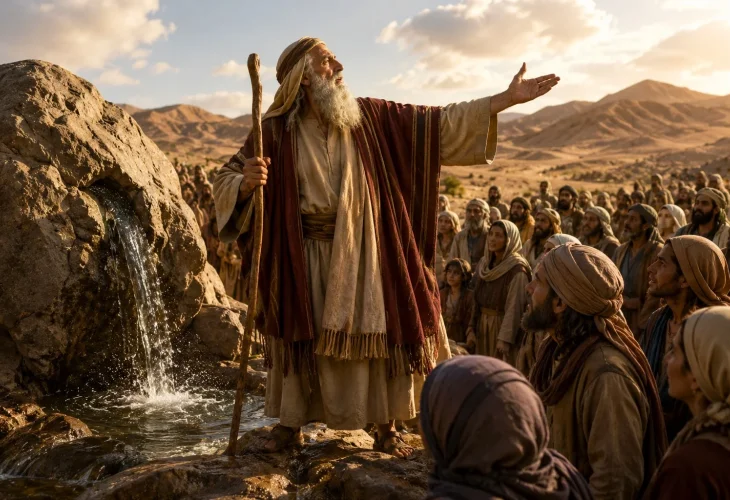
One of the most difficult episodes in the Torah appears in Parashat Chukat: the incident of Mei Merivah. Following this event, Moshe and Aharon are told that they will not enter the Land of Israel.
As the people complain about the lack of water, Moshe and Aharon gather the nation before the rock, and Moshe declares:
"Listen now, rebels, shall we bring forth water for you from this rock?" (Numbers 20:10)
At first glance, Moshe's words seem puzzling. Was he expressing doubt that Hashem could perform such a miracle? Did he question whether water could really emerge from a rock?
The Ramban strongly rejects such an interpretation.
Heaven Forbid
In unusually forceful language, the Ramban writes:
"Heaven forbid, heaven forbid."
He explains that it is impossible to suggest that Moshe doubted Hashem's ability to bring water from the rock.
Moshe Rabbeinu was the most faithful servant of Hashem. He had witnessed the Ten Plagues, the splitting of the sea, the giving of the Torah, and countless other miracles. Furthermore, many years earlier he had already seen water emerge from a rock at Chorev.
How could anyone think that Moshe questioned whether Hashem could perform such a miracle?
The answer, says the Ramban, must lie elsewhere.
A Question That Isn't Really a Question
The Ramban points out that Tanach often uses questions as a rhetorical device.
Sometimes a question is asked not because the speaker lacks information, but because he wishes to emphasize a truth that should already be obvious.
Examples appear throughout Scripture:
"Have you eaten from the tree from which I commanded you not to eat?"
"Will you judge?"
"Did I indeed reveal Myself?"
In each case, the speaker is not seeking information. The question itself highlights a reality that the listener already knows.
The Ramban suggests that Moshe's words should be understood in a similar way.
Ibn Ezra's Explanation
The Ramban also cites the explanation of Rabbi Avraham Ibn Ezra.
According to Ibn Ezra, Moshe was telling the people:
"Do you think we have the power to bring water from this rock?"
In other words, Moshe was reminding the nation that neither he nor Aharon possessed supernatural powers.
The miracle would not come from them.
It would come entirely from Hashem.
The same Hashem who took them out of Egypt, sustained them with manna in the wilderness, and protected them throughout their journey would now provide them with water as well.
Moshe's goal was to direct the people's attention away from human beings and toward the true source of all blessing.
A Test of Faith
The Ramban ultimately offers an even deeper explanation.
Moshe's question was directed at the people's state of mind.
He was challenging their lack of faith.
The nation had once again complained, questioning whether Hashem could provide for them. Their attitude echoed the repeated tests described throughout the wilderness journey.
Moshe's words were essentially saying:
"Listen now, rebels. Do you really believe that Hashem cannot bring water from this rock? Do you truly think such a miracle is beyond His power?"
The question was not about the rock.
It was about the people.
Moshe was exposing the doubt that lay beneath their complaints.
Looking Beyond the Surface
According to the Ramban, the episode of Mei Merivah contains a timeless lesson.
Often, the greatest challenge is not whether Hashem can help us. The real question is whether we believe He can.
The people saw the wilderness through the lens of fear and uncertainty. Moshe wanted them to remember everything they had already witnessed.
The Exodus.
The splitting of the sea.
The manna.
The clouds of glory.
After all of that, could water from a rock really be difficult for Hashem?
The Ramban teaches that Moshe's words were not an expression of doubt. They were a call to faith.
Sometimes the purpose of a question is not to seek an answer, but to help us recognize the answer that has been in front of us all along.

