

Parashat Korach
Playing with Fire: Korah’s Fatal Challenge
Why the 250 challengers misjudged spiritual heroism—and what their fate teaches about the harder challenge of living a meaningful life
- Rachel Wigman
- | Updated
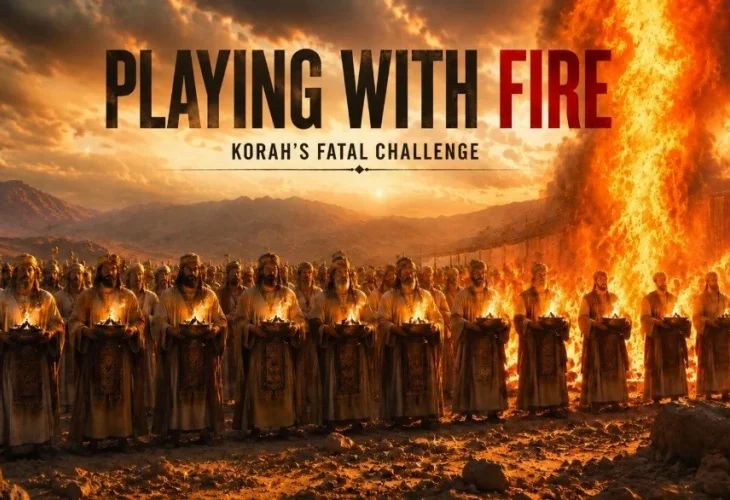
The rebellion of Korah was, in a word, a doozy. Although the timeline is not exactly clear as to when the rebellion happened, the general consensus is that it was around the same time as the Sin of the Spies, whether right before or shortly thereafter. But it was a young nation, still on somewhat shaky ground, when Korah, the first cousin of Moses and Aaron, stirred up trouble.
Ostensibly, his argument was that the nation should not need intermediaries between them and God because “the entire nation is holy” (Num.16:3). The Midrash, however, fills in the back story: Korah’s father, Yitzhar, was the second oldest in the family of Kehath, one of the three sons of Levi. Yitzhar’s older brother, Amram, fathered Moses and Aaron, who became the leader and high priest, respectively. By birthright, the next in line in the Kehath family for a position of prominence should be the eldest son of Yitzhar, which would be Korah. Instead, the youngest of the cousins became the prince of the tribe, and Korah was assigned the task of carrying the Ark of the Covenant. To be clear, Korah’s job was an incredible honor, but he felt as though he had been both slighted and relegated, and he was not happy about it.
It is difficult, however, to stir up real trouble when the vendetta is personal. Instead, Korah made it about everyone, and specifically the firstborns who had been stripped of their priestly rights to serve in the Temple as a result of their participation in the Sin of the Golden Calf. The loss, which was relatively new, was not forgotten, and Korah played it up, convincing two hundred fifty men to join his rebellion.
One key difference between Korah and the two-fifty is that Korah was in this fight for personal reasons. His honor was slighted; he was not given the prestige that he thought he deserved. By contrast, the participants were largely motivated by their desire to be able to serve God directly as priests.
Moses knew that this rebellion had to be put to rest in a way that was so decisive it would leave no room for argument from then to the end of time. “In the morning,” he said, “God will make known who is His—who is sanctified, who He brought close to Him, and who He will choose is who He will bring close. This is what you will do: take for yourselves fire-pans, Korah and the whole congregation. You will place on them [coals of] fire and place on that incense before God tomorrow. It will be that the man whom God will choose, he is the sanctified one” (Num.16:5-7).
The test is clear, and the stakes of the test are even clearer. It was less than six months at that point since the inauguration of the Tabernacle, which included the disaster of Aaron’s two elder sons burning incense where they were not commanded to do so and instantly dying as a result. The event was still fresh in the people’s minds. Moreover, in case that was not enough, Moses uses strikingly similar language in his commandment as was used in describing the incident with Aaron’s sons. The men who are to bring this incense offering the next day know that if they are not the ones chosen, they will die.
They chose to do it anyway. It’s a powerful insight into human psychology, and how often we know how low the chances are of our emerging victorious yet our ability to convince ourselves that there’s still a chance it could be us. Each one of the two-fifty genuinely thought he could be the last one standing the next day. And each one made the calculation that even if he were to die, it would be worth the one moment of closeness to God that he will find in bringing that incense. Each calculated that his death was worth that sacrifice.
Elsewhere in the Torah, Rabbi Berel Wein points out that the challenge of Judaism is not dying a sacrificial death, but it is in living a sacrificial life. To love God with all one’s heart and all one’s soul means a willingness to live life to a higher order, to answer the call that God places before us. Yes, there are cases in which we must be willing to sacrifice our lives for the sake of God, but the real challenge of Judaism lies in living well.
That is what the two-fifty missed when they calculated the risk of their dying. And they did die, burned by fire the same way that Aaron’s sons had been burned. In their mistaken calculation, though, they left behind an important lesson: In the immortal words of that great American musical, Hamilton, “Dying is easy, young man; living is harder.”
The two-fifty took the easy way out. But they remind us, as we read of their mistake year in, year out, that we still have the chance to choose wisely—we choose to live.

