

Behind the News
What Israel Feared About the Iran Deal Is Now Being Said Out Loud
Now that the deal has officially been signed, the text and both sides’ statements are confirming Israel’s core security concerns
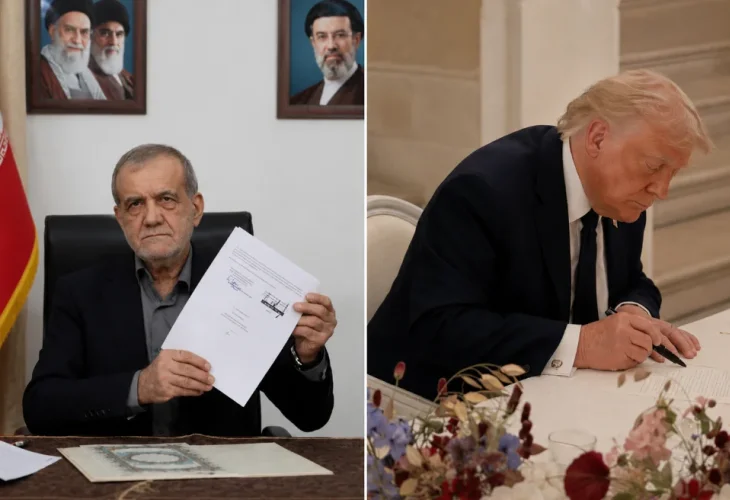
Before the agreement was signed, Israeli officials and critics warned that the emerging U.S.-Iran framework would not solve Israel’s core security problems.
They feared the deal would push the nuclear issue into future talks, leave Iran’s enriched uranium and ballistic missiles in place, preserve the regime, keep Hezbollah and the proxy network intact, and restrain Israel’s freedom of action in Lebanon. Now the deal has been signed, and the reported text, President Donald Trump and Iranian officials are confirming that out loud.
The first issue is Iran’s nuclear program. According to the reported text, “Both sides agree to address Iran’s stockpile of enriched uranium in future talks.” The same reported framework says Iran “would maintain its current nuclear program during negotiations,” with 60 days of talks toward a final agreement.
Even Trump’s own words suggested the uranium question had not been practically resolved. Asked whether he had secured an agreement on Iran’s nuclear material, Trump said, “Yes, conceptually on that. And nobody’s getting close to it because it’s buried under a mountain.” Trump was not describing a plan to remove the material, but a reason it could be left where it is for now.
Iran’s position after the signing was more direct. Foreign Ministry spokesman Esmail Baghaei said, “Transferring enriched nuclear material out of the country is unacceptable to us.”
For Israel, missiles are not a side issue. They are one of Iran’s most powerful weapons against Israel and the main tool Iran has used to strike Israeli territory directly.
On the topic, Trump drew a line Israel can not draw, treating ballistic missiles as separate from the nuclear file. “If other countries have ballistic missiles, it’s a little bit unfair for Iran to not have some. A ballistic missile is not the same thing as a nuclear weapon. If Saudi Arabia and Qatar, and they all have some, I think in relative proportion it’s okay for Iran to have some.”
Iran treated the question even more sharply, declaring the missile program completely off-limits. “Our missiles are meant to be fired, not negotiated over. Our missiles don’t even like being talked about. Iran’s defensive capabilities will not be discussed in any process, with any party.”
The agreement also leaves the Iranian regime standing. Israel’s hope was that the war might at least weaken Iran’s leadership. Trump however made clear that removing it was never the goal.
“You talk about regime change. I never cared about regime change. It was never a part.” He also described Iranian officials as reasonable negotiating partners, calling them “very rational people,” “strong people” and “smart people.”
For Israel, that was its own concern: the same regime that built the nuclear program, fired missiles at Israel and armed Hezbollah is now being treated as a legitimate partner for the next stage of talks.
And while those concerns are more strategic, Lebanon is where they become immediate. According to the reported text, the ceasefire framework also reaches Lebanon: “Iran and the US and their allies would halt hostilities, including in Lebanon.”
Iran did not treat that as a technical ceasefire detail. Parliament Speaker Mohammad Bagher Ghalibaf framed Lebanon as directly part of Iran’s camp. “Lebanon is part of the Resistance Front. Under the agreement, Iran supports the Resistance Front, while the United States is a supporter and ally of the Israeli regime. Therefore, it is natural that when a ceasefire is established, it must be respected on all fronts, especially in Lebanon.”
Ghalibaf also tied Hezbollah to Iran’s victory narrative, thanking Hezbollah and Lebanese Shiites for their role during the war, saying they “stood up during the U.S. and Israeli aggression against Iran.” Hezbollah echoed that from the other side: “The ceasefire would not have been possible without the Islamic Republic of Iran’s intervention… Thank you, Iran.”
Trump, meanwhile, spoke only about managing Hezbollah, not dismantling it. “Hezbollah. We have to have a little talk with them,” he said. He also suggested that Israel let Syria deal with Hezbollah because “they would do a better job.”
That leads to Israel’s freedom of action in Lebanon. The issue is not whether Israel has a theoretical right to respond if attacked. The issue is whether every Israeli strike against Hezbollah now becomes a diplomatic crisis with Washington because Iran claims Lebanon is part of the agreement. That concern has already begun to materialize, with Trump criticizing the scale of Israeli strikes in Lebanon.
“We have a little dispute over Lebanon. I say, ‘You can do a little softer touch, Bibi. You don’t have to knock down a building every time somebody walks into it that’s from Hezbollah.’” He added: “I’m not saying they shouldn’t protect themselves. I’m saying when two drones are shot into the desert and drop harmlessly, you don’t have to knock down buildings in Beirut.”
Iran then turned that criticism into a demand, saying continued Israeli attacks in Lebanon would violate the memorandum itself. “If the Israeli regime’s attacks against Lebanon continue, this will constitute a violation of the other side’s commitments under the memorandum of understanding," Bagaei said.
More importantly, he added that “it is the responsibility of the United States to compel the Israeli regime to respect America’s commitments to Iran under this agreement.” That turns Lebanon from an Israeli-Hezbollah battlefield into a test of the U.S.-Iran deal.
The message from Iran is clear: the regime stays, the missiles stay, the uranium stays for now, Hezbollah remains in the game, and Lebanon is part of the framework.
The deal does not remove the main threats Israel went to war to weaken. It moves them into the next diplomatic stage, with Washington expected to manage Israel’s response. That is not the end of the Iran problem. It is the beginning of the next phase.

