

Facts in Judaism
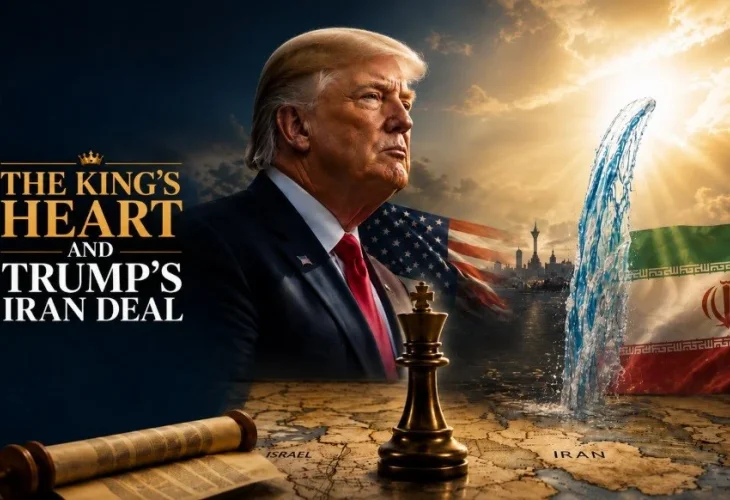
The King's Heart and Trump's Iran Deal
Trump's Iran deal has left Israel's supporters searching for political explanations. The Jewish tradition suggests a deeper possibility: that the decisions of rulers, however perplexing, are never entirely their own.
- Maayan David
- | Updated
The memorandum of understanding signed between the United States and Iran has sparked considerable outrage and confusion both in Israel and among America's pro-Israel allies—especially American Jews who supported President Trump believing that, whatever his significant shortcomings, he would at least remain a steadfast friend of Israel.
Only a few months ago, the U.S.-Israel alliance appeared stronger than ever. The two nations had fought shoulder to shoulder during Operation Rising Lion (or Epic Fury, as it was known in the United States). Yet the celebration proved short-lived. Not only does the initial agreement with Iran appear to disregard Israeli interests entirely, but its signing was accompanied by repeated criticism of Israel from senior administration officials, including the President himself.
Trump, who once took pride in claiming that no American president was more popular in Israel than he was, has seen his standing among Israelis collapse almost overnight. Given recent statements from Washington, it is difficult to see how it could have been otherwise. The administration has repeatedly urged Israel to restrain its response to Hezbollah—even as the terrorist organization continues its relentless attacks on communities in northern Israel—apparently in order to avoid upsetting Iran.
Many theories have been put forward to explain Trump's sudden reversal. We were told that a prolonged conflict would send gas prices soaring, undermining Republican prospects in the November midterm elections. Others suggested that Trump, true to form, simply grew tired of the issue and wanted to shift his attention elsewhere. Some commentators hinted at financial interests influencing American officials involved in the negotiations. Others pointed to the growing influence of the so called "Tucker wing" of the Republican Party, along with the increasingly prominent isolationist instincts associated with Vice President Vance. Perhaps some of these explanations contain an element of truth. Perhaps several of them do. Perhaps all of them do. At this stage, nobody outside the administration can say with certainty.
The attempt to understand the hidden, and often harsh, necessities behind a ruler's decisions can be traced back to Niccolò Machiavelli in the early sixteenth century. Machiavelli argued that actions which appear immoral, irrational, or even self defeating to outside observers are often calculated responses to the brutal realities of political life. A ruler is judged by outcomes, not intentions, and therefore must frequently choose between imperfect options.
Modern political science has expanded this insight while adding new layers of complexity. Today we recognize constraints that were far less familiar to Machiavelli's generation. The American political scientist Herbert Simon, through his theory of bounded rationality, argued that leaders rarely possess complete information. They operate under severe time pressures, cognitive limitations, and uncertainty about future events. Because perfect decision making is impossible, leaders do not search for the best possible solution. Instead, they settle on a solution that appears sufficiently safe or effective under the circumstances. Simon called this process "satisficing," a term combining the words satisfy and suffice. What may later look like a disastrous mistake may have appeared, at the time, to be the least risky option available.
Judaism, however, offers a very different perspective on this issue. In the Book of Proverbs we are told: "The king's heart is like streams of water in the hand of the Lord; He turns it wherever He wishes." Rashi explains that while ordinary individuals enjoy the full exercise of free will, the heart of a king is guided more directly by God because the consequences of his decisions extend far beyond his personal life. Just as a farmer channels water toward one field or another according to his purposes, so God directs the thoughts of rulers in order to accomplish His will in history.
Another great commentator, Rabbi Levi ben Gershon, known as the Ralbag, develops this idea further. In his view, God influences the decisions of rulers to ensure that justice, providence, and national destiny unfold as they should. Kings and political leaders become instruments through which reward or punishment is brought upon entire peoples. Their decisions may appear to arise solely from personal calculation, but they are also woven into a larger divine plan. Like water directed toward a particular destination, political power ultimately flows where God intends it to go.
This leads to a distinctly Jewish understanding of leadership. We often imagine rulers as uniquely powerful individuals, masters of events who bend history to their will. The biblical tradition suggests almost the opposite. The greater a leader's power, the less independent he may actually be. An ordinary citizen exercises his God given free will primarily over his own life. A ruler, however, holds the fate of nations in his hands. Because the consequences of his decisions affect millions, God does not leave history entirely to human discretion. The heart of a king remains in the hand of the Lord.
President Trump leads the last remaining superpower. Yet from a biblical perspective, that very fact means his decisions cannot be viewed as entirely his own. King Solomon, himself one of the most powerful rulers in history, articulated this truth nearly three thousand years ago. Political leaders may make choices that seem bewildering, disappointing, or even inexplicable. Yet neither those choices nor their consequences belong entirely to them.
The Tanakh therefore offers us a helpful lesson. There is little value in becoming consumed by frustration with the stream of water itself. Far better to direct our attention to the One who guides its course and turns it wherever He wills.

