

World News
Trump Warns Iran Talks Will End if Hormuz Toll Reports Prove True
Trump says nuclear negotiations with Iran will collapse if Tehran charges fees in the Strait of Hormuz.
- Hidabroot
- | Updated
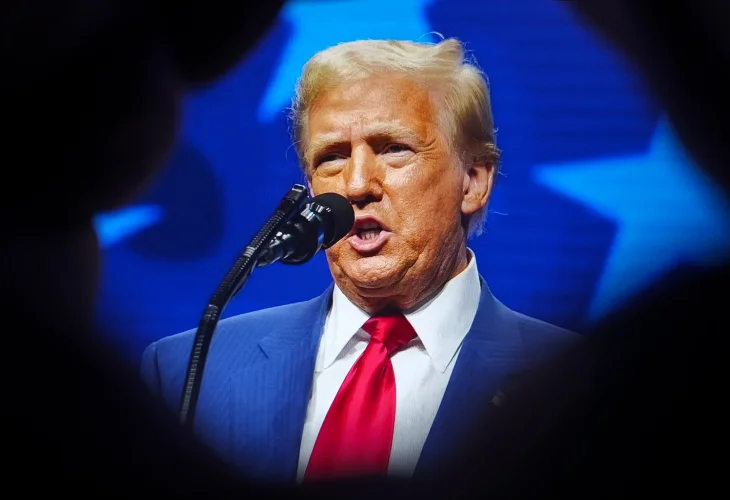 Shutterstock
President Donald Trump warned Wednesday that nuclear negotiations with Iran would collapse if Tehran is found to be collecting tolls or insurance fees from ships passing through the Strait of Hormuz. Trump posted the warning on Truth Social, citing an assurance he said he received directly from Iran that no such charges exist.
"Iran informed the United States that, despite the misleading reports of 'fake news' claiming otherwise, there are no transit fees, no insurance costs, and no payment of any kind that Iran demands or receives from ships passing through the Strait of Hormuz," Trump wrote. "If this information is wrong, the negotiations will end immediately."
The statement came amid conflicting reports over whether Iran has been trying to charge for traffic through the waterway, which handles a significant share of global oil shipments. Trump presented the Iranian denial as a rebuke of media coverage while making clear he would not tolerate deception during the talks.
On frozen Iranian assets, Trump was direct: the United States has not transferred any money to Iran and has not released any funds held under American control. He did announce that a portion of those frozen assets would be freed for one specific purpose - buying American agricultural products on Iran's behalf. "We will be releasing some of their money, which is totally under our control, for our farmers and ranchers, for the purchase of corn, wheat, soybeans, and more," Trump wrote, adding that food is "desperately needed" in Iran and that all purchases would come exclusively from American suppliers.
Vice President JD Vance had argued during a visit to Switzerland that releasing frozen funds to buy American farm goods would feed the Iranian population while benefiting American farmers. Trump repeated the same message the following day, describing Iran as suffering from a "hunger problem," a severe medicine shortage, and extreme economic crisis including extraordinary inflation.
That characterization met with sharp rejection from Iranians. Citizens speaking to the Iran International network pushed back on the picture of their country's difficulties as a food shortage. "There is no food shortage here," one person said. "Government policy has made food inaccessible for many. Shipping wheat will not solve our problems." Others blamed the country's economic deterioration on corruption and decades of mismanagement under the Islamic Republic rather than a lack of resources.
Widespread skepticism also emerged over whether any released funds would reach ordinary Iranians. "Right now the regime in Tehran is probably thinking about how to send that wheat to Lebanon and Iraq," wrote one commenter, pointing to Iran's financial support for Hezbollah, Hamas, the Houthi movement in Yemen, and militia groups in Iraq. Another wrote: "Iran is not a poor country. If you don't believe me, ask Hezbollah, Hamas, and the Houthis."
Many Iranians also rejected the idea that the nationwide protests earlier in 2026 were rooted in economic hardship. They pointed to a moment during the January demonstrations in Abadan, where protesters were filmed throwing rice into the air - widely read as a direct rejection of the notion that the uprising was about food. "The Iranian people are not fighting for food, they are fighting for freedom," one person wrote.
Trump has consistently presented the nuclear negotiations as a path to a deal while warning that any sign of bad faith would halt talks at once. The dispute over Hormuz tolls, real or exaggerated, has become one of the sharper tests of whether that process holds.

