

World News
Britain, Italy, and Japan Are Racing Ahead on a Next-Generation Fighter Jet
Britain, Italy, and Japan have signed a massive deal to speed up development of a sixth-generation fighter jet. The aircraft is expected to enter service in 2035 and will rely on artificial intelligence and other advanced technologies.
- Yuval Aviv
- | Updated
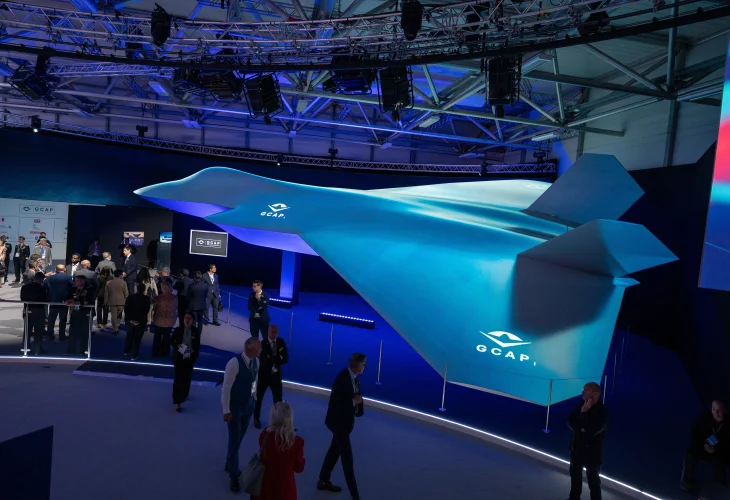 The international air show in England (Credit: shutterstock)
Britain, Italy, and Japan have signed a contract worth £4.6 billion (approximately $6.1 billion), marking a major milestone in the GCAP program to develop a sixth-generation stealth fighter jet. The agreement moves the project into its main design phase, with the goal of bringing the aircraft into operational service by 2035.
According to a report by Breaking Defense, the contract will fund the platform's detailed design and development phase over the next eighteen months. The budget was awarded to the three nations' leading defense contractors — Britain's BAE Systems, Italy's Leonardo, and Japan's Mitsubishi Heavy Industries — which will advance the detailed design and systems engineering stages of the future aircraft.
The new agreement marks a significant inflection point in the program, following the establishment of the joint venture Edgewing, selected to lead aircraft development. The stated objective is to complete development and bring the platform into operational service by the mid-2030s.
According to the report, the contract announcement also carries a clear strategic message for the global defense market. Against the backdrop of the enormous costs involved in developing next-generation fighter jets, and concerns over the financial sustainability of such programs, the new investment is intended to underscore all three nations' commitment to seeing the project through.
At the same time, officials involved in the program pointed to the widening gap between GCAP and the rival European FCAS program, led by France, Germany, and Spain. While GCAP continues to gain momentum, the competing effort remains stalled due to persistent inter-partner disputes over work-share and industrial arrangements.
The new contract is expected to allow engineers to accelerate development of the aircraft's core systems, including advanced radar, next-generation propulsion, and complex digital infrastructure. Japan — whose participation marked a milestone in its defense cooperation with Western allies — is expected to lead development of advanced electronics and sensor systems, in coordination with American entities developing comparable platforms. Britain and Italy will focus on combat systems integration and weaponry.
One of the program's central components is the aircraft's future operational concept. According to the report, it is designed to operate as the manned hub of an integrated formation comprising crewed aircraft alongside drone swarms, with real-time connectivity across aerial platforms, satellites, ground forces, and naval units — establishing a common operational picture (COP) across the battlespace.
Despite the progress and unprecedented investment, the program still faces significant challenges. The partner nations are aiming to fly a first prototype before the end of the decade — an especially demanding target, due in part to the vast scope of software development and the integration of artificial intelligence for real-time decision-making.
In the next phase, Britain, Italy, and Japan are expected to finalize production agreements that will determine procurement quantities for each air force and export potential to allied nations — a step that could reduce per-unit costs and underpin the program's long-term economic viability.

