

State Comptroller Warns: "Iran Is Using Social Media to Deepen Israel’s Internal Divides"
A report released by outgoing State Comptroller Matanyahu Englman says foreign actors sent millions of messages from fake profiles and ran campaigns designed to stir panic among the Israeli public. The comptroller warned: "Without an organized government response, these attempts could harm state sovereignty and undermine the electoral system."
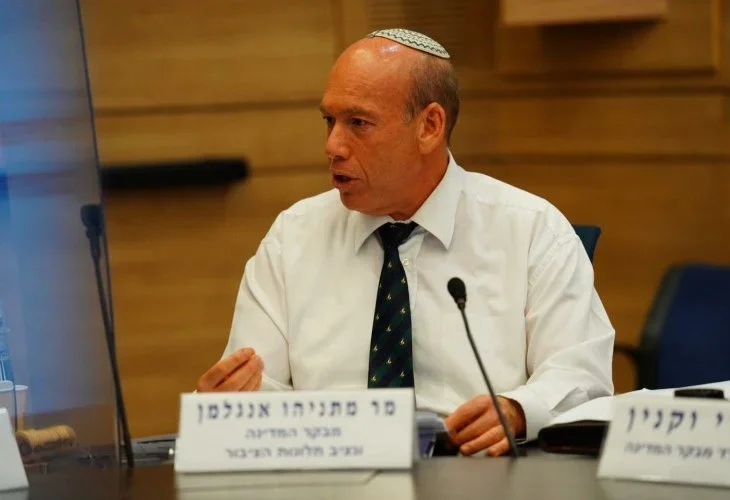 Englman (archive photo: Adina Wallman, Knesset Spokesperson)
Outgoing State Comptroller Matanyahu Englman published a report today (Tuesday) on foreign influence operations targeting Israel's digital sphere by hostile actors. According to the report, a foreign influence network known as "Isnad" was identified in 2024, operating with the explicit goal of pressuring Israel to end the Swords of Iron war on terms favorable to Hamas — by systematically manipulating Israeli public opinion.
Between December 2023 and August 2024, thousands of messages were drafted by foreign operatives and disseminated through approximately 300,000 fake profiles across the social network X. Separately, in the early days of the war, an Iranian influence campaign was launched and achieved widespread viral reach.
The Iranian campaign was designed to establish and entrench the narrative that Israel is committing "genocide" in Gaza. The report further reveals that Iran and Hezbollah transmitted roughly 5 million SMS messages to Israeli citizens — including fabricated emergency alerts instructing recipients to immediately seek shelter — with the deliberate aim of sowing panic across the civilian population.
The Comptroller noted that, according to data from the Israel Internet Association and the Technion, 56 percent of Israelis receive their news through social media — making foreign interference in that arena particularly consequential for shaping public opinion. In his words: "The threat posed by foreign influence spans many dimensions, including foreign investments, ties with academic and research institutions, investment in critical infrastructure, and the acquisition of sensitive technologies."
The audit examined Israel's capacity to identify and respond to foreign influence operations, including during election periods. It covered the National Security Council, the Prime Minister's Office, the Israel Security Agency (Shin Bet), the National Cyber Directorate, the Central Elections Committee, and the National Emergency Authority.
The Comptroller determined that significant coordination failures exist among the various bodies responsible for countering foreign influence. While the National Security Council stated its intention to lead inter-agency coordination efforts, the audit found that no meaningful progress had been made on the ground.
In January 2026, the Shin Bet informed the Comptroller's Office that it had launched focused monitoring activity ahead of the 2026 elections. Yet despite substantial technological developments since 2019 — when the Justice Ministry first formulated guidelines for combating election interference through bots and foreign-linked fake accounts — those guidelines have not been updated in the six years since.
Upon releasing the report, Englman expressed serious concern: "Hostile actors, including Iran, are exploiting social media in a covert and systematic manner to deepen societal divisions, sow panic, and engineer Israelis' perception of reality. National preparedness on this issue is inadequate, and no government body is effectively leading the response."
He added: "The threat sharpens as the next election approaches. An election period is especially vulnerable — fertile ground for malicious foreign interference, raising genuine concern about the distortion of election outcomes and the erosion of public trust in democratic institutions."
"Without an organized government response, attempts to interfere in Israel's internal discourse could ultimately harm state sovereignty and undermine public confidence in the democratic process itself."
The Central Elections Committee responded to the report: "The Committee welcomes the in-depth review conducted on this critical issue and regards the Comptroller's findings as a meaningful contribution to strengthening national preparedness against foreign influence in the digital sphere."
The Committee noted that foreign interference is not confined to election periods but constitutes an ongoing challenge in routine times as well — one that grows acutely more dangerous during campaigns, when it threatens not only voting patterns but also public trust in the integrity of the electoral process and the legitimacy of its outcomes. The Committee stated that the report's recommendations pertaining to its mandate are being actively implemented as part of preparations for the upcoming election, alongside additional steps to address the evolving threat landscape, rapid technological change, and the expanding use of artificial intelligence tools.

