

Interesting
How 29,000 Rubber Ducks Lost at Sea Changed Science Forever
What first looked like a minor shipping accident became one of the most fascinating scientific experiments in modern history.
- Shira Dabush
- | Updated
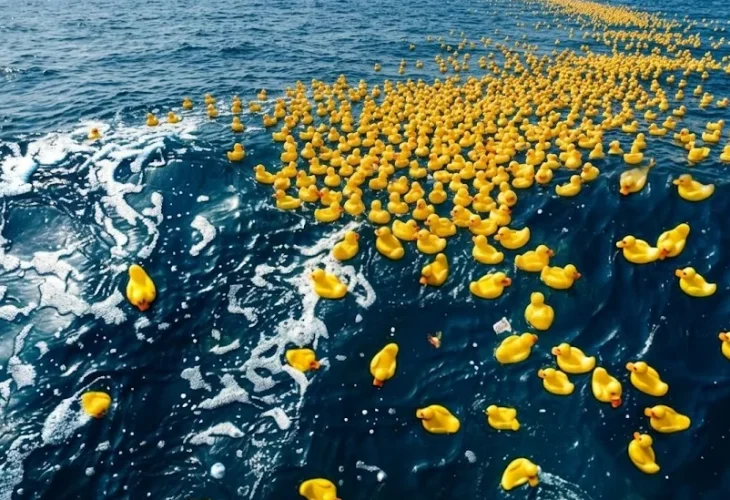
In 1992, a shipping accident in the Pacific Ocean unexpectedly became one of the most valuable scientific experiments ever conducted on ocean currents.
What began as a routine cargo shipment ended with nearly 29,000 rubber ducks drifting across the world's oceans, providing researchers with years of valuable data about how water moves around the globe.
The Cargo That Fell Into the Sea
At the beginning of 1992, the container ship Evergreen Ever Laurel departed from Hong Kong on its way to the United States.
Among the millions of products on board was a shipping container filled with 29,000 colorful rubber bath toys manufactured in China for a Japanese toy company.
Just four days into the voyage, the ship encountered a powerful storm in the North Pacific Ocean. Massive waves, reaching more than 10 meters (33 feet), and strong winds caused several containers to break loose and fall overboard.
One of those containers burst open, releasing thousands of yellow rubber ducks into the sea, where they quickly drifted apart in every direction.
An Unexpected Scientific Opportunity
The accident soon caught the attention of Seattle oceanographers Curtis Ebbesmeyer and James Ingraham, who were studying surface ocean currents.
Scientists typically rely on specially designed drifting buoys or bottles to monitor currents. However, many of these devices are never recovered, making it difficult to gather long term data.
The floating rubber ducks presented a unique opportunity.
For the first time, researchers had tens of thousands of identical floating objects, all entering the ocean from the exact same location at the same time.
The scientists later described it as a rare natural experiment that would have been nearly impossible to recreate intentionally.
Not Their First Floating Experiment
This was not the first time researchers had turned a shipping accident into valuable scientific research.
Three years earlier, another cargo ship had lost a container carrying approximately 80,000 Nike sneakers. As the shoes gradually washed ashore along the coasts of Canada and the United States, scientists used reports from beachgoers to better understand the movement of ocean currents.
The rubber ducks promised an even more detailed picture.
Following the Ducks Around the World
Ebbesmeyer and Ingraham organized an international network of volunteers, travelers, sailors, and beachcombers, asking anyone who found one of the toys to report its location.
Over the following years, the ducks appeared on beaches thousands of miles apart, including coastlines in North America, Europe, and even the Arctic.
By carefully tracking where and when the toys arrived, researchers were able to map ocean currents with a level of accuracy that had never before been possible.
A Lasting Scientific Legacy
The accidental release of the rubber ducks provided scientists with valuable insights that continue to influence ocean research today.
The data helped improve models used to predict the movement of ocean currents, forecast where marine debris and pollutants may travel, understand the drift of icebergs, and even study the migration patterns of marine animals.
What began as an ordinary shipment of bath toys ultimately became one of the most famous accidental scientific experiments in history, proving that even an unexpected mishap can sometimes transform our understanding of the natural world.

