

Magazine
The Kol Nidrei Melody That Saved a Kidnapped Jewish Child
A moving true story of Rabbi Benjamin Zev Auerbach, whose haunting rendition of Kol Nidrei awakened a kidnapped boy's Jewish soul and led him back to his parents and his faith
- Naama Green
- | Updated
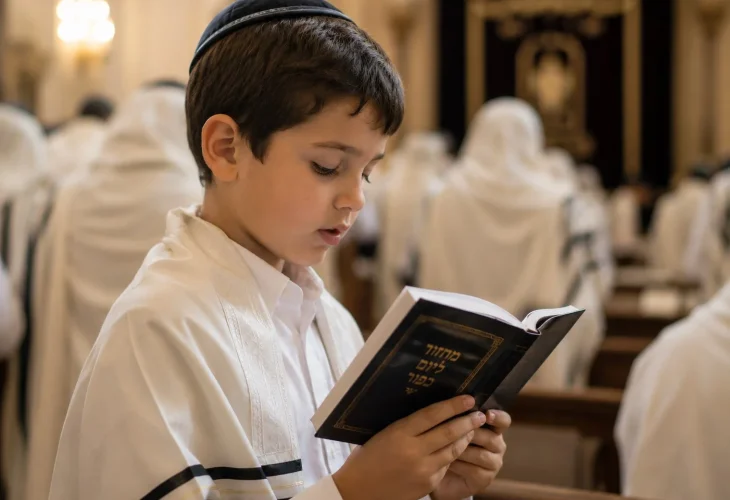
In his sefer Doresh Tov, Rabbi Chizkiyahu Mishkovsky recounts a powerful story about the High Holy Days that he heard from Rabbi Schneider in the name of his grandfather, Rabbi Wolf.
The story took place in a small town in Germany, where one of the great Torah scholars of the generation, Rabbi Benjamin Zev Auerbach, author of Nachal Eshkol, served as the town's rabbi.
One day, a young Jewish boy was kidnapped and taken to a monastery. When his parents returned home, they were horrified to discover that he was missing. They questioned their maid, but she claimed to know nothing about his whereabouts. Desperate and heartbroken, they searched everywhere until they finally learned that their son was being held at the monastery.
A Deceptive Defense
The parents immediately brought the matter before the court, accusing the priests of kidnapping their child. The priests, however, responded with calculated deceit.
"This is no kidnapping," they declared before the judges. "The boy came to us after his parents abandoned him. He was hungry, thirsty, shivering from the cold, and utterly miserable. Out of kindness and compassion, we took him in. If his parents truly want him back, they are welcome to take him — but first ask the child himself whether he wishes to return."
In the meantime, the monks had showered the boy with sweets, gifts, affection, and promises. By the time he appeared before the court, he had been thoroughly manipulated. When asked whether he wanted to remain at the monastery, he answered yes.
His parents were devastated.
A Second Appeal
In their anguish, they consulted a skilled attorney, who suggested filing a second appeal.
"It is simply unnatural," he argued, "for a child to reject his own parents. His prolonged separation from them has caused him to forget the bond they shared. Let him return home for two weeks, and only afterward ask him where he wishes to live. Then we will know his true feelings."
The judge found the argument reasonable but ruled that two weeks were unnecessary.
"A child's love for his parents does not require so much time to awaken," he said. "Five moments in their presence will be enough. After those five moments, he may choose."
The parents left the courtroom crushed. What could possibly be accomplished in only five moments? How could they hope to bring their son back in such a short time?
Turning to the Rabbi
With nowhere else to turn, they came to Rabbi Benjamin Zev Auerbach, the author of Nachal Eshkol.
"There is no need for you to meet the child yourselves," the rabbi told them. "I will go in your place. Meanwhile, pray that Hashem grants me success."
The Power of Kol Nidrei
On the appointed day, the rabbi arrived at the monastery. The child was placed in a room at the far end of a long corridor, and no one was permitted to enter except Rabbi Auerbach.
The rabbi appeared almost angelic. Clothed in a white kittel and wrapped in a tallit, he stepped into the corridor. Before he even reached the child, he began softly chanting the haunting melody of Kol Nidrei — the sacred prayer that ushers in Yom Kippur.
The melody floated through the hallway with extraordinary sweetness and holiness. As the familiar notes reached the child's ears, something deep within him stirred, and he burst into tears.
Suddenly, he remembered Kol Nidrei in the synagogue. He remembered the congregation dressed in white, the solemn atmosphere of Yom Kippur, the holiness that had once surrounded him. Memory after memory came rushing back. He saw his parents, his home, his Jewish life. His entire body trembled.
"I Am a Jew"
Rabbi Auerbach approached him gently and asked, "Tell me, my child, what do you want to be? A Jew or a gentile? This world alone, or the World to Come?"
Through tears streaming down his face, the boy answered, "Rebbe, I am a Jew. I want to go home."
"In that case," the rabbi replied, extending his hand, "give me your hand. Let us go home."
Hand in hand, the two walked out of the monastery, and the child returned to his people and to the faith of his ancestors.

