

World News
At 5,400 mph: Elon Musk’s Rocket Stage Crashes Into the Moon
After drifting off course due to gravitational forces and solar activity, the upper stage of a Falcon 9 rocket that launched two private lunar landers in 2025 crashed into the Moon this morning.
- Yuval Aviv
- | Updated
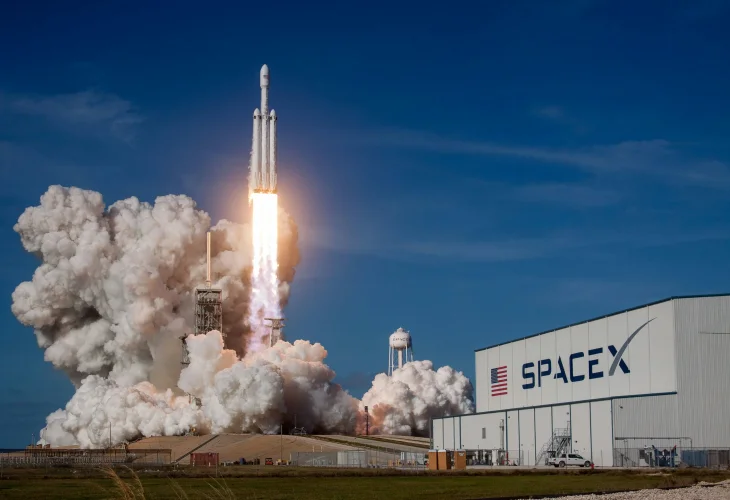 The Falcon B demonstration mission (Photo: SpaceX on Unsplash)
About a year and a half after launching two private landers toward the Moon, the upper stage of SpaceX’s Falcon 9 rocket crashed into the lunar surface this morning (Wednesday), after drifting off course due to a combination of gravitational forces and solar activity. According to scientists, the collision occurred at 9:35 a.m. Israel time, at a speed of roughly 5,400 mph, creating a new crater near the Moon’s illuminated rim. The impact was estimated to be equivalent to an explosion of about three tons of TNT.
SpaceX clarified that the event was unplanned. The BBC reported that while scientists confirmed the rocket struck the Moon, they are still awaiting final verification through data from telescopes operated by NASA, the American space agency.
The rocket that hit the Moon was the same upper stage that launched two private landers on January 15, 2025. One of them, Firefly Aerospace’s Blue Ghost, became the first private spacecraft to successfully complete a lunar landing. The second lander, from Japan’s ispace, crashed during its landing attempt.
According to space experts, the collision could have been avoided if the upper stage had been redirected into an orbit around the Sun after completing its mission. In fact, this is only the second known case in which a discarded rocket stage has accidentally crashed into the Moon. The previous case occurred in 2022, when part of a Chinese rocket struck the far side of the Moon and created a pair of craters.
"What happened was essentially a combination of solar activity and gravitational forces that pushed it onto a trajectory leading to the Moon," Juliana Scheiman, NASA’s director of science programs and SpaceX’s Dragon program, explained to reporters this week.
Bill Gray, the developer of widely used astronomy software who published a report as early as April about the expected collision, also believes the event may have limited scientific value: "There may be some scientific interest in it—probably small—and perhaps we can learn a few things from it." At the same time, he added that "the event poses no danger to anyone, but it highlights a certain degree of carelessness in the way leftover space hardware is disposed of after missions—that is, space debris."
Impacts of space debris on the Moon are considered relatively rare. In 2022, a Chinese rocket stage crashed onto its surface after a test mission, while in 2009 a NASA rocket stage was deliberately crashed as part of an experiment designed to study the cloud of material thrown up from the surface by the impact.

