

Raising Children
Do Kids Really Need Expensive Vacations to Have a Happy Childhood?
Before stretching the family budget for another big vacation, consider what really turns an ordinary summer into a childhood worth remembering.
- Avinoam Harash
- | Updated
It often starts with an innocent conversation at the playground, school pickup, or the regular gathering at synagogue after Musaf: “So, what did you guys do this summer?”
Once, the answer might have been, “We spent a few days at the lake,” “We went camping,” or “We stayed with Grandma for Shabbat.”
Today? Sometimes the answers sound more like an international travel itinerary. One family has just returned from Japan with four children, another is talking about a Caribbean cruise, and a third is describing the incredible villa they rented in Europe.
And there you are, watching your child finish a half-melted popsicle in the August heat, feeling a small, nagging pinch in your heart. Thank Hashem, your family is not lacking anything. Still, that guilty parental voice whispers: Are we supposed to be doing more? Since when did giving our children a wonderful summer start requiring passports, expensive flights, and thousands of dollars?
Somehow, without quite noticing, many parents have been pulled into a competition. Social media certainly has not helped. Scroll through Instagram during summer break and it can seem as though everyone else's children are swimming in turquoise water, visiting theme parks, eating breakfast beside an infinity pool, or posing in front of some spectacular European view.
Slowly, a dangerous idea creeps in: If our children do not come home from summer vacation with a stamped passport, an elaborate itinerary, and a camera roll full of impressive experiences, perhaps we have not given them enough.
But before we put another expensive vacation on a credit card just to keep up, it is worth asking a much simpler question: When did we lose the ability to enjoy the little things?
What Do You Actually Remember From Childhood?
Think back 20 or 30 years. What are your sweetest and most powerful childhood memories?
Are they really the most expensive trips you took?
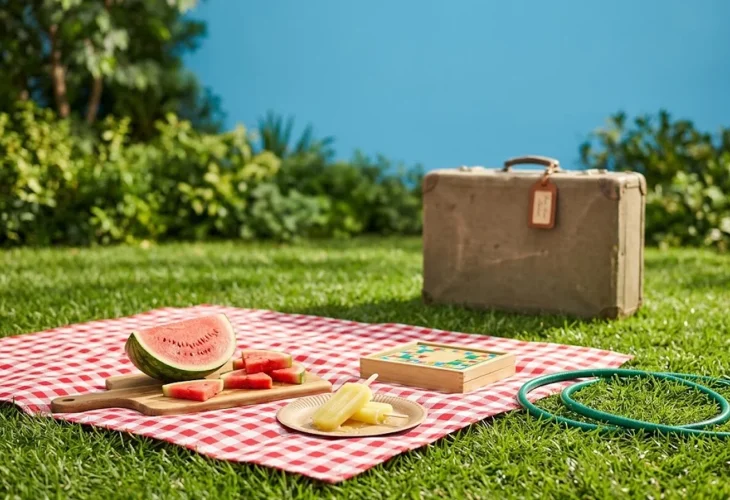
For many of us, the memories that stayed are much smaller. Sitting on a blanket in the backyard eating watermelon. Dad turning on the hose and spraying everyone until the yard became the greatest water park imaginable. Building a pillow fort in the living room. Riding bikes with neighborhood friends until the streetlights came on. Staying up late playing Monopoly. Going to the community pool, having a picnic at the park, roasting marshmallows on a camping trip, or spending a long summer afternoon at Grandma's house.
None of it was particularly impressive.
And somehow, it was magical.
We once understood a simple secret: A child's soul is not searching for the perfect vacation photo. It is searching for togetherness.
Children notice the sparkle in Mom and Dad's eyes far more than the quality of the hotel room. They remember being laughed with, listened to, chased around the backyard, and allowed to stay up a little later because it was summer.
They do not need us to take them to the other side of the world to experience joy.
Children Need Presence More Than Experiences
What makes an ordinary day memorable is often not the destination but the people who were there.
A child spending the afternoon with relaxed, emotionally available parents who are genuinely enjoying themselves can receive something far more valuable than an elaborate vacation with parents who are stressed about money, rushing from attraction to attraction, arguing over the schedule, and trying desperately to make sure everyone is having the “perfect” time.
There is nothing wrong with traveling, of course. Family vacations can be wonderful. Visiting new places, experiencing different cultures, seeing beautiful landscapes, and simply getting away together can create extraordinary memories.
The problem begins when those experiences stop being a gift and start becoming a requirement.
When parents feel pressured to provide increasingly elaborate vacations because “everyone else is doing it,” travel becomes another arena for comparison. And that competition can cost far more than the price of airfare.
It can put enormous pressure on family finances, drain parents emotionally, and continually raise children's expectations about what qualifies as fun.
Perhaps most troubling, it can unintentionally teach children that ordinary life is not enough.
Bring Back the Magic of Ordinary Summers
Children benefit from learning that joy does not always have to arrive wrapped in something expensive or spectacular.
A day at the beach can be enough. So can a picnic at a local park, a hike, a trip to the library followed by ice cream, baking a chocolate cake together, inviting cousins over, setting up a sprinkler in the backyard, or turning the living room into a movie theater for the night.
And sometimes, children can simply be bored.
They can wander around looking for something to do until imagination takes over. They can build, invent, explore, argue, make up, and create games that no adult planned for them.
There is something valuable in giving childhood room to be ordinary.
So the next time another parent casually mentions the incredible overseas vacation their family just returned from, we do not have to mentally calculate whether our own children are somehow missing out.
We can simply be happy for them and continue building the kind of childhood that works for our own family.
Take the trip if you want to and can comfortably afford it. Enjoy every minute of it. But do not mistake the plane ticket for the memory itself.
Our children do not need the Caribbean, Europe, or a week at a theme park to know they are loved.
They need us: present, loving, relaxed enough to laugh with them, and still capable of finding genuine joy in the smallest things.
Because in the end, some of childhood's greatest magic is not waiting across the ocean.
It is right here, around our table.

