

Parashat Ki Tavo
Why Leave Part of the Field Unharvested? Lessons From Parashat Ki Tavo
The mitzvot of the field reveal a powerful truth about Hashem, Jewish continuity, and the eternal message of Parashat Ki Tavo.
- Rabbi Moshe Sheinfeld
- | Updated
This week’s Torah portion, Parashat Ki Tavo, includes the section of Vidui Ma’asrot, the Declaration of Tithes. This declaration is recited on the eve of Passover in the fourth and seventh years of the shemitah cycle.
Unlike the usual meaning of the word “confession,” this is not an admission of wrongdoing. Quite the opposite. It is a declaration that one has done what is right. In the Declaration of Tithes, the field owner announces that he has fulfilled all the commandments connected to his field, including terumot and tithes, gifts for the poor, and more.
This is what the field owner declares:
“I have cleared away the sacred portion from my house, and I have also given it to the Levite, the stranger, the orphan, and the widow, in accordance with all the commandment You commanded me. I have not transgressed any of Your commandments, nor have I forgotten them. I have not eaten of it while in mourning, I have not removed any of it while impure, and I have not given any of it for the dead. I have listened to the voice of Hashem my God; I have done everything You commanded me. Look down from Your holy dwelling place, from Heaven, and bless Your people Israel and the land You gave us, as You swore to our ancestors, a land flowing with milk and honey” (Deuteronomy 26:13–15).
Today, we do not recite the Declaration of Tithes because the Holy Temple has been destroyed and we are unable to eat the produce of ma’aser sheni, the Second Tithe, in purity in Jerusalem as the Torah commands. Some observe a remembrance of this mitzvah by reading from the Torah the entire section in which the verses of the declaration appear.
There is an essential connection between observing the commandments associated with the field and the blessings and curses that appear in Parashat Ki Tavo. What is it?
Why Does the Torah Connect Pe’ah With Rosh Hashanah?
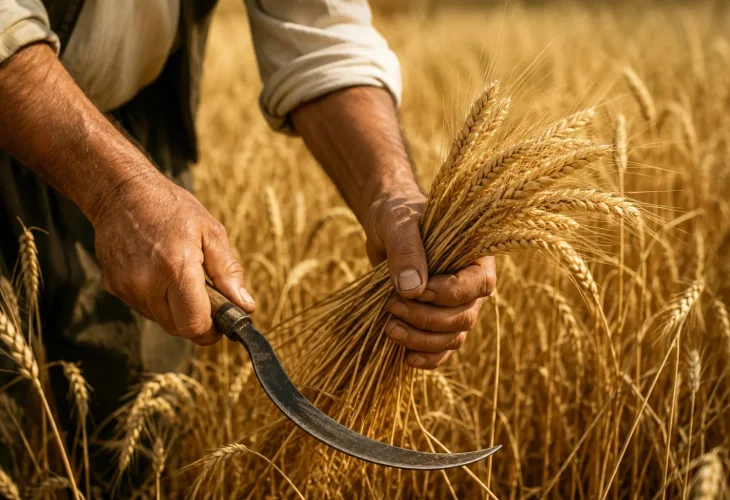
In Parashat Emor, the Torah commands us regarding pe’ah, leaving a corner of one’s field as one of the gifts a field owner is obligated to provide for the poor. The owner must leave some grain at the edge of the field rather than harvesting everything for himself. That portion is designated for the poor.
Immediately after the mitzvah of pe’ah, the Torah mentions Rosh Hashanah:
“When you reap the harvest of your land, do not completely reap the corner of your field, and do not gather the gleanings of your harvest. Leave them for the poor and the stranger. I am Hashem your God. Hashem spoke to Moses, saying: Speak to the Children of Israel and say: In the seventh month, on the first day of the month, you shall have a day of rest, a remembrance marked by the sounding of the shofar, a sacred gathering” (Leviticus 23:22–24).
Why does the Torah place the mitzvah of pe’ah next to Rosh Hashanah?
The Midrash offers an answer.
The prophet Jeremiah foretells: “For I will make an end of all the nations among whom I scattered you, but of you I will not make an end. I will discipline you with justice, but I will not leave you entirely unpunished” (Jeremiah 30:11).
The Midrash explains this verse: “The nations of the world, who completely harvest their fields, ‘I will make an end’; ‘but of you I will not make an end,’ Israel, who do not completely harvest their fields, as it is written: ‘Do not completely reap the corner of your field,’ ‘I will not make an end.’ ‘I will discipline you with justice,’ I will afflict you with suffering in this world in order to cleanse you of your sins in the World to Come. When? ‘In the seventh month’” (Vayikra Rabbah 29:2).
The Midrash teaches that the nations of the world, who completely harvest their fields and reap them to the very end without leaving anything for the poor, are ultimately wiped out from the world. By contrast, the Children of Israel do not completely harvest their fields. They leave pe’ah at the edge of the field. Measure for measure, they themselves are not wiped out.
Yes, there is suffering. Yes, there are troubles. But the curses that come upon the people of Israel are not meant, God forbid, to destroy them. They are meant to refine them.
Why We Never Harvest the Entire Field
There is tremendous depth in these words. The world is Hashem’s “harvest,” and Israel is described as the first of that harvest: “Israel is holy to Hashem, the first fruits of His harvest” (Jeremiah 2:3).
Why does Israel not completely harvest its fields?
Because every field contains a divine portion that does not belong to the individual. Part of the field belongs to the Master of the Universe, and a person is forbidden from harvesting it. Hashem chose to give His portion to the poor.
The “first” of the field is not ours either. A person may not eat from the harvest without first giving to the kohen, who represents spirituality and holiness. Both the beginning and the end belong to Hashem. Of course, everything ultimately belongs to Hashem, but we give practical expression to that truth at both the beginning and the end of the harvest.
We do not harvest the field to its very end because we belong to the Infinite.
Every nation has a defined role. Each nation begins its existence at a particular point in history, and when it completes its role, it disappears from the world. History is filled with empires that rose, flourished, and eventually fell, including ancient Egypt, Assyria, Babylon, Persia, Greece, and Rome.
Even today, we can see how the nations of the world “completely harvest their fields.” Europe, for example, is gradually disappearing. Borders are blurring, birth rates are falling, and its nations are steadily fading away. Many European leaders have no children. Renewal disconnects itself from the old world and therefore has no continuity. Every generation starts over and eventually ends. Every nation completely harvests its field, fulfills its role, and ultimately disappears from the world. If there is no eternal purpose and no faith in the future, why bring children into the world?
The Jewish People Are Connected to Eternity
The people of Israel are renewed precisely because they remain connected to what came before, from the creation of the world, and to the eternal future.
Only Israel counts the years from Creation because we began with Creation, and we continue with it until the world reaches its ultimate purpose. We know that the world has a divine beginning and a divine end.
Jewish birth rates are higher compared with those of many other countries, particularly among Jews who believe in Hashem and His Torah. We are connected to the past, and we believe in the future. Renewal does not consume what came before us. Instead, it adds another layer to who we are.
We see the fulfillment of the Midrash: the nations of the world are gradually disappearing. Countries are falling apart in the Middle East and in Europe. But regarding Israel, Hashem promises: “I will not make an end.” We continue to grow and flourish.
The deeper insight behind these commandments contains the foundation of everything: there is a First and there is a Last, and that is Hashem.
As the verse says: “Thus says Hashem, King of Israel and its Redeemer, Hashem of Hosts: I am the First and I am the Last; besides Me there is no God” (Isaiah 44:6).
A person enters this world and finds the Creator who was here before him. A person leaves this world knowing that Hashem remains, watching over all that exists.
This fundamental belief finds practical expression in the beginning and the end of a field’s harvest. Both remind us of the same eternal truth: everything begins with Hashem, everything ultimately belongs to Hashem, and Hashem remains forever.

