

Faith (Emunah)
“Always Look at What You Have”: A Final Lesson in Faith
After losing his wife and young son, Rabbi Eliaz Cohen shares the extraordinary faith of his late wife Hodaya and the lessons that give him strength to keep learning, raising his children, and finding joy
- Michal Arieli
- | Updated
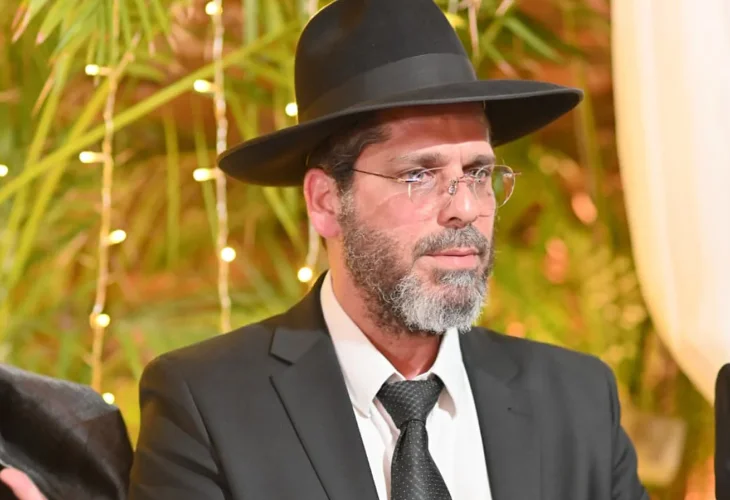 Rabbi Eliezer Cohen (Photo: Eran Chen)
“Exactly one year ago, I had a conversation with my wife, Hodaya, of blessed memory. It was just two days before she was hospitalized for the last time, shortly before she passed away.”
Rabbi Eliaz Cohen speaks with unmistakable longing and admiration for his wife. “By then, her condition was very serious. She needed a walker to get around and was suffering from swelling in her hands and feet.
“It was painful for me to watch, and I found myself asking her, ‘Aren’t you angry with God or disappointed in Him? We both became observant and devoted our lives to serving Him. I studied at Yeshivat Netivot Olam, I try to learn Torah 12 hours a day, we send our children to the best Talmud Torah schools, we don’t bring inappropriate devices into our home, and we try to follow halacha. So why is all of this happening? Why is God bringing us such suffering?’
“Hodaya looked at me, and I could almost feel the spiritual level she had reached. She said one short sentence: ‘If you are angry with God, it means you haven’t even begun to serve Him.’
“You have to understand that these weren’t empty words. By that point, she had already endured nearly two years of serious illness and tremendous suffering. Her faith was completely genuine. She continued, ‘Until recently, you were studying in a kollel for halachic instruction. You’re about to publish a book. You were blessed with healthy children and so many happy occasions in the family. Everything in life was going smoothly. So what happened? Suddenly, when God does things that don’t fit your plans, you become angry and disappointed?’
“Then Hodaya told me, ‘Don’t be afraid. You’ll see that everything will be all right.’
“I said to her, ‘I’m afraid you’re going to die.’
“She answered, ‘You don’t love me or have more compassion for me than the Creator does. Always look at what you have, not at what you don’t have.’
“She was so right. Her words continued echoing in my mind nine days later, when she left this world in holiness and purity.”
Seeing the Good
The challenge of “looking at what you have” is anything but simple for Rabbi Eliaz. His wife’s passing came approximately a year after both of his parents died, one after the other. They had lived to an advanced age, but they passed away less than a month apart.
“After that, the Creator decided to take our three-year-old son, who passed away in his sleep,” he says. “And a year later, my wife passed away. Parents, a wife, and a child are among the people closest to a person. And despite everything, I believe exactly what Hodaya said: everything is ultimately for the good. Our task is to see the good, focus on it, and hold on to it.”
During the month of Elul, Rabbi Eliaz is marking the first anniversary of his wife’s passing. A special booklet containing some of her talks and reflections on her remarkable character is being published in her memory.
“It is only a tiny glimpse of who she was,” he emphasizes. “Hodaya’s life was never easy. She became observant as a young woman, then endured many years of being single and later years of waiting to have children. Yet she always had exceptionally strong faith. You could see it in everything she did.
“Personally, I had the privilege of being Hodaya’s student. I learned so much from her. I’ll give you an example. During the first years of our marriage, we sometimes got into arguments. Afterward, I would feel terrible. How could I have allowed myself to lose my temper? How could I have spoken that way? I would approach Hodaya and say, ‘I apologize. Please forgive me.’
“Instead of responding, ‘Good that you apologized. Don’t do it again,’ she would tell me, ‘Eliaz, these are behavioral patterns that we picked up throughout our lives, and they come out in both of us. We need to work on ourselves so that our disagreements become more constructive.’ Over time, our disagreements really did become much more constructive, and that was entirely thanks to her.”
Hodaya also had enormous respect for Torah learning. Whenever her husband left for kollel, she would accompany him to the door. She ran a daycare from their home, which meant the house was usually filled with children, but she would leave everything for those few moments to see him off.
“Sometimes I would be frustrated about something, and she would notice. She would whisper to me, ‘Eliaz, you’re a lion. A roaring lion!’ Those words strengthened me tremendously. There is nothing like encouragement that comes from inside your own home, from the person closest to you. I would carry those words with me throughout the day, remembering that I was a ‘roaring lion,’ and with God’s help, I would succeed.”
Making Her Children Feel Precious
Hodaya made her children feel that they were the most important and precious people in the world to her.
In the middle of the conversation, Rabbi Eliaz walks into the kitchen. “The sign is still here,” he says, reading the sentence his wife chose to hang in a central place in their home: “Behind every child who believes in himself are a father and mother who believe in him.”
“She really did believe in them,” he says. “She would always tell the children, ‘You’re righteous. You’re good. Your soul is holy.’ And that was the message she constantly communicated to them.
“It’s not that she was an angel who never became angry. Sometimes she got upset or raised her voice. But she always made them feel that they were destined for greatness and were inherently good. If they behaved improperly, the message was simply: ‘That isn’t like you.’
“The children would come home in the afternoon after already eating at Talmud Torah, but Hodaya always made sure there was a large plate of cut fruit waiting for them. She would say, ‘When a child comes home, he needs to experience the taste of home. He wants something to eat.’ She got so much joy and satisfaction from seeing everyone sitting around the fruit and telling her about their day.
“And I received my fruit and treats too,” he adds. “Whenever I left for kollel, she made sure I had enough food for the entire day. I can say without hesitation that because of her, I was never hungry in kollel. She gave me everything I needed to be able to learn Torah for thirteen years.”
What happened after Hodaya passed away? Were you able to continue learning?
“I’ll tell you the truth. From the time she passed away last Elul until Pesach, I couldn’t return fully to learning. I studied with my chavruta in the mornings, but once I came home in the afternoon, I was with the children and couldn’t really go out again.
“But it wasn’t only the practical difficulties. Something inside my heart simply wasn’t available for learning. Perhaps I was still hurt and disappointed, and maybe, God forbid, even angry with God.
“During Pesach, I went away with the children for a week. We encountered people who were ill and using wheelchairs, as well as children with special needs. The vacation wasn’t specifically intended for families with disabilities, but I noticed how many families were dealing with serious challenges.
“Suddenly, I realized how much I had been given. I have six healthy children. How could I complain? From that moment, I felt my desire to learn Torah returning.”
Today, Rabbi Eliaz continues going to kollel every morning and learning with his chavruta. In the afternoons, he stays home, arranging activities and visits with friends for his children. Between his responsibilities, however, he finds opportunities to continue learning, following the goals he has established for himself, including a daily page and a daily Mishnah.
“Torah learning gives me tremendous strength,” he says. “That is how I experience it. It is the one thing that strengthens me.”
Where does someone find the strength to endure so much loss?
“It isn’t easy to find strength at times like these,” Rabbi Eliaz admits. “It comes only from the Creator. I feel that God is truly with me every moment, and only with His help can I cross this unimaginable ocean. If He weren’t with me, I wouldn’t even be able to cross the street. God gives me strength, and He channels that strength to me through Torah.
“It’s true that I could have abandoned everything and stopped learning. During the shiva, leading Torah figures came to comfort me, and they all told me the same thing: ‘You are serving as both father and mother now, and you are exempt from Torah study.’ But I knew that wasn’t what I wanted my children to see, and it wasn’t what I wanted for myself either.”
Rabbi Eliaz had already confronted unimaginable grief when his three-year-old son, Aharale, passed away suddenly.
“It happened on his birthday, the day of his chalakeh. He went to sleep and didn’t wake up the next morning. Yet even then, I felt that I was being given tremendous strength that I had never possessed before.
“At his funeral, I said, ‘I don’t know whether I have truly accepted what happened, but one thing is clear to me: I cannot ask questions. When Aharale was born, I didn’t ask the Creator, “Why did You give this child to me and not to somebody else?” So I’m not asking now either.’”
The Strength of the Jewish People
Rabbi Eliaz also draws strength from the extraordinary kindness his family experienced during Hodaya’s illness.
“I have to acknowledge how much strength I receive from the Jewish people, who revealed themselves in all their beauty during Hodaya’s illness. There was so much help and unconditional kindness. So many people prayed for her. Women took upon themselves greater care in modesty and guarding their speech. Young men strengthened their Torah learning. Torah classes were dedicated to her recovery. We held a regular women’s Torah class in our home. There were large gatherings, blessings and prayers from leading rabbis, and her friends held challah-separation gatherings for days in a row. Surely all of those efforts produced spiritual fruits.”
And, of course, he continues to draw strength from Hodaya herself.
“Even during the final days of her life, she experienced an extraordinary closeness to God. She wrote the words ‘Father loves me’ in large letters on a yellow sheet of paper decorated with many hearts. She attached it to the wardrobe door opposite her bed. It is still there today, so that I will remember it too.
“Even during the terrible physical suffering she endured, when she was crying in pain, she used those tears to pray for the hostages and for wounded soldiers.
“I know Hodaya would want to see her children growing up with joy, and I am here to make that happen. I understand that this is my task in this world, and I see it as a tremendous privilege.”
Are there moments when you can genuinely feel happy?
“The truth is, yes,” he says. “It happens, for example, when I teach Torah at a kollel in Tel Aviv that specializes in outreach to new immigrants from Italy and France. Sometimes I enter the beit midrash completely drained of strength. But at the end of the learning session, we dance and sing, and you can feel hearts awakening. That is genuine joy.
“There are also moments of simple enjoyment. For example, when I took trips with my children during bein hazmanim, we had such a wonderful time and came back refreshed. We also bought a new car, and thank God, our home has abundance and we lack nothing. Those things bring me enjoyment, and I thank the Creator for them too.
“And then there is satisfaction, which is different from enjoyment because it isn’t momentary. It stays with me. When I see that the children are happy and doing well, or when I receive encouraging phone calls from their schools and Talmud Torahs telling me how beautifully they are thriving, it brings me tremendous happiness. It tells me that perhaps I am doing what I need to do.”
We are all living through challenging times. What message can you offer from your own experience?
“Who am I to give messages to other people?” he responds. “But I can share a teaching from the Akeidat Yitzchak that gave me tremendous strength.
“He discusses the verse in Psalms, ‘To declare Your kindness in the morning and Your faithfulness at night.’ Morning represents redemption, when we can clearly see God's kindness. But at night, during darkness and exile, it is much harder to see that kindness.
“Why, then, does the verse speak of ‘Your faithfulness’ rather than ‘our faith’? He explains that it refers to the faith and trust that God places in us. God gives us challenges because He trusts that we are capable of facing them. That is the meaning of ‘Your faithfulness.’ “In fact, it is exactly what we say every morning in Modeh Ani: ‘Great is Your faithfulness.’
“If only we could always remember that more than we believe in God, God believes in us.”

