

Magazine
His Wife and Baby Were Killed in a Crash: “Six Years Is Outrageous”
Six and a half years after the crash that killed his wife and infant daughter, Ephraim Rimmel responds to the driver’s sentence and calls for stronger deterrence.
- Michal Arieli
- | Updated
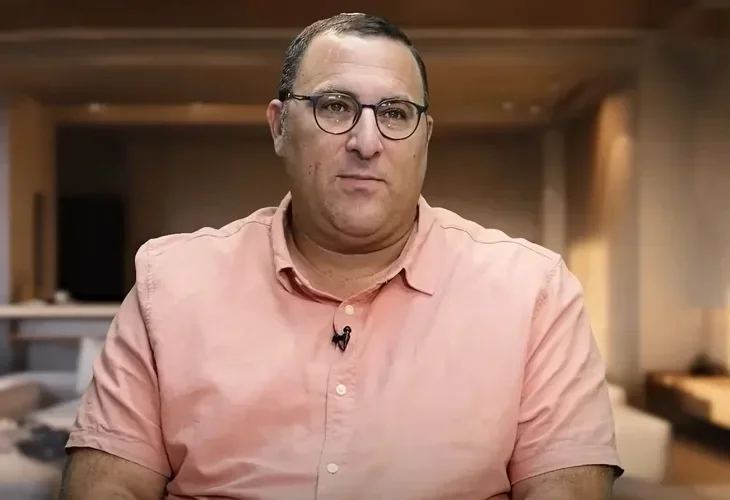 Ephraim Rimmel
Six and a half years after the devastating crash that killed Tzipi Rimmel, 35, and her three-week-old daughter, Noam Rachel, the driver responsible has finally been sentenced.
Tarek Kard, an East Jerusalem resident who was convicted of two counts of causing death by recklessness after driving at excessive speed and crashing into the Rimmel family’s vehicle, was sentenced by the Jerusalem District Court to six years in prison. His driver’s license was also suspended for 15 years.
For Ephraim Rimmel, Tzipi’s husband, the sentence is painfully inadequate. Rimmel was seriously injured in the crash and has used a wheelchair ever since. But he stresses that his objection is not about seeking revenge or finding personal comfort. Nothing the court could impose, he says, could restore what his family lost.
For him, the issue is deterrence—and the value society places on human life.
“Nothing Can Bring Tzipi or Noam Back”
“My goal is not, even for a moment, to make things easier for myself, because nothing can help me anymore,” Rimmel says. “Even the harshest punishment imaginable would not change reality, and there is no way to create true justice in a case like this. Nothing will bring Tzipi or Noam back to me, and nothing will get me back on my feet or erase my son Itai’s severe injuries.
“What matters is not compensating me with a harsher sentence, but creating real deterrence. It must be clear that a road accident is not an inevitable fate that we can simply move on from, and that human life is not cheap. It must be absolutely clear that a road is not an arena for games, and that driving is meant to get from one place to another safely—not to take unnecessary risks.”
Did you follow the court proceedings throughout the process?
“I followed the developments through Tzipi’s brothers,” Rimmel says. “They attended every hearing with dedication and in a way that was truly inspiring, though it goes without saying how much emotional strength that required of them over six and a half years.
“The truth is, it is hard to understand why the proceedings took such a long time. Some of the hearings were completely pointless, while the driver sat in the courtroom and his defense attorney raised various arguments that repeatedly tried to reduce his responsibility. Some of the arguments were entirely unfounded, and others were even more absurd. I personally attended just one hearing, and that was more than enough for me.
“The very fact that the proceedings went on for so long is outrageous in itself. The facts were completely clear, the police report was unequivocal, as was the footage from the speed cameras. There was nothing complicated or difficult to prove here, yet it took years to reach a sentence.”
For Rimmel, the length of the proceedings makes the final sentence even more difficult to accept.
“It would be one thing if the judges had issued an unprecedented, especially deterrent ruling,” he says. “But the court handed down just six years in prison, even though the prosecution had sought 15 years—a gap that is impossible to comprehend.”
“Six Years Is Simply Outrageous”
What did you expect?
“I’ll tell you the truth: Even if the driver had received 15 years in prison, it would not have comforted me or given me a sense of closure or justice,” Rimmel says. “No punishment can restore the lives we had before the crash.
“But six years is simply outrageous, because it means my wife’s life is worth three years, and my infant daughter’s life is worth another three years. It is terrible and unacceptable.
“And the ‘cherry on top’ is that even the driver’s license suspension is only 15 years, six and a half of which have already passed during the legal proceedings. That means that in seven and a half years, this man will be back on the road.
“True, this driver had previously driven without a valid license, but even the theoretical thought that a person who caused the deaths of two people can return to driving after such a short time should shake every citizen of Israel.”
“This Is an Epidemic”
For Rimmel, his family's tragedy is also part of a much broader problem. He believes road deaths have become so common that society risks treating them as an unavoidable part of life rather than something that can and should be prevented.
“This is an epidemic in every sense of the word,” he says. “In recent years, an average of about 450 people have been killed on the roads each year, and most of us continue to treat it as an inevitable fate we have to accept.
“That is a serious mistake, because there is so much that can be done. It begins with legislation, continues through strict enforcement and the sentencing system, and of course requires education and public awareness.”
Rimmel argues that road safety should receive the same serious political attention as other major issues affecting Israeli society.
“We all know exactly where the various political parties stand on every issue on the public agenda—from drafting yeshiva students to a Palestinian state, the economy, or the Shabbat status quo. But how many people know where those parties stand on the fight against road accidents?
“When people lose their lives in such numbers every year, we cannot continue to treat this with disregard.”
He also emphasizes that the damage caused by a fatal crash extends far beyond the people directly involved.
“Someone once asked me whether I am capable of forgiving the driver,” Rimmel recalls. “I answered that I do not think I can, but even if I could, I would not be allowed to do so. Because he did not harm only me; he harmed my children, Tzipi’s parents and siblings, her friends, her students, and entire wider circles of people.
“Only recently, I accompanied my son on the first day of the school year, and suddenly realized that he was the only one arriving without a mother. This is a daily struggle that no legal system can compensate for.”
“It Depends on Us”
Despite everything his family has endured, Rimmel believes Israel's road safety crisis can be changed.
Do you truly believe there is a chance to change the situation?
“Of course it can be changed, and it depends entirely on us,” he says. “We must demand it from our public representatives, who need to understand that road accidents are not a ‘sectoral’ issue but a disaster that affects everyone—secular people, religious people, Haredim, every group and community.
“There is no one who has not been affected by this in one way or another. The reality is that, for years, the Transportation Ministry has been led by representatives from across the political spectrum—from right to left, Haredi and secular alike—and none of them has taken this issue on as a genuine life mission.”
For Rimmel, the court case may finally have reached the sentencing stage, but the larger issue is far from resolved. His message is not simply that one driver should have received a harsher punishment. It is that preventable deaths on Israel’s roads must stop being accepted as inevitable.
“It is time,” he says, “to change direction at the root.”

