

Personal Stories
"I Refuse to Die From Fear”: Shiri Arazi’s Journey From Crisis to Faith
After financial collapse, years of searching, and a life-changing return to Judaism, Shiri Arazi found faith, marriage, and a new sense of home in Samaria
- Shira Dabush (Cohen)
- | Updated
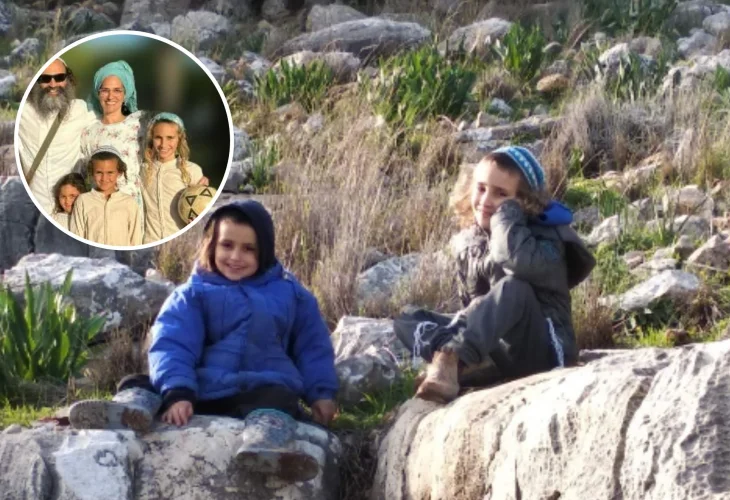 Nir and Shiri Arazi with their family, against the backdrop of their home in the Shomron
On a cold winter Friday afternoon at Kibbutz Hazorea, Shiri Arazi walked into the nearby forest and asked for a sign. She had already endured financial collapse, millions in debt, a court order preventing her from leaving Israel, and years of searching for a sense of meaning she could not quite define.
“Give me a sign that You hear me,” she whispered through her tears to what she still called, at the time, “the universe.”
When she finished praying, she wiped her eyes and looked up. Standing before her was Nir, a man she already knew casually and who would, just a few months later, become her husband.
“I smiled and asked Hashem, ‘Are You sure? Is it really him?’”
For Shiri, it was one more moment in a long journey in which events that had once seemed random, painful, or even disastrous gradually came to look very different through the lens of faith.
Searching for Something She Couldn’t Name
Shiri Arazi, 49, is married to Nir, a mother of seven, and today lives in Maoz Tzvi in northern Samaria. For as long as she can remember, she had been searching for meaning. Even when words such as “Hashem,” “God,” and “Master of the Universe” felt foreign to her, there was a longing somewhere inside her, a sense that she wanted to return. She simply did not yet know where she was returning to.
Shiri was born and raised in Kiryat Ono in a warm, secular home. “We didn’t make Kiddush or keep Shabbat, although we did fast on Yom Kippur. My mother was born in Bahrain and immigrated to Israel when she was 18, while my father was born in Israel. We grew up in a simple, happy home with a lot of laughter.”
Her mother emphasized choosing peace and goodness and discouraged arguments and anger. “We weren’t perfect,” Shiri says, “but there was a general feeling of: Let’s go through life pleasantly.”
When Everything Fell Apart
That peaceful existence began to unravel toward the end of Shiri’s military service. Her father, who managed a smoked-fish factory in Jaffa, became entangled in serious financial difficulties.
“It had been a successful business, but there were management problems, loans, and debts to the gray market,” she recalls. “We had been living at a very high standard, and then one day everything fell apart.”
As the second of four children, Shiri felt a responsibility to rescue her family. She opened a restaurant in Tel Aviv in her own name, convinced that she could make it work.
“I had no experience, but I had a lot of courage. Looking back, that courage got me into serious trouble. Today I understand that there was a certain innocence in what I did. At the time, though, I completely believed in the idea and worked around the clock to make it succeed.”
Instead, she found herself with devastated parents, millions in debt, and a court order preventing her from leaving the country.
“While all my friends were flying abroad for their post-army trips, I was forced to stay in Israel. Looking back, that was one of the greatest kindnesses of my life, because it was precisely through that experience that I discovered Hashem and realized that He had been with me all along.”
“We Hid My Father in the Attic”
The family’s situation continued to deteriorate until their lives took on an almost surreal quality.
“My parents and I had all written checks connected to the gray market. Then one day, people came knocking on our door looking for my father. We hid him in the attic. I remember him coming back with a baby sock stuffed with dollars. It was my sister Adi’s sock from when she was a baby. My mother had hidden the money there and forgotten about it.”
Today, Shiri sees that moment as an early experience of Divine providence. At the time, however, she did not yet have the language to describe it that way.
“I was the rebel in our family, the one who was always searching for meaning. And when I couldn’t find it, I even stopped fasting on Yom Kippur. I still had a long journey ahead of me before I discovered that Hashem had never left me.”
There were times when she traveled to Eilat with barely enough money for pita and cream, yet she somehow trusted that “creation,” as she called it then, would provide what she needed: somewhere to sleep, something to eat, even a cigarette.
“Today, I understand that I was witnessing miracles, that Hashem really was taking care of everything I needed.”
Eventually, even the enormous debt hanging over her was unexpectedly erased by the court.
The Answer That Lowered Her Defenses
Later, Shiri enrolled at Tel-Hai College. It was there that her spiritual search began to take a more defined direction.
One evening, she attended an introductory class on the teachings of Yemima Avital. When she saw that the instructor was religious, she immediately became suspicious.
“Are you here to make us religious?” she challenged her.
The instructor remained unfazed. “I connect each woman to her own inner truth,” she replied. “Whatever is revealed will be revealed.”
Something about the answer disarmed Shiri completely. “At that moment, I heard an inner voice saying, ‘That’s it. Now you can return to Judaism.’” The thought was not entirely new. Judaism had surfaced in her mind before, but she had resisted it.
“As the rebel of the family, I didn’t want anyone telling me what to do with my life or deciding things for me. But suddenly I had received the most liberating answer possible. No one was trying to force me into anything. I was being given space. I no longer felt that I had to defend myself. I was ready to discover what was actually inside me.”
When the Jewish Holidays Became Personal
The studies were not overtly religious. Their focus was largely on understanding the inner world and learning to recognize what was happening within oneself. Yet whenever the lessons touched on the spiritual meaning of the Jewish holidays, Shiri felt deeply moved.
“I would get chills,” she says. “Suddenly, I understood that the holidays were a profound inner journey. Something in my Jewish heart began to awaken.”
Until then, the holidays had felt distant and largely superficial. Now she began to understand that they were not simply commemorations of events from the distant past. “I realized that this isn’t just something that happened once. It is happening now. It belongs to me. It has something to say about my life. I had never experienced the holidays that way before.”
The change was real, but gradual. Shiri was still deeply afraid of how her friends and family would respond if she openly embraced Judaism. “I prayed to Hashem to give me the strength to do it in the way that was most right for me.”
One of the people who helped her take that step was her friend Meital. The turning point came during a concert by Israeli singer Etti Ankri. Something about the experience gave Shiri the courage to say aloud what she had until then been afraid to admit: she was returning to Judaism, and she wanted to buy a siddur.
By that stage in her life, she also deeply wanted to marry. “I felt that Hashem wasn’t going to send me my match until I helped myself, until I was willing to come out and say openly who I was becoming.”
Meital, although not religious herself, bought Shiri her first siddur. Soon afterward, Nir entered her life in an entirely new way.
“Hashem Knew I Needed Someone”
Shiri already knew Nir. He was a friend of her cousin and a neighbor of Meital, but until then their relationship had consisted of little more than casual greetings.
Once Shiri stopped hiding her spiritual journey, something shifted. “When I took that step, Hashem knew I needed someone,” she says. “Nir and I connected, and we began the journey together.”
After finishing her studies at Tel-Hai, Shiri received a call from Nir. He told her that Kibbutz Hazorea, where he was already working, was looking for employees. She decided to move there.
By then, Meital was married, and Shiri and Nir began spending Friday nights at her home, joining her and her husband for Kiddush.
Then came the winter Shabbat that would change everything.
“Give Me a Sign That You’re Listening”
Shiri was already beginning to observe Shabbat when, one weekend, all her friends left the kibbutz for a trip. She stayed behind alone. She was 29 and increasingly discouraged by the long wait to find the person with whom she would build her life.
“I didn’t really know how Shabbat was supposed to work,” she admits. “I knew you weren’t supposed to drive, so I simply tried to keep myself occupied.”
It was a cold, wintry day. Shiri had recently read about hitbodedut, the practice of speaking personally and privately with Hashem, and decided to try it. She walked into the forest.
“It felt crazy,” she remembers. “I was crying and talking out loud. I felt a little ridiculous. Then I asked Hashem for a sign, something that would make me feel that He was listening.”
She finished her prayer, wiped the tears from her eyes, and looked up. Nir was standing there, walking his dog. “I smiled to myself and asked Hashem, ‘Are You sure? Is it him?’”
That Saturday night, Nir called her and said they needed to talk. Three months later, they were standing beneath the chuppah.
“We talked about everything,” Shiri recalls. “We opened our lives to each other completely: what I dreamed about, what I wanted, my weaknesses, even the craziest dates I had ever been on. And then we decided that we should get married.”
At first, they tried to keep their relationship quiet. Their friends knew them both, and no one had ever imagined them as a couple. “But when we finally told everyone,” she laughs, “suddenly it made perfect sense to them.”
Building a Religious Life Together
Shiri and Nir married at Kibbutz Hazorea and began their journey toward greater religious observance together. It was not always welcomed by those around them.
“When Nir started wearing a kippah, some of our friends on the kibbutz became worried that we would make their children religious,” Shiri recalls. “We assured them that we weren’t going to remain there, and eventually we moved to Yokneam.”
Their early married years took them through several communities. Eventually they moved to Harish, where they were happy, but the constant construction around them became overwhelming. “We felt as though we were eating dust,” Shiri says.
Then, during a family outing, they happened to visit Maoz Tzvi in Samaria. For Shiri, something immediately clicked. “Once I visited, that was it. I couldn’t go back to ordinary life. I knew this was what I had been searching for my entire life. I started trying to convince Nir that we had to move there.”
“I Felt That I Had Come Home”
By then, the couple had five children, and moving was anything but simple. There was no large home available, so the family initially moved into a small caravan. Physically, it was difficult. Emotionally and spiritually, however, Shiri felt she had finally arrived.
“On the first Shabbat when I lit candles in our home in Samaria, I cried. I felt that I had come home.”
For Shiri, the landscape brought the Torah she had discovered to life. “I felt that I had reached a place where the Torah of Israel, the people of Israel, and the Land of Israel all came together. The Dothan Valley is where the story of Yosef and his brothers took place. Here, history is alive. It doesn’t exist only on the pages of a book.”
The realization profoundly affected her. “These aren’t simply stories that happened thousands of years ago and ended. We are part of their continuation. To live in a place where our ancestors walked is to experience something deeply sacred.”
Discovering a Different Side of the Hilltop Youth
Living in the area also introduced Shiri to young people she had previously known only through media reports: the so-called “hilltop youth.”
What she encountered surprised her. “Suddenly, I saw 14- and 16-year-old boys sleeping on the ground, working the land, helping anyone who needed them, without being paid anything. We discovered a world of gentleness and beauty that is difficult to put into words.”
Her husband, who loves cooking meat, has developed his own unusual measure of character. “He says you can tell something about a person’s character from the way they eat. When you watch these boys, you see how gently they eat and how grateful they are. It is remarkable.”
Life there, however, has been far from easy.
“When we arrived, we faced enormous challenges. We didn’t have water. We didn’t have electricity. Homes were demolished. At times, we felt like second-class citizens.”
Yet Shiri felt that what her family received in return was worth the hardship. “Our children grow up with freedom. They know how to get pine nuts out of a pinecone from the time they are tiny. Where do children get a childhood like that anymore?”
“I Am Not Willing to Die From Fear”
There is another reality that cannot be ignored. Living in Samaria means regularly traveling roads near hostile villages, some of which have been the source of terrorist attacks. Shiri commutes to work in Harish, and she does not pretend that she has never been afraid.
“There were absolutely moments of fear, even intense fear. In the beginning, I would drive with my children past hostile villages and suddenly feel terrified.”
But at some point, she realized that fear itself was taking something from her. “I gathered my thoughts and said to myself: ‘No. I will die only once, and it will happen when Hashem decides. I am not willing to die from fear as well until that day comes.’”
She thought of her grandmother, who immigrated to Israel from Aleppo, Syria, at the age of 12. Years later, when the family suggested putting security bars on her windows, her grandmother refused.
“There is only Hashem in the world,” she told them. “I am afraid only of Him.”
“So maybe it’s in my genes,” Shiri says with a smile.
Looking Fear in the Eye
That conviction has been tested during periods of heightened security tension. During an Iranian attack, Shiri’s children were frightened because their home did not have a protected room.
“They wanted a mamad because we had nowhere to shelter, and they were very afraid. Eventually, we told them, ‘We are the mamad. We are protected here.’”
For Shiri, faith does not mean pretending that fear does not exist. It means refusing to allow fear to become the force that governs her life. “Living in Samaria means looking fear in the eye every day and saying, ‘I understand you. I understand why you have come. But only Hashem gives life and determines death.’”
Finding the Thread Through It All
Her journey to that conviction was neither simple nor predictable. She endured financial collapse and crushing debt. She searched for meaning without even knowing what to call the One she was searching for. She resisted religion because she feared losing her freedom, only to discover a path to Judaism that allowed her to choose it for herself.
Today, Shiri looks back at experiences that once seemed like disasters, coincidences, or unanswered questions and sees a thread running through them all. To her, faith is not the promise of a life without hardship, nor is it a guarantee that she will never be afraid.
It is the knowledge that fear does not have to be the final word. “I will die only once,” she says. “It will happen when Hashem decides. Until then, I refuse to die from fear.”

