

Parashat Ki Tavo
The Story That Keeps a Nation Alive
As Moses’ life draws to a close, he teaches the Jewish people that their future depends on remembering and retelling their story.
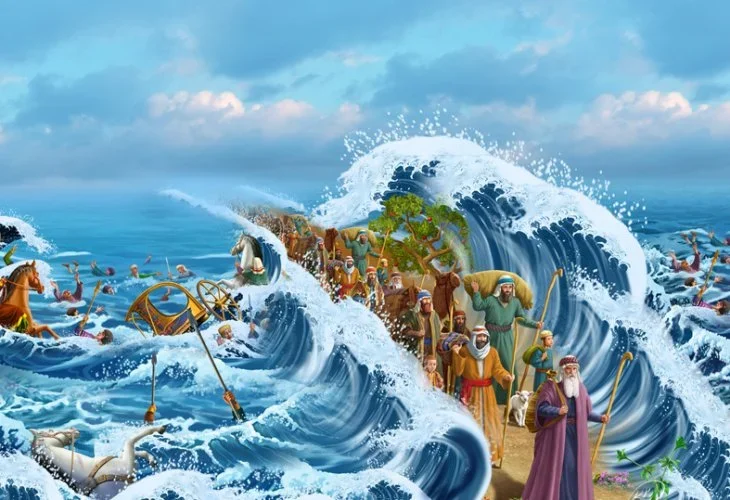 (Illustration: Malchut Waksberger)
We’re in the last gasps of summer now. Somehow, September begins next week. Yeshivot are back in session already, and all other schools will be following shortly. The airport here in Israel is as busy as it gets, with families flying back after summer break and seminary and yeshiva students pouring back into the country. Rosh Hashanah is right around the corner.
Whenever we get to this time of year, I always marvel at how quickly the year has flown by. We all know that sensation of time dragging its feet when you least want it to (has anyone not had the experience of thinking the clock moved backwards while they were sitting in an interminable class?), and the flip side, the way it slips through your hands the more tightly you try to hold onto it.
That’s the feeling that comes across as we begin winding down the Torah, with our now reading the second half of the book of Deuteronomy. Moses’ life is coming to a close. His magnificent thirty seven-day speech is in its last days. In last week’s Torah portion, Ki Teitzei, there were more commandments listed than in any other portion in the Torah, relayed with the frenetic urgency of a man who knows his time is running out. In this week’s portion, Ki Tavo, Moses’ tone takes a decisive shift as he begins to focus much more on what will happen to the Jewish people beyond his forthcoming death.
The bulk of this week’s portion is taken up by a series of very scary, very vivid curses that Moses lays out as warning for the Jewish people. This is the second series of curses listed in the Torah; the first was at the end of the book of Leviticus, which took place nearly forty years before our portion as Moses and the Israelites thought they were about to enter the land only to find themselves on a detour of their own making. This set of curses, in contrast to the first, is much longer, much more detailed, and does not include any promises of redemption at the end. It is Moses’ best—and last—chance to warn the people not to stray from God.
Yet, before he arrives at the curses, at the very beginning of our portion, Moses instructs the people regarding bringing the first of their fruits to the temple once they enter the land. This fruit offering, called bikkurim, which is given to the priests as one of their priestly gifts, is brought to the temple with joy and festivities. As Moses commands, when the farmer arrives at the temple, he gives the basket with the fruits to the priests, then recites a brief history:
An Aramean tried to destroy my father, and he went down to Egypt. He dwelled there few in number, and there he became a great, strong, and multitudinous nation. The Egyptians treated us badly and they pained us, and they placed upon us hard labor. We cried out to God, the Lord of our forefathers, and God heard our voices and He saw our suffering and our toil and our oppression. God took us out of Egypt with a strong hand and an outstretched arm, with great awe, signs, and wonders. He brought us to this place and He gave us this land flowing with milk and honey. And now I have brought the first of the fruits of the land which God has given me, and I placed it before God and I bowed before God. (Deuteronomy 26:5-10)
This paragraph may be familiar to many readers as the verses that we recite at the Passover seder when retelling the story of the Exodus (with the exceptions of the last two verses recorded here, which go beyond the Exodus story), using this very paragraph to give us the framework to fulfill the commandment of the evening: “And you shall tell it to your child” (Exodus 13:8). In an article from 2011 on this very topic, Rabbi Jonathan Sacks noted, “What remains remarkable is that, even in biblical times, every member of the nation was expected to know the story of the nation, and recite it annually, and make it part of his or her personal memory and identity.” In fact, it is the act of telling that story, Rabbi Sacks explained, that kept the Jewish people together:
It is utterly astonishing that the mere act of telling the story, regularly, as a religious duty, sustained Jewish identity across the centuries, even in the absence of all the normal accompaniments of nationhood – land, geographical proximity, independence, self-determination – and never allowed the people to forget its ideals, its aspirations, its collective project of building a society that would be the opposite of Egypt, a place of freedom and justice and human dignity, in which no human being is sovereign; in which God alone is King.
Moses knew that the key to the continuity of the Jewish people lay not simply in frightening warnings. Those will only go so far. Instead, he instructs the people, in one of the last commandments he gives, to hold onto their story, to keep memory alive, and to let that become the backbone of the nation itself.
Because a nation that tells its own story is a nation that can outlast even its greatest leader. And when it came down to it, that was all that Moses really wanted.

