

The Month of Elul
Before Alarm Clocks: Who Woke Jews for Selichot?
They knew every home, every shutter, and exactly whom to wake. Discover the fascinating Jewish tradition of the Selichot wake-up caller.
- Yehosef Yaavetz
- | Updated
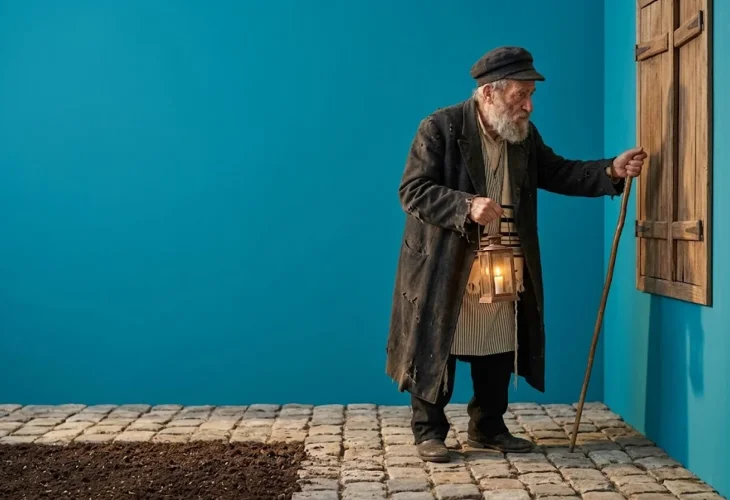
“When I was a small child,” Raphael Ben Shimhon writes in his memoirs, “the elderly Rabbi Yosef Elkobi was the first to awaken on the nights of Elul throughout the Jewish quarter of Meknes. At midnight, he would go from house to house and call out, ‘Brothers, rise for Selichot; rise and stand ready for the service of Hashem,’ while gently tapping on the shutters.”
Rabbi Yosef was a remarkable elderly man who walked slowly through the streets. He was also regarded as a mekubal who wrote amulets, and he had the privilege of waking the members of his community for Selichot.
Like Rabbi Yosef Elkobi, Jewish communities across the world once had distinctive figures known as “wake-up callers.” From the sun-drenched cities of the East to the gray streets of Europe, someone would walk through the neighborhood before dawn, knocking on shutters and calling Jews to prayer.
In Yiddish, this person was known as the veker, meaning “wake-up caller.” Often, the role belonged to the shamash or gabbai of the synagogue. It required more than simply making enough noise to wake everyone up. He needed to know his community: which shutters to tap, where a widow lived who should not be disturbed, which families prayed in another synagogue, and where a gentle knock would simply not be enough.
In short, the wake-up caller needed to know what was behind every shutter.
The Sounds of Elul in Jerusalem
Jerusalem researcher Prof. Yosef Yoel Rivlin, who documented the customs of Mizrahi Jewish communities during the High Holy Days, wrote that on the nights of Elul, the shamash of Jerusalem’s Sephardic community would walk through the streets, knocking on doors or windows and calling out, “Selichot.” Sometimes, he would even call the homeowner by name, adding a personal invitation to wake up and join the prayers.
Margalit Samandar, who was born in Jerusalem, recalled the wake-up caller of Nachlaot in her memoirs. She remembered the sound of his stick tapping first against the paving stones and then against the shutters. After his knocks, doors would slowly begin to open and footsteps could be heard as people made their way to Selichot: young people walking quickly, parents bringing their children, and older women heading to the women’s section.
The wake-up caller of Nachlaot awakened Sephardic and Ashkenazi Jews alike.
Decades later, those sounds remained deeply embedded in the memories of Jerusalem residents.
In 2019, as part of a nostalgia program, several elderly Jerusalemites listened to an old recording of Rabbi Yudel Cohen, a legendary Jerusalem veker. The recording had been made in 1960 by a resident of the Mea Shearim neighborhood using the recording equipment available at the time.
As the familiar voice played, some of those listening were moved to tears. They were hearing the sounds of their childhood once again: “People of Israel, holy people, rise for the service of Hashem... Rise for Selichot! Rise for the service of Hashem!”
Rabbi Yudel Cohen became a legendary figure, remembered not only for waking people for Selichot, but also for his devotion to prayer, his mourning for the destruction of the Temple, and his remarkable knowledge of the families living in each home. He knew his neighborhood and understood how to approach the people behind each door.
A Tradition That Crossed Continents
The custom was by no means unique to Jerusalem.
The photography archive of ANU – Museum of the Jewish People contains a photograph dating back to 1925 from Vilkaviškis, Lithuania. It shows a dignified-looking Jewish man identified as the gabbai and “wake-up caller for Selichot” before Rosh Hashanah.
A more detailed description of the role appears in the memorial book of the town of Ratne in Volhynia. It mentions two shamashim by name—Rabbi Moshe the shamash and his deputy, Rabbi Chaim Topolovsky—and describes the many responsibilities that came with the position.
Before dawn, the shamash would walk past the homes and tap on the shutters. Before prayers, he would summon the community. On Friday evening, he would walk through the market announcing the arrival of Shabbat. He also inspected the eruv and took care of other communal responsibilities.
The book even records the words used to awaken the townspeople for morning prayers: “People of Israel, holy people, rise for the service of Hashem.”
Remarkably, the same call appears in accounts from other Jewish communities, suggesting a tradition passed down among generations of wake-up callers.
When an Entire Community Woke for Selichot
Dr. Meir Nizri, who documented the customs of the Jewish communities of Tafilalt and Sijilmassa, shared a family memory from his grandfather, Rabbi Makhlouf Nizri, known as Abu Ben Yahya.
The local wake-up caller had his own distinctive style. In Arabic and Hebrew, he would announce: “Whoever does not rise for Selichot is as though he is not in the city.”
During Elul, continuing to sleep after midnight was almost unthinkable. Some people returned to bed after Selichot, while others remained in the synagogue to study Torah and pray. Even those who were not ordinarily regular synagogue-goers became part of synagogue life during Elul.
It was not simply an alarm waking individuals from sleep. The entire community was waking together.
With the arrival of alarm clocks, the role of the human wake-up caller gradually disappeared. There was no longer a need for someone to walk through dark streets tapping on shutters and calling each family to rise.
But the veker offered something an alarm clock never could. His voice was part of the atmosphere of Elul, a reminder that the High Holy Days were approaching and that the entire community was preparing together.
The wake-up callers may have disappeared from our streets, but for those who once heard their footsteps and knocks in the darkness before dawn, their voices remain etched in memory.

