

Torah Personalities
A Leader Forged in Tragedy: Who Was Rabbi Shimon ben Tzemach?
From a successful physician in Majorca to an exiled rabbi in Algeria, discover how tragedy shaped the extraordinary life and legacy of the Rashbatz.
- Yehosef Yavetz
- | Updated
The year was 5150, or 1390. A delegation of sages from Majorca entered the spacious courtyard of Rabbi Shimon ben Tzemach’s home in one of the island’s wealthy districts.
Rabbi Shimon was a physician who treated members of high society and owned property. He was still young, only about 30 years old, but the delegation had not come to seek medical advice. They had come to hear his halachic opinion.
After listening to his thorough, knowledgeable, and carefully considered response, they asked him, “Rabbi Shimon, why not serve as a rabbi? Your salary could come from the community fund.”
“I want to earn my living through the work of my own hands,” the young scholar replied.
No one could have imagined that within a year, Majorca’s Jewish community would be devastated.
Fleeing Majorca With Nothing
In 1391, the “Decrees of 5151” began. Riots erupted in the southern Iberian Peninsula and quickly spread to other Jewish communities. That summer, disaster reached Majorca.
A mob stormed the Jewish quarter of Palma, looting homes and murdering hundreds of Jews. Many of those who survived were forced to convert to Christianity, while others desperately tried to escape. Rabbi Ephraim Vidal, the Rashbatz’s teacher, was among those killed.
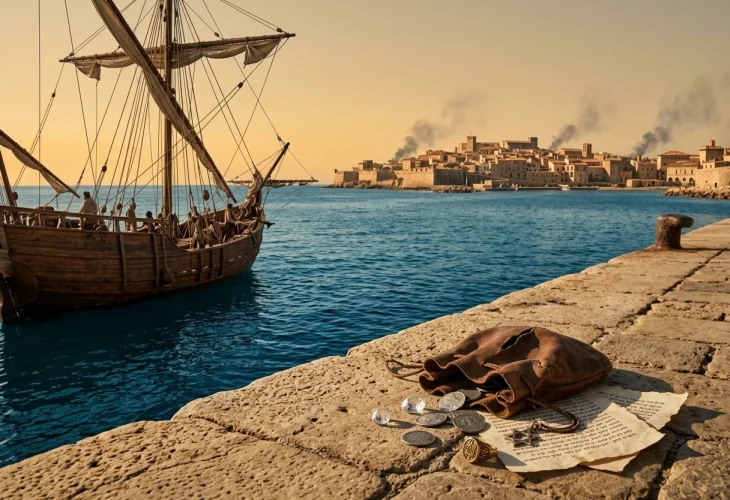
Rabbi Shimon ben Tzemach reached the harbor with his family, hoping to escape aboard a ship he owned. He had been forced to leave his home and nearly all his possessions behind, taking only a bundle of diamonds and whatever cash he could carry.
But another ordeal awaited him at the harbor.
Dockworkers who recognized him took advantage of the chaos. They told him they would not allow him to pass unless he converted to Christianity or surrendered everything he had with him.
Rabbi Shimon did not hesitate.
He threw them the bundle of diamonds and ran with his family toward the ship, escaping the island and leaving his former life behind.
He sailed to Algeria and arrived with virtually nothing. Years later, he wrote in one of his responsa: “Our lives were spared as spoils, and we left all our possessions there.”
In Algeria, circumstances forced him to accept the very kind of position he had once resisted: he became a community rabbi. That turn of events would ultimately have an enormous impact on the Torah world of North Africa.
A Torah Scholar, Physician, and Scientist
Rabbi Shimon ben Tzemach, known as the Rashbatz, was born toward the end of the month of Adar in 5121 to the Duran family, a distinguished family of Torah scholars and physicians originating in Provence. One of his relatives was the Ralbag, Rabbi Levi ben Gershon.
His teacher in Majorca was Rabbi Ephraim Vidal, a student from the study hall of the Ran. He also studied with Rabbi Yonah de Mastre in Aragon, who later gave him his daughter Bongoda in marriage.
The Rashbatz’s knowledge extended far beyond Torah scholarship. He studied mathematics, astronomy, natural science, logic, and medicine and worked as both a physician and surgeon.
Even before the upheaval of 1391, he was already recognized as an accomplished Torah scholar. His own teacher, Rabbi Ephraim Vidal, consulted him on matters of halacha. The Rashbatz also records that in 1390, just one year before the destruction, he delivered a Shabbat HaGadol sermon before rabbis and scholars.
His arrival in Algeria brought him face to face with a major question debated among the sages of his generation.
The Rambam famously ruled that a person should not accept payment for teaching Torah. Many Spanish sages followed this approach, as the Rashbatz himself had done before being driven from his home.
But was this an absolute rule? What if a Torah scholar had no other practical way to support himself?
The Rashbatz addressed the question in a lengthy responsum. He explained that the Mishnah and Gemara demonstrate that when there is no other option, accepting payment for teaching Torah is permitted.
Speaking about his own situation, he wrote: “Had the practice of medicine been sufficient in this land where we have settled, we would not have come to this.”
He would have preferred to continue supporting himself through medicine. But in Algeria, he did not have the clientele he had enjoyed in Majorca. He therefore taught Torah and accepted financial support from the community.
This arrangement enabled him to devote himself completely to the Torah needs of Algerian Jewry. “Through this, our Torah will be our vocation, and we will not cease day or night.”
Maran the Beit Yosef later relied on the Rashbatz’s detailed responsum in issuing his own lenient ruling. This became an important basis for the practice that allows kollel students to dedicate themselves to Torah study while receiving a stipend.
The Rashbatz and the Rivash
Another great Spanish sage had also escaped persecution and reached Algeria: the Rivash, Rabbi Yitzchak bar Sheshet.
The two scholars belonged to different generations. While the Rashbatz was in his thirties, the Rivash was close to 70. The Rivash served as rabbi of Algiers, and the Rashbatz sat alongside him on the rabbinical court.
But they did not always agree.
The Rivash’s appointment had been made under the authority of the Algerian monarchy. The Rashbatz argued that such an appointment had no validity under halacha. In his view, a non-Jewish ruler could not determine who would head a Jewish rabbinical court. Only the Jewish community’s acceptance of the Rivash could validate his position.
The responsa of these two great scholars preserve fascinating debates that offer a glimpse into Jewish life during that turbulent period.
One case involved a Jew named Eshterok Yechiyon, who claimed property that had been deposited with merchants before its owners fled Majorca during the persecution and forced conversions. The Rivash ruled that the property should go to the widow.
Some of the judges were not fully satisfied with the ruling and sent the claimant to the Rashbatz. The younger scholar wrote a responsum disagreeing with the Rivash.
Years later, when organizing his responsa, the Rashbatz added a striking admission at the beginning of the ruling:
“I was youthful, and I dared to challenge a rabbi outstanding in age and wisdom.”
Despite their disagreements, their collaboration was profound.
On the second of Elul 5154, in the summer of 1394, the rabbis of Algiers gathered: the Rivash, Rabbi Yitzchak Bonastruk, and the Rashbatz. Together, they established 12 ordinances governing marriage, divorce, the ketubah, and financial obligations within the family.
The Rashbatz was one of their chief authors.
Initially, these ordinances were intended largely for refugees who had arrived from Spain and Portugal. Over time, however, their influence expanded, and they became an important foundation of family law in North African Jewish communities.
Thirty years later, in 1424, the Rashbatz republished the ordinances with explanations and additions.
A Halachic Authority Across the Mediterranean
By 1399, less than a decade after arriving in Algeria, the Rashbatz was asked to rule on a complicated dispute involving a get issued in Italy, in a case that became known as “the Get of Fano.”
His extraordinarily lengthy responsum opens the first section of the Tashbatz responsa.
The fact that a dispute involving a get in Italy was brought to a relatively young rabbinical judge across the Mediterranean in Algeria demonstrates how quickly the Rashbatz’s reputation had spread throughout the world of halacha.
His responsa addressed an extraordinary range of questions.
In one, he discusses the responsibility of a physician who makes a mistake while treating a patient. He distinguishes between a surgeon, “a skilled physician” who uses instruments and may cause physical injury, and a physician who treats patients with medicines, liquids, and baths.
He explains that even an experienced doctor should not rely solely on his own expertise when someone wiser is available for consultation. But if the physician followed proper professional practice, “his reward is great in Heaven.”
The Rashbatz approached halachic rulings with remarkable confidence and rigor. He wrote that he did not issue rulings based on guesswork: “In my rulings, I do not grope like the blind against a wall.”
He said that he never declared something forbidden or permitted before thoroughly investigating the issue and maintained that he had never needed to retract a ruling after issuing it.
His commitment to truth even outweighed family loyalty. Writing about his relative, the Ralbag, he declared:
“Although the Ralbag, of blessed memory, was a great and important man and our relative... the truth is closer to us than our relatives.”
From Refugee to Leader of Algerian Jewry
After the Rivash passed away, around 1408, the Rashbatz became the rabbinic leader of Algiers. Consistent with his earlier position, he insisted that his appointment not be confirmed by a government decree.
Yet he never forgot the Jewish community he had been forced to leave behind.
Some 44 years after his escape from Majorca, a small Jewish community still remained there. From across the Mediterranean, the Rashbatz continued to follow its fate.
His responsa preserve a lengthy letter of rebuke he sent to the island’s Jews after hearing about severe internal disputes and a weakening of religious observance. He reminded them that the previous community had already been devastated amid internal conflict and urged them to learn from the past.
“Why will you not take instruction?” he wrote.
He warned that disputes within the community endangered its very existence. He also described young people arriving from Majorca with the sides of their heads shaved and raised concerns about wine-trading practices that did not meet halachic requirements. The community’s distance from major Jewish centers, he noted, also left it without meaningful Torah guidance.
In the margin of the responsum, the Rashbatz later wrote a few painful words:
“After I wrote this, they did not heed my voice.”
The Jews of Majorca were ultimately unable to preserve an established Jewish community on the island. Some converted to Christianity, while others scattered elsewhere. In 1435, the official Jewish settlement in Palma de Majorca came to an end.
A Legacy Preserved for Centuries
Alongside his work on the rabbinical court, the Rashbatz wrote extensively.
Beyond his hundreds of responsa, he authored Magen Avot, which discusses faith, philosophy, nature, and medicine; Ohev Mishpat on the Book of Job; Zohar HaRakia on the Azharot of Rabbi Shlomo Ibn Gabirol; commentaries on tractates; works on ritual slaughter, Passover, the Haggadah, astronomical calculations of new moons, and the Jewish calendar; as well as liturgical poems, elegies, and selichot.
His son, Rabbi Shlomo ben Shimon Duran, known as the Rashbash, grew up in Algeria and gradually joined his father in teaching Torah and serving as a rabbinical judge.
The Rashbatz even composed a poetic inscription for his own gravestone. One line reads: “With the body buried, the memory remains, for the name of Shimon has not departed,” hinting that his son Shlomo would continue his legacy.
After the Rashbatz’s death in 5204, the Rashbash indeed succeeded him as leader of the community, and the Duran family continued to lead Algerian Jewry for generations.
Remarkably, the Tashbatz responsa were not printed during the Rashbatz’s lifetime, or even for centuries afterward. His writings remained preserved within his family until they were finally collected and printed in Amsterdam in the 18th century, nearly 300 years after he had served on the rabbinical court in Algiers.
A special tradition is associated with his books: copies of the Tashbatz are said not to wear out or become worm-eaten, but to remain remarkably well preserved.
The Steipler, of blessed memory, shared this tradition and explained that this special merit was attributed to the Rashbatz’s extraordinary care in honoring holy books. He testified that he had personally seen a centuries-old copy of the Tashbatz that still looked new.

