

Rosh Hashanah
The Voice That Cannot Be Silenced: The Shofar in Jewish Tradition
For more than three thousand years, the shofar has called Jews to repentance, celebration, mourning, and defiance—and its ancient voice still speaks to us today.
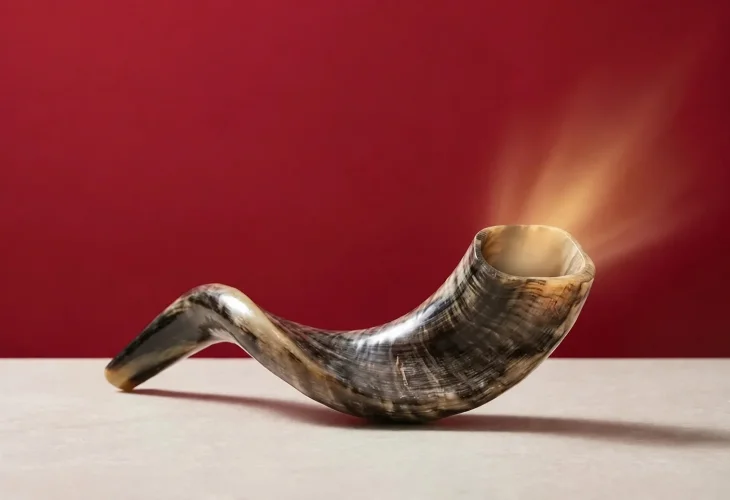
This coming Rosh Hashanah, in September 2026, an old rabbinic dilemma will return for the first time in several years: the first day of the Jewish New Year falls on Shabbat.
For most of Jewish history, that has meant one thing almost everywhere outside the ancient Temple courtyard in Jerusalem: silence. No shofar. The commandment that defines the day more than almost any other will not be fulfilled by a sound, but by its conspicuous absence.
It is an unusual way to begin a story about the shofar—with the one circumstance in which it is not blown. But that silence opens the door to a remarkably rich history. For more than three thousand years, the ram's horn has been used to crown kings, announce danger, express grief, and proclaim redemption. In the modern era, it has even become a symbol of Jewish defiance.
Origins: A Sound Without an Explanation
The Torah never actually explains why the shofar is blown on the first of Tishrei. Leviticus calls the day zichron teruah, "a remembrance of blasts" (Vayikra 23:24). Numbers calls it yom teruah, "a day of sounding" (Bamidbar 29:1). Neither verse, however, identifies the instrument or explains the purpose of the sound.
The connection between teruah and the shofar is a rabbinic inference. The word teruah appears again in Leviticus 25:9, where it clearly refers to a shofar blast announcing the Jubilee year. From there, the rabbis understood the teruah of Rosh Hashanah to mean the sound of a shofar.
The Mishnah eventually devoted an entire tractate, Rosh Hashanah, largely to the laws surrounding the shofar. The Babylonian Talmud discusses those laws at length, from roughly Rosh Hashanah 16a through 34a. But because the Torah does not give an explicit reason for the mitzvah, the question of what the shofar is supposed to mean became a subject of rabbinic reflection.
Rav Saadia Gaon, the tenth-century Babylonian sage, famously listed ten themes associated with its sound. Among them were the coronation of a king, the warning blasts of a city under siege, and the trumpets that will announce the ingathering of the exiles.
Maimonides took a more philosophical approach. The mitzvah, he wrote, is ultimately a divine decree whose reason is not explicitly given. Still, the shofar contains a message for us: "Awake, you slumberers, from your sleep" (Rambam, Hilchot Teshuvah 3:4).
The Talmud also connects the shofar to the Binding of Isaac. When Abraham was prepared to sacrifice his son, a ram was caught in the thicket and offered instead. That connection helps explain why Jewish law prefers a ram's horn above other kosher animal horns: on the Day of Judgment, the sound of the shofar invokes the merit of Abraham and Isaac (Rosh Hashanah 16a).
The Law of the Blast
The basic biblical obligation is simple: to hear the teruah three times.
Talmudic reasoning places each teruah between two plain, unbroken tekiah blasts. At the most basic Torah level, that means nine sounds in all (Rambam, Hilchot Shofar 1:1).
But the rabbis faced a problem. By the time of the Mishnah, no one was completely certain what the biblical teruah was supposed to sound like. Was it a series of short, staccato blasts? Three medium-length broken cries, known as shevarim? Or some combination of the two?
Rather than choose one interpretation, the Talmud required that all three possibilities be heard, each surrounded by tekiot. That brought the total to thirty blasts (Rosh Hashanah 33b–34a).
Jewish custom later expanded the number even further. Most Ashkenazi communities blow 100 blasts during the services. Many Sephardi communities blow 101. Some Yemenite communities have traditions involving either 40 or 70.
Even the shofar itself is subject to detailed rules. It must come from a kosher animal, but not from cattle. A bull or cow's horn is technically called a keren, rather than a shofar, and is not valid for the mitzvah (Shulchan Aruch, Orach Chaim 586:1).
The horn must be hollow, which rules out antlers, and Jewish law prefers a curved horn rather than a straight one. The curve is associated with the humility appropriate to the Day of Judgment (Rosh Hashanah 26b).
The shofar is also woven into the special Musaf service of Rosh Hashanah. Three unique sections of the Amidah—Malchuyot (Sovereignty), Zichronot (Remembrance), and Shofarot—are each accompanied by their own set of blasts, a structure already described in the Mishnah (Rosh Hashanah 4:5–6).
Why the Shofar Falls Silent on Shabbat
This brings us back to the silence with which we began. When Rosh Hashanah falls on Shabbat, the Mishnah says that the shofar was blown in the Temple in Jerusalem, but nowhere else (Rosh Hashanah 29b).
The Talmud's explanation is practical. Rabbah taught that although every Jew is obligated to hear the shofar, not everyone knows how to blow it. The rabbis were concerned that someone who did not know how might pick up his shofar and carry it through a public domain to find an expert who could teach him. Carrying on Shabbat would be a much more serious violation than failing to perform the positive commandment of hearing the shofar.
The Temple was different. There, the shofar was blown in a controlled setting by people who knew what they were doing. The concern did not apply.
After the destruction of the Temple, however, the suspension became universal. The result is the law we follow today: when the first day of Rosh Hashanah falls on Shabbat, the shofar is not blown, whether in Israel or in the Diaspora.
That is exactly what will happen this Rosh HaShana.
Ashkenaz, Sepharad, and the Sound of the Shofar
The basic laws may be shared across the Jewish world, but the experience of hearing the shofar can vary considerably from one community to another.
In most Ashkenazi and Sephardi communities, the teruah is produced as a rapid series of short blasts. In Yemenite, Tunisian, Babylonian, and some Western Ashkenazi traditions, it may instead be a single long, quavering sound.
Ashkenazi communities traditionally end the service with an extended tekiah gedolah. Many Sephardi communities extend the final teruah instead. The Shulchan Aruch explains this practice as a way "to confound the accuser" (Orach Chaim 596:1).
The shofar itself can look very different depending on where it comes from. Ashkenazi shofarot are generally shorter and relatively plain around the mouthpiece. Many Sephardi and Yemenite shofarot, often made from the long, spiraled horn of an African kudu, are dramatically longer and sometimes intricately carved.
Women are formally exempt from the mitzvah because it is a positive, time-bound commandment. But that exemption has rarely meant that women do not hear the shofar. For generations, Jewish women have made a point of hearing it, and according to Ashkenazi custom, a woman may recite the blessing over the mitzvah herself even though she is not technically obligated.
The Shofar in Exile, Past and Present
The laws of the shofar may be ancient, but its role as a symbol of Jewish endurance is anything but a relic of the past.
During the British Mandate in Palestine, the authorities formally banned the sounding of the shofar at the Western Wall beginning in 1930. The restrictions were part of a broader policy that also prohibited benches, an ark, and even praying aloud at the Wall, amid British concerns about provoking the local Arab population.
The ban was repeatedly defied.
In 1930, Rabbi Moshe Segal, a young Chassid, blew the shofar at the Wall in open violation of the order. He was arrested on the spot and released only after Rabbi Avraham Yitzchak Kook intervened.
In the years that followed, members of Betar and the Irgun developed a tradition of smuggling a shofar into the Wall for the closing moments of Yom Kippur. They continued doing so almost every year through 1947, with some participants serving jail time as a result.
Then, in June 1967, the shofar was heard again at the Wall under very different circumstances. When Israeli paratroopers reached the Old City during the Six-Day War, IDF Chief Rabbi Shlomo Goren blew the shofar at the newly liberated Western Wall. The image and sound became among the defining symbols of the war.
That symbolic charge has not disappeared. In August 2025, the Palestinian Authority's Jerusalem Governorate publicly described the customary sounding of the shofar during Elul as one of the tools of what it called Israeli control over Jerusalem. The statement was another reminder of how politically charged even a ritual instrument can become in the city.
In Israel, meanwhile, the meaning of the shofar has taken on another dimension in the years since the October 7, 2023 attacks and the war that followed. Commentators have repeatedly returned to the Talmudic image of the shofar's broken notes as resembling the cry of a mother grieving for a child who has gone to war.
Ahead of Rosh Hashanah in 2025, one Jerusalem Post writer noted how little explanation was needed to make that ancient image speak to the year Israel had just lived through. The same instrument that Rav Saadia Gaon associated with coronation and warning has proved capable, centuries later, of carrying grief and defiance at the same time.
Bringing the Shofar to Those Who Cannot Hear It
Modern Jewish communities have also had to find ways to fulfill the mitzvah in circumstances the Talmud could never have imagined.
Because hearing the shofar in person is considered central to fulfilling the obligation, communities organize elaborate efforts each year to bring its sound to people who cannot get to a synagogue.
Volunteer ba'alei tekiah visit hospitals, nursing homes, and military bases. Chabad emissaries, in particular, have built extensive networks for sending shofar-blowers to isolated and homebound Jews. Those efforts have grown even more important since the war years of 2023–2025, when so many soldiers found themselves stationed far from their home communities.
The laws of the Shofar are clearly defined, but its meaning has never been confined to a single interpretation. One year, Shabbat requires it to be silent. In another age, Jews risked arrest to make sure it could be heard. It has been a royal trumpet, a warning cry, a mother's sob, and a call to wake up. It has marked exile and return, mourning and celebration, fear and hope.
The shofar says nothing in words. Perhaps that is why, after thousands of years, it can still say almost everything.

