

History and Archaeology
The Auschwitz Shofar: From a Death March to the Shores of Israel
A shofar hidden inside Auschwitz survived a death march and Buchenwald before sounding again on Rosh Hashanah as Holocaust survivors approached the Land of Israel.
- Yehosef Yaavetz
- | Updated
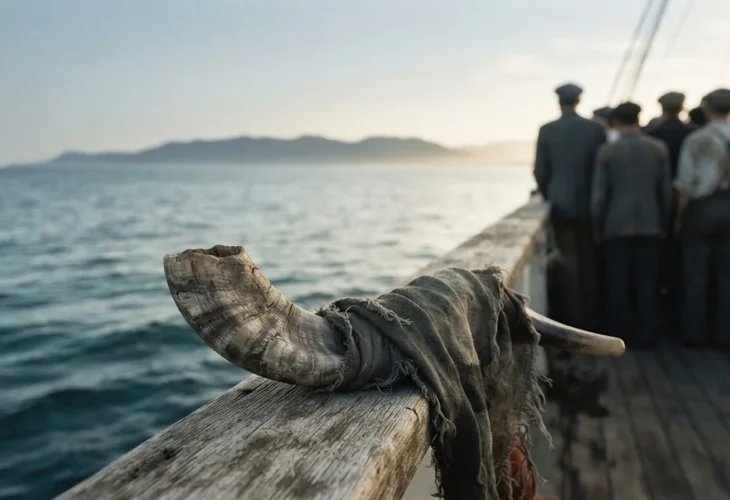
By September 1944, World War II was already in its sixth year. At Buna, one of Auschwitz’s satellite camps, prisoners had no way of knowing what the coming months would bring. The Germans still controlled the camp, work continued at the Buna factories, and thousands of Jewish prisoners were being subjected to grueling forced labor under brutal conditions.
For observant Jews, another date was approaching: Rosh Hashanah. There was no synagogue, no proper prayer books, and no guarantee that even a secret prayer service could take place. And there was something else almost impossible to obtain inside Auschwitz: a shofar.
A Secret Rosh Hashanah Service in Auschwitz
Auschwitz-Buna, also known as Monowitz or Auschwitz III, was a labor camp established around the I.G. Farben factories. Thousands of prisoners were forced to work there, including a group of observant Jews determined to preserve whatever they could of Jewish life.
One of the prisoners who tried to make Rosh Hashanah prayers possible was Yechezkel Tidor, known as Cheskel Tidor. Born in 1903, Tidor was an observant Jew who held a position of practical importance in the camp: he was responsible for organizing work groups. That position gave him some influence over prisoner assignments, and he used it when prisoners wanted to organize prayers for the High Holidays.
The challenge was twofold. They needed a shofar, and they needed somewhere it could be sounded without attracting the attention of the guards. Before Rosh Hashanah, Tidor managed to arrange for some of the Jewish prisoners to be assigned to a work group relatively far from the center of the camp. If they could hold a secret prayer service there, the sound of the shofar would be less likely to reach camp personnel.
Tidor himself could not join them. His position supervising the work groups required him to remain at his post, and disappearing suddenly could have aroused suspicion. Instead, he helped others reach a place where they might be able to pray.
But there was still one problem. Tidor approached the prisoner who was believed to have a shofar and asked him about it. The man denied having one.
Tidor understood that he was afraid. If the shofar were discovered, it could serve as evidence that the prisoner was participating in forbidden religious activity. As Tidor later told his daughter, the prisoner apparently knew that possessing such an object could cost him his life. Everything was ready except for the shofar. It existed somewhere inside Auschwitz, but the man protecting it was too afraid to reveal it.
“Take the Shofar”
Four months later, at the end of January 1945, everything changed. The Soviet army was approaching Auschwitz, and the Germans began evacuating the camp. Thousands of prisoners were forced westward on what became known as the death marches. Exhausted, starving, and sick, they were driven through the bitter winter cold, and for many, the march became the final chapter of their lives. Tidor was among them.
During the march, a Jewish prisoner in dire physical condition approached him. He was gaunt and ill and apparently understood that he had little chance of surviving the journey. In his hands was an object wrapped in rags. He gave it to Tidor. Inside was the shofar.
According to testimony given by Tidor’s daughter, the prisoner told him: “Take the shofar, and show them that we had a shofar in Auschwitz.”
The shofar had passed into Tidor’s hands, but its journey was far from over. Tidor survived the march through the snow and reached Gleiwitz. From there, he was transferred with another group of prisoners to Buchenwald, carrying the shofar with him.
As the war approached its end and German control weakened, Tidor managed to conceal the shofar inside a small bag. It remained with him throughout the final weeks of the war. On April 11, 1945, Buchenwald was liberated by the American army. Tidor walked out of the camp with the shofar still in his possession. It had survived Auschwitz, the death march, Gleiwitz, and Buchenwald.
The Shofar Sounds Again
A few months later, Tidor was no longer a prisoner. He was aboard a ship bound for Mandatory Palestine, surrounded by young Holocaust survivors, many of whom had themselves endured concentration and extermination camps. The war was finally behind them, and they were making their way toward the land they had dreamed of reaching.
Rosh Hashanah 5706 fell in September 1945. This time, there were no guards from whom the shofar had to be hidden. There was no need to wrap it in rags or conceal it among other belongings.
Tidor took it out and sounded it for a group of survivors aboard the ship. From where they stood, they could see the Carmel range.
The same shofar that had been hidden inside Auschwitz, carried through a death march, and concealed in Buchenwald now sounded openly from a ship approaching the shores of the Land of Israel.
Decades later, in 2019, the Museum of Jewish Heritage in New York shared the story of Tidor’s shofar as part of an exhibition about Auschwitz. The object had survived alongside him, carrying with it the memory of Jews who, even inside Auschwitz, still longed to hear the sound of the shofar on Rosh Hashanah.

