

Parashat Haazinu
The Song of History
The lessons of Ha’azinu remind us that memory and song have the power to shape who we become
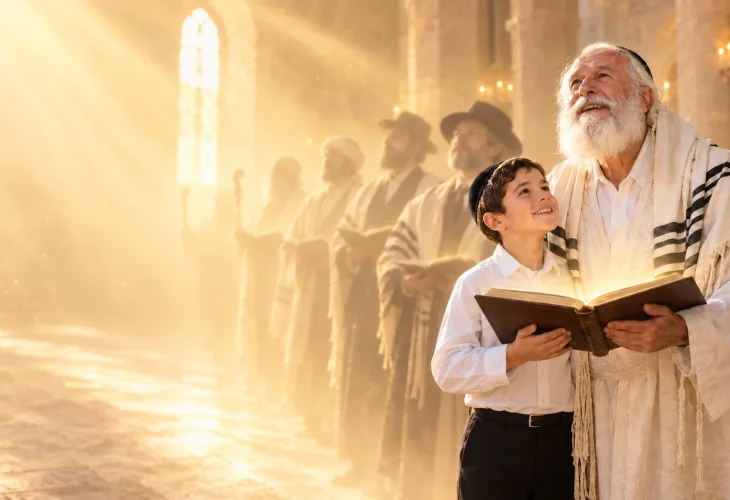
I had a phenomenal sixth grade history teacher. She was a seasoned veteran who still had outstanding classroom management and was the old-school style teacher who expected her students to work hard and put in real effort. And she firmly believed in memorization, which I definitely did not understand as a sixth grader but for which I am, now, eternally grateful.
Her history curriculum, uniquely, was Jewish history. Her classroom was where I first learned about the Crusades. It was where we delved into the Spanish Inquisition, where we encountered the Holocaust, where we learned about the difficult history of the Jews of Europe. This teacher of mine understood the importance of teaching and understanding history; her father was Rabbi Moshe Sherer, who led Agudath Israel of America for decades, and she knew that part of educating the next generation of Jews meant teaching them—us—where we come from and what we’ve experienced as a people.
One of the things that this teacher had us memorize was the verse from this week’s Torah portion which she used in the introduction to her course. This week we will read the penultimate portion, Ha’azinu. It’s an unusual portion, structured as a poetic song, and is Moses’ parting message to the people. The song follows a very specific arc: Moses begins with a few introductory verses, then paints a long picture of history, moving from beginning to end. He tells of God choosing this nation to be His own, warns of how in the future the Jewish people will falter and fail, tells of the punishments that await them, and finishes with the eventual redemption that will come.
The verse that bridges the introduction and the sweeping vision of history is the one my teacher targeted for us to memorize. Moses instructs the people, “Remember the days of old, investigate the years of previous generations. Ask your father and he will tell you; your elders, and they will relay to you” (Deuteronomy 32:7). Long before George Santayana wrote, “Those who do not remember the past are condemned to repeat it,” Moses was imparting that same warning in poetic form.
In fact, Rabbi Jonathan Sacks offers a brilliant insight into Moses’ turning to this poetic song now, at the very end of his life. This was, in fact, the very last day of Moses’ life, and he had already been instructing the people, day in and day out, for more than a month at that point. But he had been speaking of laws, speaking to their intellect, and Moses—the consummate leader—knew that more had to be done. In the words of Rabbi Sacks, “Intellect alone does not inspire in us the passion to change the world. To do that you have to take thought and turn it into song. That is Ha’azinu, Moses’ great hymn to God’s love for His people and his role in ensuring, as Martin Luther King put it, that ‘the arc of the moral universe is long but it bends towards justice.’” To imprint his final words on the souls of the people, Moses turned to their emotions, reaching them through poetic verse in a way that prose could not.
Depending on the calendar, Ha’azinu does not always fall out on the Shabbat between Rosh Hashana and Yom Kippur, but it often does. These twin pillars of Ha’azinu—the sweeping view of history and the song of the soul—are appropriate as frames as we begin our final spiritual preparations for the Day of Atonement. Yom Kippur is a day in which we are cleansed from our sins, giving us a fresh slate with which to start the year. But that fresh slate is not a tabula rasa; we have our personal past on which we build as well as hundreds of generations who came before us on whose shoulders we stand. We are the next link in an unbroken chain of tradition, and that alone can inspire us to make the most of our new year.
But it’s not enough, of course. And so we turn to song, Moses through the poetic verse of Ha’azinu and us through the familiar tunes of our prayers. We are swept away by the songs, carried to greater heights than we might be otherwise, such that the words themselves move us because they are conveyed as song.
And we carry the tunes all year, because they are beautiful and moving and keep us grounded in who we are and who we want to be. We have Yom Kippur once a year. We return to Ha’azinu once in the annual Torah cycle. But the responsibility we hold to our past, and the songs that inspire us to live up to it, those stay with us year round, keeping us on the path towards the ultimate redemption, in which the greatest song of all will be sung.
Wishing everyone an easy and meaningful fast.

