

World News
Yemen War Escalates as Government Launches Major Offensive Against Houthis
Saudi-backed forces are seeking to retake Houthi-held territory and break the group’s grip on the Bab el-Mandeb Strait as fighting spreads across Yemen.
- Shlomo Hodges
- | Updated
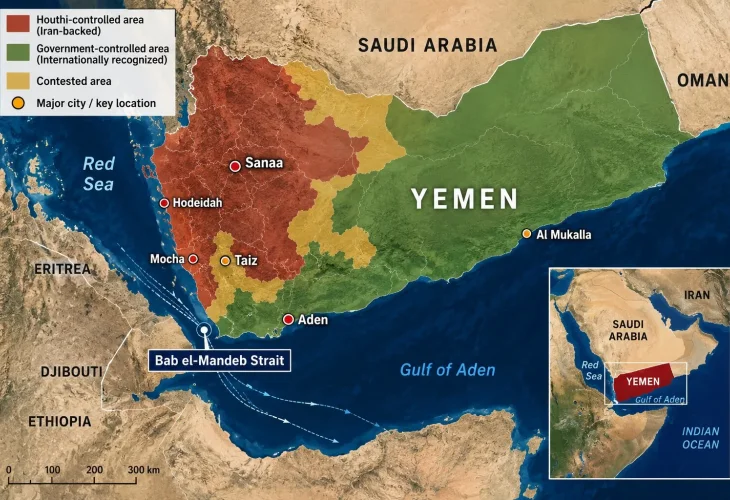
Yemen’s internationally recognized government has launched a major military campaign against the Iran-backed Houthis, marking a sharp escalation in a civil war that had remained relatively contained since a 2022 truce.
Rashad al-Alimi, head of Yemen’s Presidential Leadership Council, announced on Sunday that government forces would seek to retake Houthi-controlled territory across the country. The offensive follows a series of rapid Houthi advances along Yemen’s Red Sea coast and toward the strategic city of Taiz.
Saudi Arabia is backing the government offensive and has carried out extensive airstrikes against Houthi positions. Reuters reported last week that Riyadh was preparing a broader operation involving Yemeni ground forces, Saudi air support and US intelligence assistance. More than 100,000 Yemeni troops could potentially take part, according to officials familiar with the planning.
The Houthis have responded with missile and drone attacks against Saudi Arabia. The group claimed attacks on Saudi Aramco facilities in Riyadh and Yanbu in recent days, saying they were retaliation for Saudi strikes in Yemen. Saudi authorities have not confirmed all of the Houthis’ claims.
The renewed fighting follows a major Houthi offensive in September. The group captured the Red Sea port city of Mocha and nearby islands before reaching positions around Bab el-Mandeb. Iranian advisers assisted the Houthis during parts of the offensive, according to officials cited by the Associated Press.
Government forces are also fighting to prevent further Houthi advances around Taiz. The Houthis recently captured Turbah, a strategically important town on a road connecting Taiz with Aden, placing additional pressure on government supply routes.
The Bab el-Mandeb Strait gives the conflict significance far beyond Yemen. Ships traveling between Asia and Europe through the Suez Canal generally pass through the strait. In the first half of 2023, routes through the Red Sea carried around 12% of globally traded seaborne oil and 8% of worldwide liquefied natural gas trade.
The Houthis have previously used missiles and drones to target commercial shipping and Israel as part of their wider alignment with Iran. Their growing control of Yemen’s western coastline therefore gives the group greater ability to threaten Red Sea traffic and regional states.
The latest escalation has also worsened Yemen’s humanitarian crisis. The World Food Programme said approximately 125,000 people were displaced within days during fighting along the western coast in September. The agency has warned that food insecurity is rising rapidly as fighting disrupts supply routes and pushes up prices.
Yemen’s civil war began after the Houthis seized the capital, Sanaa, in 2014 and forced the internationally recognized government from the city. Saudi Arabia intervened militarily the following year in support of the government.
A UN-backed truce beginning in 2022 sharply reduced major fighting, although no permanent peace agreement followed. The latest offensives have now produced the most serious escalation since that ceasefire period began.
At the same time, diplomatic efforts continue. Iran has proposed political talks involving the Houthis, while Saudi Arabia, Turkey and Pakistan are discussing the conflict as part of their new defense cooperation framework.

