

Parashat Bereshit
Cain and Abel: A Powerful Reading of Parashat Bereishit Through the Lens of the *Kli Yakar*
Cain brought an offering to Hashem only after reflecting on the end that awaited him—and even then, he did not make the effort to bring his best. Abel’s offering, by contrast, flowed naturally from his belief in the World to Come and the importance of preparing for it. A *dvar Torah* on *Parashat Bereishit* based on the commentary of the *Kli Yakar*.
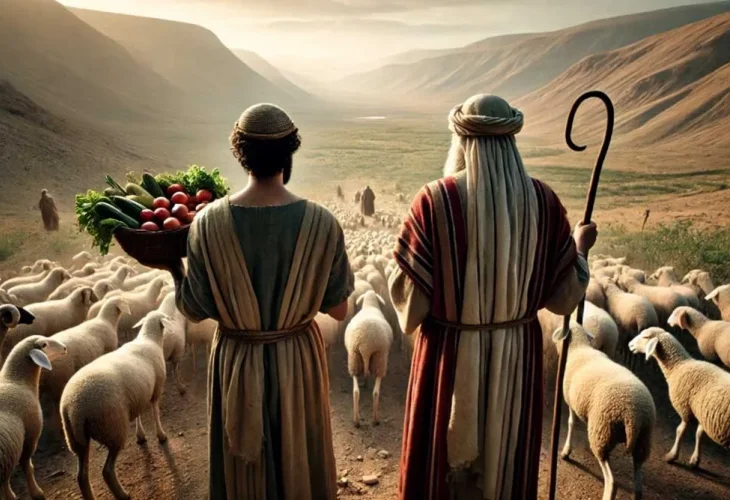
The story of Cain and Abel, found in Parashat Bereishit, has occupied Torah commentators not only because they sought to understand the motives behind the first murder in history, but also because of another question: Why did Hashem not accept Cain’s offering, while favoring that of his brother Abel?
Rabbi Shlomo Ephraim of Luntschitz, in his book Kli Yakar, develops a full approach according to which Cain and Abel disagreed over whether there is anything beyond this world. Here are his precious words:
“It seems that, by way of allusion, Cain and Abel disagreed about what constitutes human perfection: Is this world and its successes the ultimate fulfillment of a person, with no fulfillment beyond it? Or is there another, eternal world?
And it appears that Cain, who loved the earth, believed that there is no reckoning in the grave and that this world leaves nothing behind. He therefore chose for his portion all the delights and successes of this world, believing that the advantage of the land is in everything. Abel, however, believed that there is another eternal world, where a person attains the ultimate purpose. He therefore chose to be a shepherd, an occupation that brings solitude—as was the way of many prophets, such as Moses, David, and others—and also so that he could bring an offering to Hashem from the flock.”
The brothers’ disagreement over whether there is a World to Come—a world beyond human existence in this one, an eternal world in which the true purpose of the righteous is held in reserve—led them to choose different occupations. As Midrash Rabbah teaches:
“‘Cain said to Abel his brother, and when they were in the field...’ What were they arguing about? They said: Come, let us divide the world. One took the land, and one took the movable property.” [Bereishit Rabbah, chapter 22, 7]
Continuing his interpretation, the Kli Yakar gives the following explanation for the Midrash, which describes Cain and Abel dividing the world’s assets: Cain, who denied the existence of a World to Come, preferred material earthly possessions—working the land. Abel, by contrast, turned to shepherding, both in order to find solitude and deepen his thoughts, and so that he could offer a sacrifice to Hashem from his flock.
“This is the meaning of the Midrash that says Cain took land as his portion and Abel took movable property, and so on. This teaches what was in their hearts regarding the division between the reward of this world and the World to Come. For a person cannot move or take anything from all the delights of this world with him when he goes on to the next world; they are like land, which remains in its place. It is like someone who goes to a fair and uses his money to buy land and houses there, which he cannot bring home with him. He has from them only what he eats from their produce while in a foreign land, and when he returns home, he comes back empty-handed. He carries nothing away from all that he labored over, built, and planted, leaving the wealth and walls he established for others. So too, one who makes this world the main thing has from it only a handful of pleasure, attained through armfuls of toil and anguish of spirit. He uses it only during his brief stay in this world, where he dwells like a stranger and a guest who has pitched a tent for the night. He takes nothing with him to the eternal world, which is his true home. This was the view of Cain and his companions, lovers of temporary possessions. But Abel, who regarded all temporary possessions as mere vanity, chose movable property. This represents fulfilling Hashem’s commandments, which a person can carry with him from the place where he stands as a guest and stranger to the place where he is a resident and citizen, where he will make his home.”
Land, a symbol of permanence and stability in this world, in fact represents the limits of the material world and the mistaken outlook of Cain and those like him, who devote their lives to loving wealth and obsessively accumulating it. After a person’s 120 years, after all, the land remains in this world and cannot be brought along to the eternal one. Movable property, by contrast, represents fulfilling Hashem’s commandments, because the merit a person accumulates goes with them to the World to Come. Abel, whose very name suggests that he understood that in this world “everything is vanity,” embraced this outlook.
The question naturally follows: Why did Cain, who represents lovers of wealth—those unwilling to spend their money on mitzvot and charity—bring an offering to Hashem at all? The Kli Yakar explains:
“It is already known that all those who love acquiring wealth never perform any mitzvah or give charity from their money throughout their lives, because they think: The day is still long; there is still time to eat their fill here and make use of their wealth. As long as they see themselves as strong and healthy, with their strength still intact, they give nothing of their fortune and possessions for the service of Hashem, thinking: Who will eat it and who will enjoy it besides me?
But at the end of their lives, when they see themselves approaching the gates of death and realize that they cannot take everything with them when they die, a spirit of jealousy comes over them. They become jealous of their friends who do Hashem’s work, and they too do a very small amount, agreeing to bring an offering to Hashem—whether through a sacrifice, giving to the poor, or another way... Yet even then, as they approach the gates of death, they do not give for the sake of the mitzvah. They give only the smallest, least valuable part of their wealth; they select the refuse and send it as an offering to Hashem. Every contemptible and worthless thing becomes the portion set aside for Heaven, while every fine cut remains their own. Their hands refuse to touch the best portion, and they begrudge giving a worthy share as an offering to Hashem.
Therefore, it says of Cain, who belonged to this group, ‘And it came to pass at the end of days.’ That is, the end of his life—whether he was actually near its end or merely remembered that it would end—caused this small awakening in him, as he sensed that all his labor in this world would come to an end. Had he not felt that all flesh will come to an end and remembered the days of his life, he would never have brought any offering to Hashem. And even the memory of life’s end helped only enough for him to set aside the lesser and inferior part—namely, flaxseed.”
Even Cain, the man of this world, eventually reached the conclusion that an exclusive focus on money is not enough. According to the Kli Yakar, people nearing the final stage of life take stock of themselves and show a willingness “to bring an offering to Hashem”—whether as a sacrifice or as charity for the poor. Yet even at the gates of death, they are not ready to part with the possessions they spent their lives accumulating. For the sake of a mitzvah, they give miserly and grudgingly, both in quantity and quality. That is what Cain did, as the Midrash says:
“‘Cain brought from the fruit of the ground an offering to Hashem’—from the refuse. He was like a bad tenant farmer who ate the first fruits and honored the king with the late-ripening fruits...” [Bereishit Rabbah, chapter 22, 5]
In the straightforward reading of the Midrash, the first fruits are the good fruits, which ripen first, while the late-ripening fruits are the inferior ones that ripen later. According to the Kli Yakar, the first fruits and the late-ripening fruits represent not only the quality of Cain’s giving, but also the stages of life of a person who loves money:
“This means that in his youth—the early days, which have the status of the first and primary portion—he consumes his wealth to the fullest extent he can. Then he sends the late-ripening fruits to the King, the King of the universe, blessed be He: the end of his life. Those days when he says, ‘I have no pleasure, desire, or physical craving in them’—those are the days he sends to the King, to perform Hashem’s service, which seems foreign to him. And ‘late-ripening fruits’ means ‘at the end of days,’ as was mentioned.”
Cain brought his offering to Hashem only because he reflected on the end awaiting him later in life, and even then he did not make the effort to bring something of quality. Abel’s offering, in contrast, was a natural and direct expression of his belief in the World to Come and in the importance of gathering provisions for the journey ahead:
“Abel brought from the firstborn of his flock and from their choicest parts—not because he remembered the end and the close of his life, but for the true purpose: to bring sustenance to his eternal home at the end of days. It is like one traveling far away, who does not concern himself with fine food while he is a guest, but sends the choicest portion to his permanent home.”
It is no wonder, then, that Hashem accepted Abel’s offering:
“Therefore, ‘Hashem turned to Abel and to his offering’—that is, to Abel, because his intention was pleasing to Him, and to his offering, because the deed itself was also pleasing. But to Cain and to his offering He did not turn, because both his actions and his intention were unacceptable.”

