

Wonders of Creation
Noah’s Flood Explained: Where Did All the Water Come From and Where Did It Go?
Explore a scientific hypothesis about the biblical Flood that draws on discoveries of water deep within the Earth, geological processes, and tidal forces to explain how the waters may have risen and receded
- Yosef Yaavetz
- | Updated
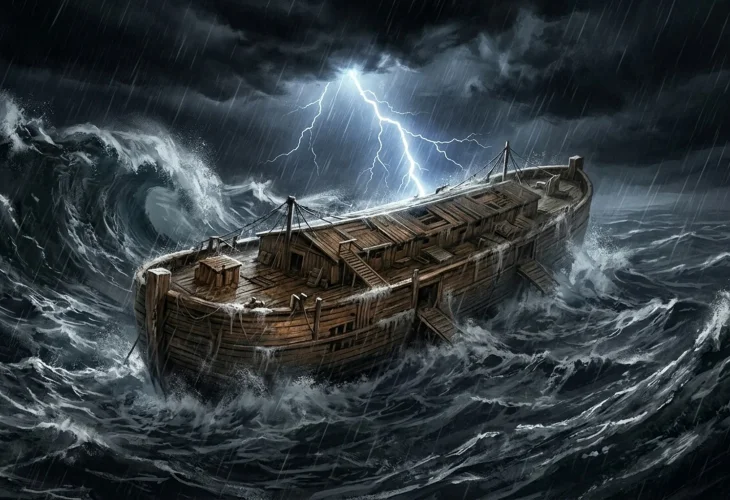
The biblical account of Noah’s Flood describes the waters gradually receding in stages. First, the sources of the water were closed. Then the water level began to fall, revealing the mountaintops, until eventually the earth became dry.
The Torah states, “And the waters receded from the earth, continually receding” (Genesis 8:3). However, it does not explain where the waters went or the physical processes involved in their disappearance.
This raises two fundamental questions: Where did the enormous volume of water that covered the earth originate, and where could it have gone afterward?
How Much Water Would Be Needed to Cover the Earth?
Covering the entire planet, including its highest mountains, would require an extraordinary quantity of water. Estimates indicate that approximately two billion cubic kilometers of additional water would be needed, roughly one and a half times the volume currently contained in the world's oceans.
Where could such an enormous quantity of water have come from?
In his work The Physics of the Biblical Flood, Roi Lotan Glazer proposes an explanation involving water stored deep within the earth's interior. According to his hypothesis, water released from rocks and magma during the Flood was subsequently reabsorbed as geological conditions changed.
The reservoir he describes is not an underground cavern or a vast subterranean lake. Rather, it consists of water incorporated into the minerals and other materials that make up the earth's mantle.
Scientific Evidence of Water Deep Within the Earth
The idea that water can be stored in minerals deep within the earth has a basis in scientific research. In 2014, Graham Pearson and his colleagues published a study in the scientific journal Nature examining a ringwoodite crystal discovered inside a diamond from Brazil.
Ringwoodite is a mineral associated with the extreme pressure conditions found in the mantle's transition zone, approximately 410 to 660 kilometers beneath the earth's surface. The researchers' findings provided direct evidence that water-bearing minerals exist in at least some regions at these depths.
This discovery supports the scientific understanding that substantial quantities of water may be stored within the earth's interior. However, it does not establish that this water was released during the biblical Flood.
How Could the Water Have Reached the Surface?
Glazer's hypothesis attempts to explain how water trapped deep within the earth might have been released in sufficient quantities to produce a massive flood.
He draws on a teaching of the Sages that associates the beginning of the Flood with changes in the positions of certain stars. Based on this account, he suggests that the earth may have passed near a cosmic cloud, generating unusually powerful tidal forces, heating, and fractures within the planet.
According to his proposed scenario, these disturbances caused water stored in deep geological materials to escape and rise toward the surface through fractures and volcanic regions, particularly along the ocean floor.
As the cosmic cloud moved farther away, the disturbances gradually weakened, allowing the earth's geological system to begin returning to equilibrium.
Where Did the Floodwaters Go?
Glazer proposes that as the earth's interior cooled and conditions stabilized, the geological materials that had released the water became capable of absorbing it once again.
In his model, water traveled downward through fractures, dissolved into magma, and penetrated deeper layers of the earth. He also describes a possible process in which infiltrating water contributed to localized melting, allowing it to move farther into the planet's interior. As the surrounding materials subsequently cooled and solidified, the water became trapped within them.
According to this explanation, the waters that had emerged during the Flood eventually returned to reservoirs deep within the earth, offering a possible physical interpretation of the Torah's description of the receding waters.
Could the Floodwaters Have Covered Mount Everest?
Glazer acknowledges that the quantity of water described in his model would not have been sufficient to submerge the entire planet up to the height of Mount Everest. Instead, he estimates that the additional water could have reached approximately four kilometers above the land.
To account for the biblical description of waters covering even the highest mountains, he introduces another possible factor: extraordinary tidal activity caused by the proximity of celestial bodies.
According to his hypothesis, powerful tidal forces generated enormous waves capable of temporarily carrying water above the highest mountain peaks, including Mount Everest. These waves, he suggests, could have swept across the planet and destroyed living creatures wherever they reached.
In this interpretation, the Flood involved not only a dramatic increase in the volume of surface water but also extraordinary tidal disturbances that temporarily raised the waters to even greater heights.
Exploring the Biblical Flood Through Science
Glazer's theory offers one proposed explanation for the origin and disappearance of the waters described in the biblical Flood. By drawing on research into water-bearing minerals deep within the earth, he attempts to construct a physical model in which large quantities of water were released from the mantle and subsequently returned to it.
The existence of water stored within deep mantle minerals is supported by scientific evidence. However, the proposed cosmic disturbance, rapid release and reabsorption of enormous quantities of water, and mountain-covering tidal waves remain speculative. These mechanisms have not been established as scientific explanations for a global flood.
Glazer's proposal is therefore best understood as a hypothesis seeking to reconcile the biblical narrative with geological knowledge, rather than a scientifically demonstrated account of the Flood.
Nevertheless, the research into water stored deep within the earth introduces an intriguing dimension to the ancient question of where the Flood's waters might have originated and where they could have gone.

