

Interesting
The Surprising Reason Hollywood Films Are Stored Deep Underground
Discover how former mines in Kansas and Norway are being used to protect Hollywood film reels, historical documents, and digital archives for future generations.
- Tehila Cohen
- | Updated
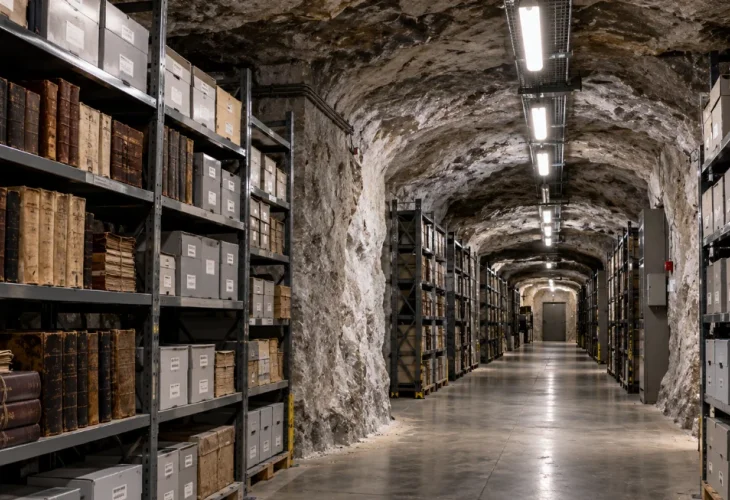
In Hutchinson, Kansas, about 650 feet below the Earth's surface, lies one of the storage facilities operated by Underground Vaults & Storage. What was once a working salt mine is now home to valuable documents, historical archives, and original film reels from Hollywood productions.
The unusual location offers a combination of stable environmental conditions and security, making it an ideal place to preserve materials that could otherwise deteriorate over time.
A Salt Mine Protecting Hollywood's Archives
Old film reels are particularly sensitive to storage conditions. Heat and humidity can accelerate the deterioration of film materials, and when an original reel is damaged, the loss can be permanent.
Inside the Hutchinson mine, temperatures remain relatively stable throughout the year, thanks to the surrounding rock layers that insulate the underground chambers from changing weather conditions above ground. Particularly delicate archival materials are stored in specially controlled environments designed to meet their preservation needs.
The underground location also makes it easier to restrict access to storage areas. For companies protecting valuable original materials, this added level of security is another significant advantage.
Norway Stores Its Data Inside a Mountain
A similar approach is being used in Norway's Svalbard archipelago, where the Arctic World Archive operates inside a former coal mine. Instead of Hollywood film reels, this facility preserves copies of important documents, works of art, and cultural information using a technology quite different from ordinary computer storage.
The information is recorded on a specialized film called piqlFilm, which is designed for long-term preservation. Unlike conventional digital storage systems, the film does not require electricity to retain the information stored on it.
The naturally cold temperatures and sheltered environment inside the mountain help protect the materials over time. Although accessing the information in the future will require appropriate decoding tools, the archive does not need continuously operating servers to keep its data intact.
Why Underground Storage Can Be Better Than the Cloud
Digital files may seem permanent, but the systems used to store them require ongoing maintenance. Hard drives eventually wear out or become obsolete, servers need replacing, and older file formats may no longer be supported by modern software.
As a result, organizations must regularly transfer, update, and maintain their digital information to prevent it from becoming inaccessible.
The preservation method used at the Arctic World Archive aims to reduce this dependence on continuous technological maintenance, allowing important information to be stored for extended periods without relying on active computer systems.
However, underground storage is not completely risk-free. Fires, flooding, equipment failures, and other unexpected incidents can still threaten valuable archives, making proper safety measures and monitoring essential.
Even so, the combination of stable temperatures, protection from external weather conditions, and restricted access makes certain underground mines particularly suitable for preserving important materials.
From original Hollywood films to records of human history and culture, these former mines have found a remarkable new purpose: protecting valuable information for future generations.

