

Parashat Noach
Why Noah's Flood Was Called “The Waters of Noah”
A puzzling phrase in Isaiah opens up a deeper lesson about moral responsibility, Moses’ intercession, and our obligation to fight for a better world.
- Rachel Wigman
- | Updated
Perhaps the most overlooked part of the Shabbat morning services is the haftarah, the portion from the prophets that we read directly following the weekly reading of the Torah portion. It’s not exactly clear where the custom comes from; some attribute it to Ezra HaSofer, who led the Jewish people in rebuilding the Second Temple, while others say it comes from the time of the Chanukah story, in which readings from the Torah were outlawed but readings from the prophets were not. Regardless, it is an old custom indeed, yet is usually the point in the prayers where people nod off, step out, or simply zone out.
Typically, the haftarah is connected to the Torah portion that we just read. On a special Shabbat, such as when Rosh Chodesh falls on Shabbat, the haftarah is thematically connected to the blending of Shabbat and Rosh Chodesh. During the weeks surrounding the fast of the Ninth of Av, in which we commemorate the destruction of the two Temples, the haftarot are first ones of prophetic warning followed by seven weeks of comfort.
Personally, I’ve been partial to the haftarot since I was in twelfth grade, when we had a class in which we covered the weekly portion. That partiality was fueled, in part, by the fact that I’ve always been drawn to the underdog, and in the grand scheme of Shabbat prayers, the haftarah is the biggest of the underdogs. But the more I learned, that year and in subsequent years, the more I learned how much the haftarot have to offer to us beyond their basic connection to the Torah portion.
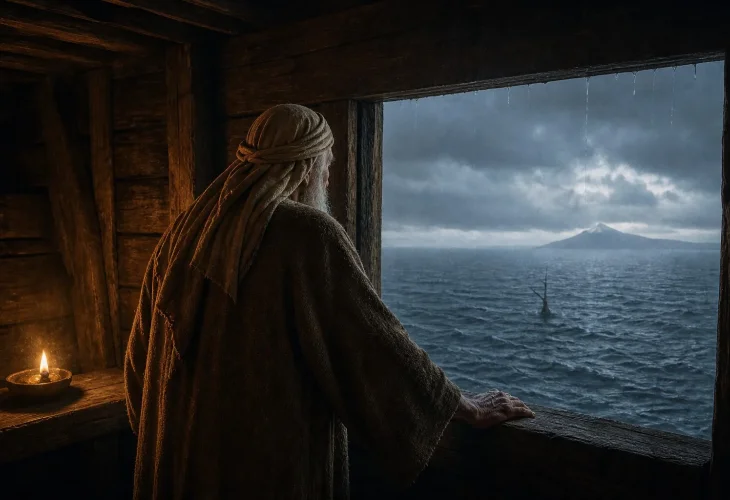
This week’s haftarah is taken from Isaiah 24-25. Rabbi David Abudraham, a fourteenth century Spanish scholar who is well known for his commentary on the prayer book, highlights the ninth verse as the connection to this week’s Torah portion. The story that takes up the bulk of this week’s portion is the Biblical flood narrative, in which Noah and his family were saved in the ark, along with the animals that Noah gathered. In the haftarah, which is a beautifully prophetic vision of Jerusalem at the time of the redemption, Isaiah makes mention of this story: “For this, to Me, is like the waters of Noah. As I swore that the waters of Noah would never again pass over the land, so I swear that I will not become angry with you or rebuke you” (Isaiah 24:9).
On the surface, it’s a very simple connection. The Torah portion is concerned with the flood story, and the haftarah mentions God’s promise afterwards to never bring a flood again. What is particularly intriguing is that the flood is referred to as “the waters of Noah,” making them his, in some way. Granted, he was the primary survivor, and as the builder of the ark and the patriarch of the family that was saved—in his merit, I might add—he is intimately connected with this flood. Yet, by referring to the flood itself as Noah’s, the prophet is implying something much deeper.
To explain this attribution, the Zohar compares Noah’s reaction to being told of the impending flood to Moses’ reaction following the sin of the Golden Calf when God tells him that He will wipe out the Jewish people and rebuild from Moses. In this week’s portion, God comes to Noah, tells him that He will be destroying the world, and instructs him to build an ark to save himself, his family, and the animals. “And Noah did all that God commanded him, so he did” (Genesis 6:22). In contrast, when God tells Moses, “Leave Me, and My anger will burn against [the Israelites] and I will destroy them and make you a great nation” (Exodus 22:9), Moses does not do as God commands him. Instead, he immediately began entreating God, intervening on behalf of a nation who had sinned terribly yet who nevertheless still had someone willing to advocate on their behalf.
This distinction, says the Zohar, is why the flood waters are referred to as Noah’s. Once Noah heard that he and his family would be saved, he was alright with doing what he was told. He did not pray on behalf of the sinners, did not beg God to save the rest of the world. The flood came and the world was destroyed as a result of Noah’s inaction.
That’s not to say that he didn’t warn the people of what was to come. The Midrash says that Noah spent one hundred twenty years building the ark so that when people would ask, “What are you building?” Noah would tell them that God was planning to destroy the world to give them a chance to repent. But that, as we learn through this week’s haftarah, is not enough.
The deeper lesson of Noah’s flood, as Isaiah calls it, is that we cannot rest easy on our rebuking the people around us. We cannot stand idly by and say, “They brought it upon themselves.” We have a bigger role to play, one which was modeled by Moses—and will be first modeled by Abraham in two weeks’ time—to argue with God, to insist on a better world and a better outcome for the people around us.
And if we do that, we can bring about the redemption that is so beautifully described in the rest of the haftarah, to see Jerusalem once again in all her glory, where “the mountains may move and the hills may be shaken” (Isaiah 24:10), but God’s loyalty will never move from us and His covenant, firm as God Himself, will never be shaken.

