

Jewish Law
Two Halachot a Day: Honoring God's Name and Understanding the 613 Mitzvot
Learn the proper way to pronounce God's Name during prayer, the importance of concentration when reciting blessings, and the meaning and significance of the Torah's 613 commandments
- Hidabroot
- | Updated
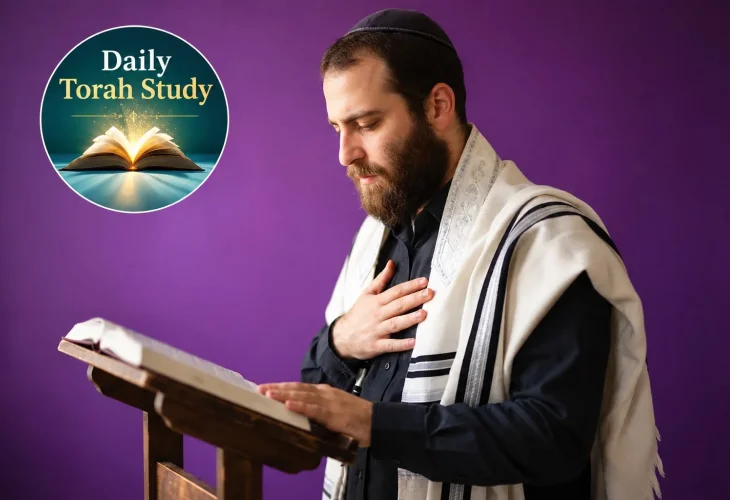
Two daily halachot from BeHalacha U'VeAggadah, based on the rulings of Rabbi Ovadia Yosef, of blessed memory.
How Should We Pronounce God's Name During Prayer?
The Torah states: "If you do not observe... to fear this glorious and awesome Name, the Lord your God" (Deuteronomy 28:58).
Part of demonstrating reverence for God is approaching the mention of His Name with profound awe and respect. A person should be so conscious of the holiness of God's Name that they experience a deep sense of reverence when pronouncing it.
For this reason, one should never mention God's sacred Name unnecessarily, even in other languages. It should be used only in appropriate contexts, such as expressions of praise or blessings that one is obligated to recite.
Maimonides (the Rambam) writes: "Anyone who recites an unnecessary blessing is considered to have uttered God's Name in vain, as though he had taken a false oath, and it is forbidden to answer Amen after his blessing." (Shulchan Aruch, Orach Chaim 215:4; Chayei Adam, Klal 5)
When pronouncing God's Name during a blessing, one should concentrate on its meaning: "Master of all, Who was, is, and will be."
Similarly, when mentioning the Name Elokim, one should contemplate its meaning: "The Almighty, Who possesses all power and authority and is the source of all forces."
By focusing on these meanings, a person transforms the recitation of God's Name from a familiar expression into a conscious acknowledgment of His eternal existence and absolute sovereignty.
Ideally, a person should make every effort to contemplate the appropriate meaning whenever pronouncing God's Name. However, someone who is concerned that they may forget to concentrate properly and inadvertently mention God's Name without the necessary intention may make a declaration in advance. Nevertheless, there are two important exceptions. When pronouncing God's Name during the recitation of Shema Yisrael and during the first blessing of the Amidah, one must actively concentrate on its meaning rather than relying on the declaration made earlier.What Should You Do if You Are Concerned About Forgetting to Concentrate on God's Name?
Daily Jewish Concept: The 613 Mitzvot
The term Taryag Mitzvot refers to the 613 commandments given to the Jewish people in the Torah, according to the tradition of our Sages.
The Hebrew word Taryag (תרי"ג) represents the number 613 through gematria, the numerical values assigned to Hebrew letters. The letter tav (ת) has a value of 400, resh (ר) equals 200, yud (י) equals 10, and gimel (ג) equals 3. Together, these letters add up to 613.
These commandments form the foundation of Torah law and are divided into two categories: 248 positive commandments (mitzvot aseh), which require a person to perform specific actions, and 365 negative commandments (mitzvot lo ta'aseh), which prohibit certain actions.
Throughout the generations, Jewish scholars have devoted considerable effort to identifying, analyzing, and enumerating the precise commandments that make up the traditional total of 613. This task requires careful interpretation because the Torah itself does not present the commandments as a numbered list.
One of the most widely recognized and authoritative enumerations was compiled by Maimonides in his Sefer HaMitzvot (Book of the Commandments). Other prominent works, including Sefer HaChinuch, also provide detailed explanations and classifications of the mitzvot.
Today, following the destruction of the Holy Temple, it is no longer possible to observe all 613 commandments in practice. Many depend on the existence of the Temple, including laws governing sacrifices and certain aspects of ritual purity. Others apply specifically to the Land of Israel, such as agricultural commandments associated with produce grown there.
Nevertheless, the 613 mitzvot remain the foundation of Jewish religious life, reflecting the comprehensive nature of the Torah's guidance. Through these commandments, Judaism provides a framework for serving God in every aspect of life, from prayer and spiritual devotion to ethical conduct, interpersonal relationships, and everyday responsibilities.

