

Books
Before Google and AI: How We Did School Projects in the Good Old Days
Take a nostalgic trip back to childhood, when school projects meant books, paper, and plenty of creativity
- Tehila Cohen
- | Updated
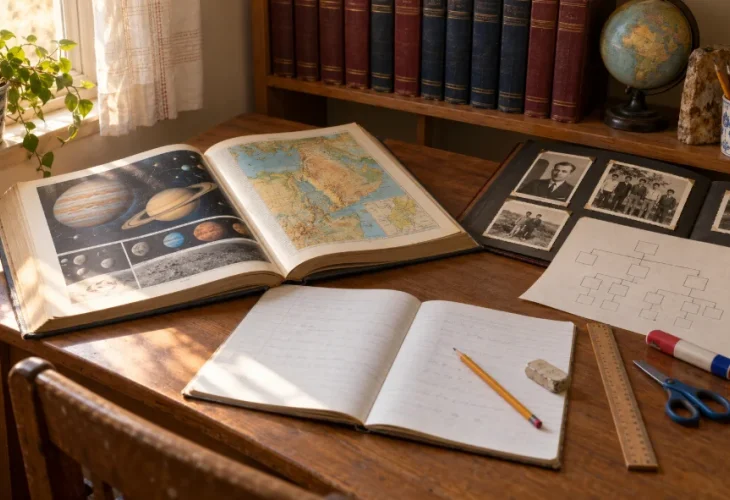
Before we could type a question into a computer and receive an answer within seconds, preparing a school project began in front of a bookshelf. We would pull out a heavy encyclopedia, flip through its pages in alphabetical order, and settle down with a sheet of paper and a pencil.
Encyclopedias were an essential part of our school years and an indispensable resource for homework assignments. The living room shelves were lined with volumes of reference books. Whenever we were given a school project, we would turn to these books, searching through their pages for the information we needed.
Most assignments were submitted in handwriting, carefully written on sheets of paper. A single mistake could mean reaching for the correction fluid or, if we wanted our work to look especially neat, starting the entire page over again. A fortunate few had access to computers or printers and could submit beautifully printed assignments with large, impressive lettering.
A Trip to the Local Library
When the encyclopedias at home didn't provide enough information, we headed to the local public library. We would approach the librarians, explain the subject of our assignment, and return to our tables carrying stacks of books.
Hours could pass as we sat surrounded by open volumes, reading, researching, and carefully copying the information we needed. Sometimes, we became so absorbed in an interesting book or an unexpected discovery that we found ourselves reading about subjects that had absolutely nothing to do with the assignment that had brought us there in the first place.
When the Whole Family Helped With the Family History Project
Family history projects were an entirely different experience. Unlike ordinary school assignments, the stories of our ancestors couldn't be found in an encyclopedia. Instead, we opened old photo albums, searched through family documents, and began asking our parents and grandparents questions: Where were you born? What did your childhood home look like? And who was that little boy in the black-and-white photograph?
On a large sheet of paper, we carefully drew a family tree, trying to leave enough space for every aunt, uncle, and cousin. As the branches multiplied, the names became smaller and smaller, squeezed into whatever space remained.
Faded family photographs found their way into the project, accompanied by fascinating stories passed down through generations, many of which we were hearing for the very first time. We decorated the cover with elaborate handwriting, bold titles, colorful designs, and carefully glued pictures, determined to make our work as beautiful as possible.
When everything was finally complete, we gathered the pages, checked that we hadn't forgotten to write our name on the cover, and carefully placed the project in our schoolbag, making sure the corners wouldn't become bent or creased.
And when the assignment was finally returned, complete with a grade and a teacher's handwritten comment in red ink, we could breathe a sigh of relief.
Some of those school projects have long since disappeared. Others are still tucked away in a closet at our parents' homes, waiting to be rediscovered. With them remain the memories of a simpler childhood, when finding an answer required turning pages, asking questions, and sometimes spending an entire afternoon surrounded by books.

