

Interesting
The Surprising Technology That Can Produce Drinking Water From Air
Can drinking water really be extracted from the air? Discover the fascinating technologies scientists are developing to collect moisture from the atmosphere.
The air around us contains water vapor, even when we can't feel it. In recent years, researchers have been developing technologies that make it possible to collect this moisture and turn it into drinking water. But how does the process work, and could it provide a solution to water shortages?
How Can Water Be Extracted From the Air?
One method of extracting water from the air relies on cooling. A special device draws in air and cools it until the water vapor condenses into droplets. These droplets are collected in a tank, and after appropriate treatment, the water can be used for drinking.
However, producing a meaningful amount of water requires suitable environmental conditions and energy. The challenge is that dry air contains less water vapor to collect. In desert regions, where humidity is low, these devices may produce less water while consuming more electricity relative to the amount collected.
Another approach uses special materials that absorb water vapor from the air. Some contain tiny pores that capture and hold water molecules. Once the material has absorbed enough moisture, it is heated to release the water vapor, which is then cooled and condensed into liquid water.
Can This Technology Work in Dry Regions?
Researchers are testing a variety of materials, including porous substances known as metal-organic frameworks (MOFs). These materials can be designed to capture water molecules, and some types are capable of working even when humidity levels are relatively low.
Certain systems use heat from the sun to release the moisture absorbed by the material. This can reduce dependence on electricity from the power grid, making the technology potentially useful in remote areas.
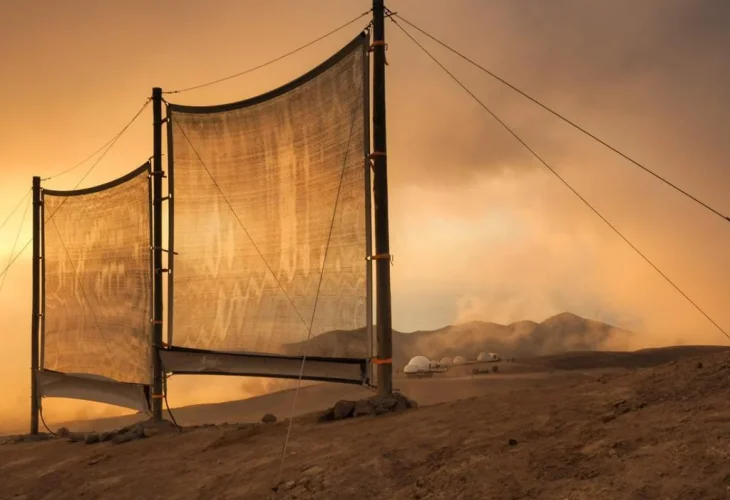
Alongside these advanced devices, there are simpler ways to collect water from the atmosphere. In foggy regions, special nets can capture tiny water droplets, which accumulate and flow into collection tanks.
Another method is dew harvesting, which involves collecting water vapor that condenses on cooled surfaces.
These approaches can require very little energy, but their effectiveness depends heavily on environmental conditions. In particularly dry areas, they may produce too little water to be practical.
Is Water Collected From the Air Safe to Drink?
Extracting water from the atmosphere is only part of the process. Before it can be used for drinking, the collected water must meet appropriate safety and quality standards.
Depending on the system, this may involve filtration, disinfection, and regular water quality testing. The materials used in the equipment and storage tanks must also be carefully evaluated to ensure that unwanted substances do not enter the water.
While extracting drinking water from the air is already technically possible, its practicality depends on factors such as humidity, energy consumption, cost, and the amount of water produced.
As researchers continue to improve these technologies, atmospheric water harvesting could become an increasingly useful source of drinking water, particularly in locations where conventional water supplies are limited.

