

Parshat Lech-Lecha
The War of the Four Kings: What Does Archaeology Reveal?
What does history reveal about the War of the Four Kings in the Torah? Explore ancient kingdoms, archaeological clues, and Abraham's remarkable battle.
- Yosef Yabece
- | Updated
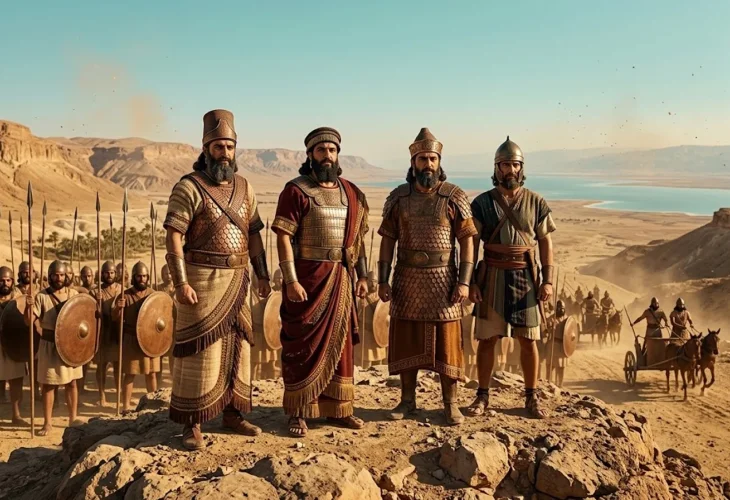
In Parashat Lech Lecha, the Torah describes the War of the Four Kings, an account that highlights Abraham's courage, the siyata diShmaya (Heavenly assistance) he received, and his devotion to his nephew Lot despite their differences. It also demonstrates Abraham's integrity in refusing the spoils of war and acting solely l'shem shamayim, for the sake of Heaven.
Beyond its spiritual lessons, the account is one of the earliest descriptions of warfare preserved in ancient literature. The Torah provides a detailed picture of the land of Canaan and its surroundings during Abraham's time, describing kings, nations, geographical locations, military routes, and political alliances. These details have fascinated biblical scholars, historians, and archaeologists for more than a century.
Four Kings Against Five: The Political Background
The Torah describes how kings from the east launched a military campaign through Transjordan and the southern regions of the land, eventually defeating the kings of the Jordan plain and taking Lot captive. Abraham pursued the invaders, defeated them, and recovered the captives and their possessions.
The eastern alliance was led by Chedorlaomer, king of Elam, together with Amraphel, king of Shinar; Arioch, king of Ellasar; and Tidal, king of Goiim. Opposing them were the kings of Sodom, Gomorrah, Admah, Zeboiim, and Bela, also known as Zoar.
For twelve years, the five kings had been subject to Chedorlaomer. In the thirteenth year, they rebelled, and in the fourteenth year, the eastern kings launched a campaign to suppress the rebellion.
The Torah does not specify exactly what this subjection involved, but in the context of ancient kingdoms, it likely meant paying tribute, providing supplies, or performing services for the ruling power. This interpretation fits what historians know about the Hebrew term avdu, meaning "they served," in descriptions of ancient political relationships.
The account reflects a political landscape in which local rulers formed alliances and sometimes lived under the authority of more powerful kings. In the ancient Near East, the title "king" could refer to the ruler of a single city and its surrounding territory. Therefore, four kings fighting five does not necessarily mean four vast empires were battling five major nations. The number of kings alone tells us little about the size of their armies.
Who Were the Four Kings?
Chedorlaomer's kingdom, Elam, was located in what is now southwestern Iran, east of Mesopotamia. His name resembles the structure of ancient Elamite names. Scholars have connected its first element to "kutir" or "kudur," while the second has been associated with Lagamar, the name of an Elamite deity.
Both elements are known from ancient sources. Although this linguistic connection provides a possible historical background for the name, it does not establish the exact period in which Chedorlaomer ruled.
The identities of the other kings have also been the subject of considerable research.
During the late nineteenth and early twentieth centuries, a popular theory identified Amraphel, king of Shinar, with Hammurabi, the famous king of Babylon. This identification appeared in numerous publications and was sometimes presented as established fact. However, linguistic and historical difficulties led many scholars to reject the connection.
Our sages offer a different identification. The Talmud (Eruvin 53a) identifies Amraphel with Nimrod.
Researchers have also proposed connections between Arioch and names found in ancient Mesopotamian sources, while some have identified Ellasar with Larsa, a city in southern Iraq. Tidal has been compared to Tudhaliya, a name associated with several Hittite kings.
These comparisons suggest that the names in the Torah fit within the broader linguistic and cultural world of the ancient Near East, although the proposed identifications remain uncertain.
The Military Route and the Dead Sea's Tar Pits
One of the most striking features of the Torah's account is its detailed description of the military campaign.
The eastern kings first attacked the Rephaim at Ashterot Karnayim, the Zuzim at Ham, and the Emim at Shaveh Kiryatayim. They then continued toward Mount Seir and El Paran before turning back to Ein Mishpat, identified as Kadesh, and attacking the Amorites at Hazazon Tamar.
Only after these battles does the Torah describe the confrontation with the five kings in the Valley of Siddim, near the Dead Sea.
The geographical sequence suggests an extensive campaign through Transjordan and the southern regions before the decisive battle. Some scholars believe the invading kings sought to subdue additional populations and secure important routes along the way.
Another particularly interesting detail is the Torah's description of the Valley of Siddim as being filled with pits of chemar, or natural bitumen, a form of tar.
Bitumen deposits and lumps are known from the Dead Sea region. Chemical analysis of archaeological finds has also shown that bitumen originating in this area was transported to locations in Canaan and Egypt as early as the fourth and third millennia BCE, according to conventional archaeological dating.
These discoveries indicate that Dead Sea bitumen was a valuable and widely used resource in the ancient world.
While such findings do not independently establish every detail of the biblical battle, they help illuminate the geographical, political, and economic setting described in the Torah.
The War of the Four Kings is therefore more than an account of ancient conflict. Alongside its lessons about Abraham's courage, loyalty, and faith in Hashem, it offers a fascinating glimpse into the world of ancient kingdoms, military alliances, and the landscape of the Land of Israel thousands of years ago.

