

History and Archaeology
Why Did Jews Pray for the Kings Who Persecuted Them?
A familiar Jewish prayer for foreign rulers may have carried more than one meaning. Discover its origins and the biblical verses that reveal a deeper story.
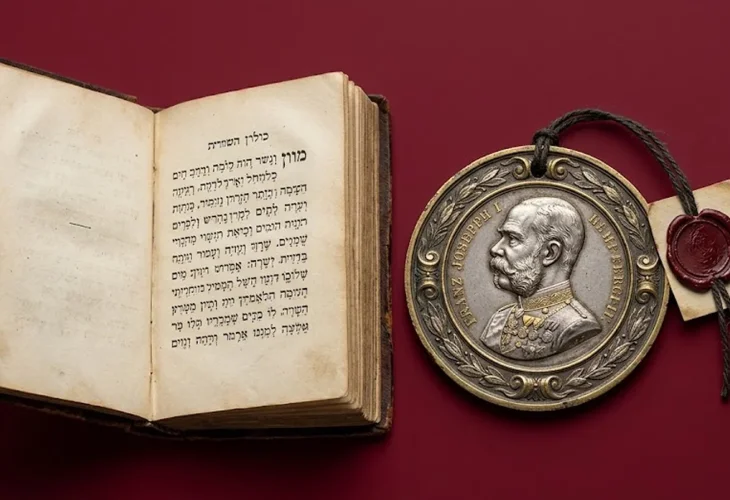
Anyone who owns an Otzar HaTefilot siddur (prayer book) may have noticed an unusual prayer tucked among its pages: the “Prayer for the Welfare of His Majesty.” The prayer even mentions the emperor by name: “Franz Joseph, may his glory be exalted, and his wife, Lady Elisabeth.”
The explanation is that this edition of the siddur is a photographic reproduction of an older prayer book printed in the Austro-Hungarian Empire during the 19th century.
But what was an emperor doing in the middle of a Jewish prayer service? And why did Jewish communities pray for the welfare of foreign rulers, including those who sometimes persecuted them?
Why Did Jews Pray for Foreign Governments?
The tradition of praying for the welfare of a non-Jewish government has ancient roots.
The Mishnah in Pirkei Avot records the well-known teaching of Rabbi Chanina, deputy High Priest: “Pray for the welfare of the government, for were it not for fear of it, people would swallow one another alive.”
The reasoning is straightforward: a functioning government maintains public order and provides stability, something especially important for Jewish communities living as minorities under foreign rule.
This principle also appears in the words of the prophet Jeremiah, who instructed the Jewish exiles in Babylon: “Seek the welfare of the city to which I have exiled you, and pray for it to Hashem, for in its welfare you shall have welfare.”
Yet the practice was not limited to Jews living in exile. Rashi points to sources showing that prayers and sacrifices were offered on behalf of foreign rulers even when the Jewish people lived in the Land of Israel.
The Book of Ezra describes sacrifices offered in the Second Temple alongside prayers for the life of King Darius and his sons. Our Sages also teach that the seventy bulls offered during Sukkot corresponded to the seventy nations of the world, with the sacrifices intended to bring them protection and blessing.
In other words, praying for the welfare of other nations and their rulers was already part of Jewish tradition long before the familiar synagogue prayers took shape.
When Alexander the Great Bowed Before the High Priest
A remarkable story involving Shimon HaTzaddik and Alexander the Great further illustrates the connection between Jewish prayer and foreign rulers.
According to the account, when Alexander encountered Shimon HaTzaddik, the High Priest, he descended from his chariot and bowed before him.
His companions were astonished. Why would a powerful king bow before a Jewish priest?
Alexander explained that before his victories in battle, he would see the image of this very man in a dream.
Shimon HaTzaddik seized the opportunity to defend the Temple. He told Alexander that the very place where Jews prayed for the success of his kingdom had been misrepresented to him by enemies of the Jewish people.
Alexander accepted his explanation and handed the Samaritans, also known as the Kutim, over to the Jews for judgment. According to the account, Mount Gerizim, which the Samaritans regarded as sacred, was subsequently plowed and sown with vetch.
The story presents the Temple not only as the spiritual center of the Jewish people, but also as a place where prayers were offered for the welfare of the ruling kingdom.
The Ancient Origins of a Familiar Synagogue Prayer
The version of the prayer familiar to many Jewish communities today begins with the words, “He who gives salvation to kings and dominion to princes…”
Known as Hanoten Teshuah LaMelachim, the prayer took shape toward the end of the Middle Ages.
The earliest known written version appears in a machzor (festival prayer book) from Aragon, Spain, dating to the late 15th century.
The ruler mentioned in that prayer was none other than King Ferdinand II of Aragon.
The historical irony is striking. Jewish communities stood in their synagogues praying that Hashem would protect, strengthen, and exalt King Ferdinand. Yet in 1492, Ferdinand and his wife, Queen Isabella, signed the decree ordering the expulsion of the Jews from Spain.
The decree brought an end to a remarkable chapter of Spanish Jewish history and forced vast numbers of Jews into exile.
How could Jews sincerely pray for the welfare of a ruler who would ultimately turn against them?
Did the Prayer Contain a Hidden Message?
The complicated relationship between Jewish communities and the governments that ruled over them has led some scholars and commentators to suggest that Hanoten Teshuah LaMelachim may have contained a second, more subtle meaning.
According to this interpretation, the prayer was deliberately composed using biblical verses that could be understood on two levels.
On the surface, the congregation publicly asked Hashem to bless and protect the king. But the original biblical contexts of those same verses could also suggest a very different hope: deliverance from foreign oppression and the eventual redemption of the Jewish people.
Two passages are particularly revealing.
1. “He who gives salvation to kings, who rescues David His servant from the evil sword…”
These words come from Psalms 144:10.
But the very next verse reads: “Rescue me and save me from the hand of foreigners, whose mouth speaks falsehood and whose right hand is a right hand of deceit.”
Read in context, the passage is not simply a blessing for kings. It is also a plea for protection against deceitful foreign powers.
According to the double-meaning interpretation, a Jew reciting the prayer for a foreign monarch could simultaneously be asking Hashem for deliverance from that ruler's oppression.
2. “He who makes a way in the sea and a path through mighty waters…”
This phrase comes from Isaiah 43:16, where the prophet describes Hashem's power.
The following verse speaks of the defeat of a mighty army: “Who brings out chariot and horse, army and might; together they lie down, never to rise; they are snuffed out, quenched like a wick.”
For Jews living under foreign domination, these words could carry a powerful message of hope. Even the greatest empires were not beyond Hashem's power, and oppression would not necessarily last forever.
This interpretation does not mean that every Jewish community secretly wished for the downfall of its ruler. In many cases, Jews genuinely hoped for the success of a fair and benevolent government, recognizing that its stability was essential to their own safety.
But in periods of persecution, the same prayer may have offered a more private form of comfort, expressing the hope that Hashem would ultimately bring an end to suffering and exile.
A Prayer That Traveled Across Generations
Over the centuries, Hanoten Teshuah LaMelachim took on different meanings depending on the circumstances of the communities reciting it.
For some, it was a sincere expression of gratitude and loyalty toward a ruler who protected Jewish life. For others, it may also have carried an unspoken prayer for deliverance from oppression.
The National Library of Israel preserves manuscripts of the prayer from different historical periods, along with recordings of its traditional melodies.
Among them is a performance by Aharon Tsarfati, a cantor born in Salonika, whose rendition reflects the Sephardic musical traditions of the Near East and the Balkans.
These surviving texts and recordings offer a fascinating glimpse into the lives of Jewish communities throughout history. Behind what appears to be a simple blessing for a king lies a much deeper story of faith, survival, political uncertainty, and the enduring hope for redemption.

