

Interesting
Could Pink Solar Panels Be the Future of Agriculture?
A new study explores how pink solar panels could help farmers produce food and renewable energy together, potentially making better use of agricultural land.
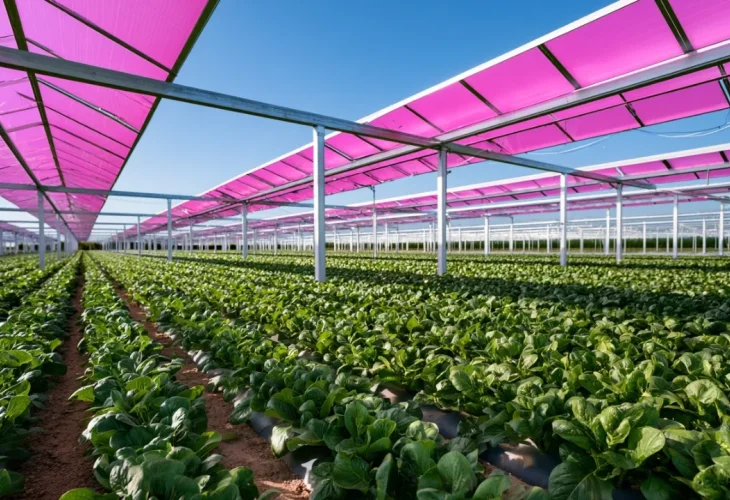
When you picture a farm, you probably imagine wide, open fields stretching toward the horizon, with crops soaking up as much sunlight as possible. And when you picture a solar farm, you might imagine something similar: a large area of land covered in panels designed to capture the sun's energy.
But that raises an interesting question: should we use our land to grow food or generate electricity?
Researchers in Sweden believe we may not have to choose.
In a new study published in Cell Reports Physical Science, scientists experimented with growing broccoli beneath semi-transparent, magenta-colored solar panels. Their goal was to find out whether the same sunlight could be used to generate electricity while still providing crops with enough energy to grow.
The results were surprisingly encouraging. Broccoli grown beneath the pinkish-purple panels reached approximately the same size as broccoli grown in full sunlight. Although it took about 25 additional days to mature, the plants became significantly more efficient at using the light available to them.
Why Did the Scientists Choose Pink Solar Panels?
The unusual color isn't simply for appearance. It relates to the way plants absorb and use sunlight.
Sunlight contains different wavelengths, which we perceive as different colors. Chlorophyll, the pigment responsible for much of the photosynthesis process, absorbs light particularly well in the red and blue portions of the spectrum. Green light is generally absorbed less efficiently, although it still plays a role in photosynthesis.
The researchers wanted to explore whether sunlight could effectively be divided between two purposes: allowing plants to receive the wavelengths they need for growth while capturing some of the remaining solar energy to produce electricity.
To achieve this, they used specially designed, semi-transparent solar panels containing strips of photovoltaic cells made from cadmium telluride (CdTe).
Unlike conventional solar panels, which block most of the sunlight passing through them, these panels have gaps between the photovoltaic strips, allowing some light to reach the crops below.
The challenge is finding the right balance. Adding more photovoltaic material increases the potential electricity output, but it also reduces the amount of sunlight available to the plants.
The Broccoli Grew With Less Sunlight Than Expected
The broccoli beneath the panels received less solar radiation than the plants grown in the open field. Yet despite the reduced light, the crops adapted and used the available sunlight more efficiently.
The researchers tested two different levels of panel transparency, allowing different amounts of light to pass through.
Interestingly, the final broccoli yields were similar under both types of panels.
According to lead researcher Silvia Ma Lu of Mälardalen University in Sweden, one of the most striking findings was how similarly the broccoli performed despite the difference in light availability.
The results suggest that some crops may receive considerably more sunlight than they actually need to achieve a comparable final yield.
However, there was a trade-off: the broccoli grown beneath the panels took approximately 25 days longer to reach maturity.
This means that while the approach could make more efficient use of land and sunlight, researchers still need to consider how slower growth might affect farming schedules and commercial production.
Growing Food and Producing Electricity on the Same Land
The real advantage of this technology is that the panels do more than provide shade. They also generate electricity.
During the growing season, the researchers estimated that the semi-transparent solar panel system could produce hundreds of kilowatt-hours of electricity across the experimental plot. Calculations for larger installations suggested that the technology could potentially generate substantial amounts of energy while allowing crops to grow on the same land.
In the future, electricity generated above agricultural fields could help power irrigation pumps, cooling systems, farm equipment, greenhouses, and storage facilities. Farmers might also be able to sell surplus electricity to the grid.
This approach is known as agrivoltaics, which combines agricultural production with solar electricity generation.
According to the U.S. Department of Energy, agrivoltaic systems allow the same land to serve both purposes. Crops may grow beneath solar panels or between their rows, while some installations also incorporate livestock grazing.
Instead of choosing between a solar farm and an agricultural field, farmers could potentially benefit from both.
Could This Technology Work in Israel?
In countries where agricultural land is limited, including Israel, the idea is particularly appealing.
Imagine growing broccoli, tomatoes, lettuce, or other crops while simultaneously generating renewable electricity above them.
The concept also challenges a common assumption: that plants always grow best when exposed to as much sunlight as possible.
In reality, the ideal amount of sunlight depends on the crop, the climate, and the growing conditions.
In particularly hot environments, excessive sunlight can contribute to heat stress and increase water loss. Under certain conditions, partial shade from solar panels may help lower temperatures around crops, reduce evaporation, and improve water-use efficiency.
However, the benefits are not universal. Too much shade can also interfere with photosynthesis and reduce crop yields.
For example, an Israeli study published in 2025 examined tomato cultivation between solar panel arrays and found that the amount of shading directly affected photosynthesis and productivity.
These findings highlight the importance of designing agrivoltaic systems around the specific needs of each crop rather than assuming that one arrangement will work for every farm.
Are Pink Solar Farms the Future of Agriculture?
For now, the Swedish technology remains at the prototype stage. Researchers will need to test it across multiple growing seasons, with different crops and under a wider range of climate conditions.
They will also need to determine whether the benefits of generating electricity alongside food production outweigh potential disadvantages, such as longer growing periods and the costs of installing specialized panels.
Still, the experiment offers an intriguing glimpse into what agriculture could look like in the future.
If the technology proves practical on a commercial scale, farmers may eventually be able to produce both food and renewable energy from the same fields.
And who knows? The farms of tomorrow might not be entirely green. Some of them could be pink.

