

Wonders of Creation
Meet the Tiny Sea Creature With Iron Teeth That Sharpen Themselves
This tiny sea creature has teeth containing iron oxide that can sharpen themselves through wear. Learn the fascinating science behind this natural wonder.
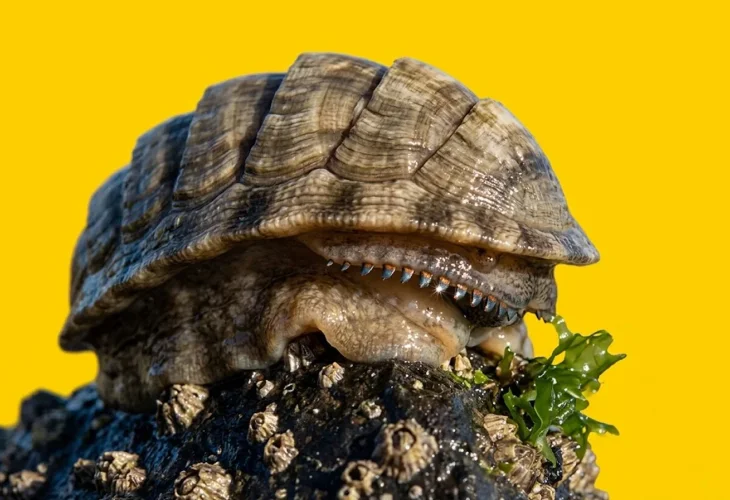
ves across the rock, allowing the teeth to scrape away algae and other food.
New teeth continually form at the back of the radula and gradually move forward toward the area used for feeding.
Along the way, they undergo several stages of development, including a process called mineralization, during which minerals are incorporated into the teeth to make them harder and stronger.
By the time they reach the working end of the radula, the teeth are ready to withstand repeated contact with rock.
As older teeth wear out, newer ones take their place. It's a continuous system of tooth production, strengthening, use, and replacement.
What Makes These Tiny Teeth So Strong?
Having a hard mineral in a tooth is only part of the explanation. After all, some extremely hard materials are also brittle and can crack under pressure.
A chiton's teeth must withstand repeated scraping, collisions with uneven rock surfaces, and forces that constantly change direction.
To survive these conditions, they need more than hardness. They also require resistance to wear and a structure capable of handling stress without breaking apart.
Researchers have discovered that chiton teeth are built from several layers of carefully arranged materials.
The hard outer region contains elongated, rod-like structures made of magnetite, aligned in an organized pattern and surrounded by organic material. These structures are incredibly small, measuring just hundreds of nanometers across. A nanometer is one-millionth of a millimeter.
Beneath the hard exterior lies a softer core containing iron phosphate and organic material.
This combination helps the tooth handle the forces generated during feeding. The hard outer surface makes contact with the rock, while the internal structure helps distribute stress.
Even the direction and arrangement of the microscopic mineral structures affect how damage develops.
A 2014 study examined how this organized structure influences stress and damage within chiton teeth, demonstrating that their durability depends not only on the materials themselves but also on how those materials are arranged.
Scientists Discover Another Remarkable Mineral
In 2021, researchers uncovered another fascinating detail about the structure of chiton teeth.
A team led by Derk Joester of Northwestern University identified a mineral called santabarbaraite in the teeth of a chiton species they studied.
This iron phosphate mineral had previously been known from geological discoveries, but the researchers found tiny particles of it within the tooth structure.
The mineral was located in the region supporting the tooth's hard head and connecting it to the flexible radula.
Its presence helps create a gradual transition between areas with different levels of hardness and stiffness.
This is particularly important because a structure made entirely of rigid material may be more vulnerable to cracking where forces are concentrated. Combining materials with different mechanical properties can help the tooth withstand the stresses of repeated use.
The discovery offered scientists another clue to how these tiny feeding tools achieve such impressive durability.
Teeth That Actually Sharpen Themselves
Perhaps the most surprising feature of certain chiton teeth is what happens as they wear down.
Normally, repeated scraping causes a cutting or grinding surface to become dull. But researchers studying chiton teeth have observed a different process.
Because different regions of the tooth wear away at different rates, the shape of the working surface can change in a way that helps maintain its effectiveness.
Rather than simply becoming blunt, the tooth can develop a sharper profile as it wears.
Scientists call this property self-sharpening.
The tooth still gradually wears down and must eventually be replaced, but its structure allows it to remain effective during repeated use.
Could Chiton Teeth Inspire Stronger Tools?
These remarkable teeth have attracted attention beyond marine biology.
Materials scientists and engineers are interested in understanding how chitons combine extremely hard minerals with softer, more flexible materials to create structures that resist wear and damage.
The microscopic arrangement of those materials is especially intriguing because it demonstrates how the performance of an object can depend on its internal structure, not simply on what it's made from.
Researchers hope that studying these natural designs could eventually inspire more durable coatings, cutting tools, and other engineered materials.
For now, the chiton remains a remarkable example of the complexity hidden in even the smallest creatures.
Clinging quietly to a rock along the seashore, this unassuming mollusk continuously produces, strengthens, uses, and replaces teeth reinforced with iron-rich minerals.
Its sophisticated feeding system offers scientists valuable insights into materials engineering while also revealing another extraordinary example of the wisdom of Creation.
Sometimes, the most remarkable wonders of the natural world are found in the creatures we barely notice.

