

Jewish Music
From Israeli Rock Star to Spiritual Awakening: Ohad Koski’s Journey of Faith
Once a rising star in Israel’s rock scene, musician Ohad Koski shares how success, Jewish roots, the teachings of Rabbi Nachman, and the power of Psalms transformed his outlook on life, music, and what truly matters
- Avner Shaki
- | Updated
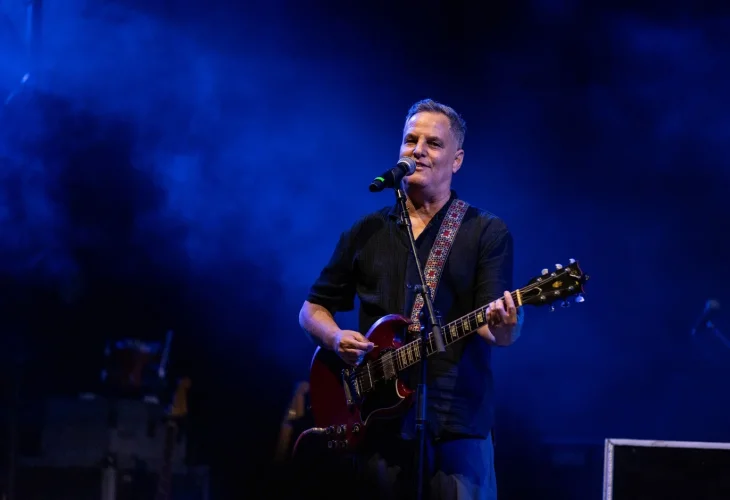 Ohad Koski (Photo: Chen Douek)
There is something refreshing about a conversation with Ohad Koski. In a world where artists and musicians are often preoccupied with cultivating their egos or chasing the spotlight, Koski, 50, a married father of three from Kfar Saba, radiates an entirely different attitude. A gifted guitarist, musician, and songwriter, he played an integral role in shaping the sound of Israeli rock in the 1990s. Yet behind his impressive musical career is a man constantly searching for something beyond himself: inner truth, spiritual meaning, and a deeper connection to Judaism and his roots.
Koski was born into a family whose history reflects much of the Jewish experience. "My mother is a Jerusalemite from a deeply rooted Sephardic family," he explains. "My great-grandfather, Rabbi Yosef, was the head of Jerusalem's Sephardic Haredi community in the late 19th century. On my father's side, the story is completely different. My father was born at a railway station on the border between Russia and Poland, immediately after World War II. Most of my grandparents' siblings were murdered in the Holocaust. I remember sitting with family photo albums as a child and hearing, 'This one was murdered, and that one was murdered.' It was a sadness that was always present in our home."
Despite his distinguished religious ancestry on his mother's side, Koski grew up in a secular household. "My parents worked in computers, and ours was a home centered around work. It was understood that we didn't eat non-kosher food at home, and we visited our grandparents for the holidays. My grandfather wore a kippah, but beyond those basic traditions, we were far removed from Torah observance."
Music became a central part of his life when he was just five years old and began playing the violin. In seventh grade, he traded the violin for a guitar and formed a local band in Kfar Saba with friends, including, for a brief period, musician Idan Raichel. What began as a teenage hobby became something much more serious in tenth grade, when he formed the rock band Kerach Tesha (Ice Nine).
From Rock Stardom to a Spiritual Search
At just 19, Koski and his bandmates found themselves signed to a major record label, performing across Israel, receiving radio airplay, and attracting extensive media coverage.
"It was crazy," he recalls. "You're a 19-year-old kid, and suddenly you have a recording contract, your songs are being recorded in the country's best studios, and there's an entire industry surrounding you. Looking back, I understand how rare that is and how difficult it is to achieve. But at the time, I was convinced that this was simply how things were supposed to happen."
After three years of remarkable success, the band broke up. Still in his early twenties, Koski suddenly found himself outside the spotlight.
"All of a sudden, I no longer had the backing of a record label. I was independent again. I continued playing music and worked extensively with Assaf Amdursky, but to make a living, I also worked as an assistant in kindergartens."
Yet the transition did not crush him. On the contrary, it opened the door to a new and deeper world. During those years, Koski began experiencing a growing spiritual thirst. His first meaningful encounter with religious life came through his then-girlfriend, Natalie, who would later become his wife.
"Natalie came from a traditional Jewish home," he explains. "Once our relationship became serious, we would spend Friday nights at her parents' house, making Kiddush and enjoying Shabbat meals with the delicious food prepared by my late mother-in-law. To this day, we still spend Friday nights at their home."
At the same time, several of his friends were becoming more religious. One joined Chabad, while others became involved with Breslov.
"We had endless conversations. I started reading and exploring Jewish spirituality from a wide range of traditions and perspectives. Suddenly, I understood that being Jewish was an inseparable part of who I am. Even if I had become distant from Judaism, that didn't erase the connection. I came to understand that there is Divine providence, that there is something profoundly real in all of this."
One particular encounter during this period left a lasting impression on him and fundamentally changed the way he viewed his artistic achievements.
"I went to visit a friend at a yeshiva, and someone there recognized me from the band. We were around 20 years old and felt like we were on top of the world. Then this person said something to me that I have never forgotten: 'You should know that you don't write a single musical note without the help of the Master of the Universe.'
"That stopped me in my tracks. Great success can create arrogance, the feeling that everything comes from your own strength and abilities. That sentence planted the understanding in me that none of it really belongs to me."
Finding Light Through Psalms and Rabbi Nachman's Teachings
That realization eventually led Koski to develop a deep connection with the Book of Psalms, which has become a constant companion, even in his recording studios.
"Tehillim is my foundation. It's a book I feel deeply connected to. Sometimes I take it upon myself to recite certain chapters, and other times I read the Tikkun HaKlali. Recently, I also composed music for Psalm 100, Mizmor LeTodah ('A Psalm of Thanksgiving'). For me, it's a completely natural connection between my faith and my art.
"The melody came to me three years ago, and it has accompanied me ever since, whether I'm reciting the psalm, walking down the street, or driving. Recently, I had the privilege of producing it together with musician and producer Ido Maimon Ben Yehoshua. I sincerely hope it will find its way into other people's hearts as well."
What draws an Israeli rock musician to a book written some 3,000 years ago?
"I simply find everything there," Koski responds enthusiastically. "I find God, but I also find myself—my smallness, my loneliness, and my ability to rise above troubling thoughts and reach a higher place. When you read Tehillim and then study the weekly Torah portion, things suddenly begin to open up before you."
Another profound influence on his life has been the teachings of Rabbi Nachman of Breslov. "It's incredible what this man brought into the world," Koski says. "His ability to embrace every person, his understanding that our flaws aren't necessarily flaws at all, and that we can actually draw strength from our shortcomings and struggles and learn how to navigate life through them.
"The principle that 'the main thing is not to be afraid at all,' the insistence on finding joy—these are extraordinary insights that I apply in my everyday life, not just in music. His teachings provide an inner strength that is impossible to describe in words."
Giving a Voice to a Child Lost in the Holocaust
One of the most moving projects Koski has participated in recent years once again connects his musical talents with Jewish history. The project, titled Abramek, is based on the poems of Abraham (Abramek) Koplowicz, a Polish Jewish boy who was murdered at Auschwitz at the age of 14.
"A friend of mine from the band, Uri Meiselman, who also guides educational trips to Poland, came across a notebook containing this boy's poems," Koski explains. "Abramek's father survived the Holocaust and returned home after the war, where he discovered the notebook hidden beneath a bed.
"When Uri brought me the texts, which had been translated into Hebrew, I read the first poem and got chills. Here was a child with extraordinary potential and talent whose life had been cut short.
"I composed music for his poems, and throughout the entire project, we felt Divine providence guiding us. The project brought us to Poland to perform and eventually reached audiences around the world. It was an act of true kindness for the soul of a child."
For Koski, the project was far more than another musical undertaking. It was an opportunity to preserve the voice of a young boy whose life and dreams had been destroyed, giving his words new life through music.
Finding Our Unique Light and Sharing It With the World
Now celebrating his 50th year, Koski is releasing his fourth solo album, intriguingly titled Quantum Leaps.
Music remains an inseparable part of his life, but his priorities have changed dramatically over the years. A devoted family man, he describes his wife and daughters as the central anchors of his existence. His ambition today is not simply to create successful music, but to bring something meaningful and uplifting into the world.
When asked what message he would most like to share during these challenging times of division within Israeli society, Koski returns to what he considers the foundation of Jewish identity.
"I come from an extended family that includes everyone—Haredi Jews, religious Jews, secular Jews, people on the political right and left. It was always clear to us that Judaism is the reason we're here and the bond that connects us. That's why, among other things, I believe the most important thing is unity among the Jewish people. There are incredible people in Israel doing extraordinary acts of kindness, from soup kitchens to charitable organizations.
"We need to embrace derech eretz, treat others with kindness and respect, and judge every person favorably. We must never assume we know the person standing in front of us before we've walked in their shoes.
"We need to approach this experience called life with tremendous humility. I hope we can stop constantly comparing ourselves to one another and that each person will simply discover the unique light Hashem has given them—and use it to illuminate the world."

