

Parshat Vayera
Why Didn’t Abraham’s Prayers Save Sodom? A Powerful Lesson in Divine Justice
Discover the Abarbanel’s profound explanation of why the Torah records this seemingly unanswered prayer—and what it reveals about Divine justice, mercy, and the power of prayer
- Yosef Yaavetz
- | Updated
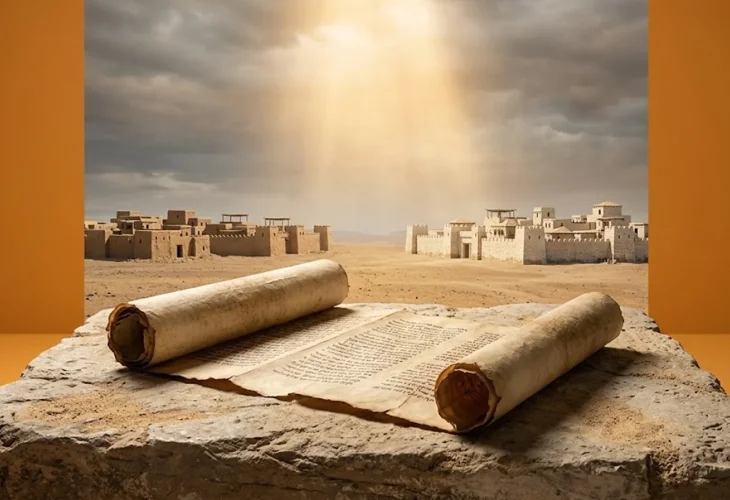
Abraham stands before Hashem, pleading for the people of Sodom. He begins by asking whether the city might be spared if fifty righteous people are found within it. He then lowers the number to forty-five, continuing until he reaches ten. Each request receives the same assurance: If the necessary number of righteous individuals can be found, their merit will protect the city.
Yet the following morning, Sodom lies in ruins. Abraham looks out over the plain and sees smoke rising from the earth.
The Abarbanel raises a compelling question: Why does the Torah devote so much attention to Abraham's lengthy negotiations with Hashem? If the purpose of his prayers was to save Sodom, and the city was ultimately destroyed, what do we gain from knowing every detail of the conversation?
An additional difficulty makes the question even more striking. Later in the Torah portion, Lot asks to take refuge in the small city of Zoar, and his request is granted. An entire city is spared following a brief appeal from Lot. Why, then, did Abraham's extensive prayers fail to save Sodom, while Lot, whose spiritual stature was far inferior to Abraham's, succeeded so readily?
To understand the significance of these events, the Abarbanel examines the entire sequence of the narrative, beginning with Hashem's decision to reveal Sodom's impending destruction to Abraham.
Why Did Hashem Reveal His Plans to Abraham?
After welcoming his visitors, Abraham accompanies them as they prepare to depart. It is at this moment that the Torah states: “And the Lord said, ‘Shall I conceal from Abraham what I am about to do?’” (Genesis 18:17).
The Abarbanel draws attention to the timing of this revelation. Abraham receives the prophecy while he is still accompanying his guests, before returning to his tent and before Sodom's destruction. This timing, he explains, was deliberate. By informing Abraham at that moment, Hashem ensured that he would have sufficient time to pray on behalf of the city's inhabitants that very day.
Why was Abraham entitled to know what was about to happen? The Abarbanel offers three explanations.
First, the revelation reflects Abraham's extraordinary closeness to Hashem. Just as a trusted friend shares his intentions with someone dear to him, it was fitting that Hashem should disclose His plans to Abraham. The Abarbanel makes an important distinction between sharing one's own affairs and revealing secrets entrusted by others. The verse specifically states, “what I am about to do,” emphasizing that Hashem was revealing His own intentions.
The second reason concerns Abraham's descendants. Hashem had promised that Abraham would become the father of a great and powerful nation. Witnessing the destruction of an entire region might cause him to fear that a similar fate could one day befall his own people. By revealing the reasons for Sodom's punishment, Hashem would teach Abraham that the destruction was not arbitrary and that the presence of sufficient righteous individuals could have spared the city.
The third explanation relates to Abraham's responsibility as the father and spiritual guide of future generations. The Torah states: “For I have known him, so that he will command his children and his household after him to keep the way of the Lord, to practice righteousness and justice” (Genesis 18:19).
Abraham was entrusted with establishing a household founded on righteousness and justice. Understanding Sodom's fate would equip him to teach his descendants about the consequences of wickedness and the moral principles by which Hashem governs the world.
In this context, the Abarbanel draws a distinction between Abraham and Noah. Noah lived among the generation condemned to perish in the Flood, so the warning he received was necessary for his own survival. Abraham, however, was not a resident of Sodom. His special relationship with Hashem, the future of his descendants, and his responsibility to educate them explain why the impending destruction was revealed to him.
Was Abraham Praying for the Righteous or for the Entire City?
Upon learning of Sodom's fate, Abraham begins his appeal with a question: “Will You indeed sweep away the righteous with the wicked?” (Genesis 18:23). He then asks whether the presence of fifty righteous people might be sufficient to save the city.
The Abarbanel identifies two distinct arguments in Abraham's plea. The first concerns the fate of the righteous themselves. Abraham questions whether it would be just for innocent people to perish alongside the wicked. The second argument goes further. Rather than asking merely that the righteous be rescued, Abraham seeks to spare the entire city for their sake.
To explain this broader request, the Abarbanel considers the practical realities of human life. A righteous person living in a corrupt community is nevertheless connected to its inhabitants. He may have relatives, neighbors, possessions, and sources of livelihood there. Even if he survives the city's destruction, he could lose everything that sustains his life.
As the Abarbanel writes: “For when a righteous person lives in a wicked city, he depends upon its inhabitants for his needs and sustains his life among them.”
In other words, preserving a person's life while destroying the world around him may not constitute complete protection. Abraham therefore asks that the merit of the righteous extend to the community itself, safeguarding not only their physical existence but also the environment upon which they depend.
His plea to save Sodom thus reflects a deeper concern for the well-being of the righteous individuals living within it.
The Deeper Meaning Behind Abraham's Negotiations
The Abarbanel also examines the changing scope of Abraham's requests. Initially, Abraham focuses on Sodom itself, where Lot and his family reside. His choice of words emphasizes the righteous people found “within the city” and the possibility of sparing “the place” for their sake.
Hashem's response, however, introduces a broader possibility: “I will spare the entire place for their sake” (Genesis 18:26).
According to the Abarbanel, this response indicates that the merit of the righteous might protect not only Sodom but also the surrounding cities of the plain. Abraham's appeal consequently expands beyond the city in which Lot lives. Later, when he lowers the number to twenty and then ten, his request once again becomes focused on Sodom alone.
Equally significant is the manner in which Abraham presents his arguments. At first, he appeals to the principles of justice, asking: “Shall the Judge of all the earth not do justice?” (Genesis 18:25). As the conversation progresses, his tone becomes increasingly humble. He asks permission to continue speaking, acknowledges his own insignificance, and repeatedly pleads that Hashem not become angry with him.
The Abarbanel explains that Abraham begins by seeking to understand the demands of Divine justice, then gradually shifts toward an appeal for kindness and mercy.
He offers a particularly striking interpretation of Abraham's declaration: “I am but dust and ashes” (Genesis 18:27). According to the Abarbanel, Abraham is suggesting that he himself be included among the righteous individuals whose merit might protect the city, while simultaneously expressing his profound humility.
The changing numbers help explain Abraham's increasingly cautious language. Reducing the required number from fifty to forty-five represents a relatively modest concession. Moving from forty to thirty is a more substantial request, while the final reduction from twenty to ten cuts the number in half. The greater the concession Abraham seeks, the more carefully he introduces his appeal. His humility deepens as his requests become increasingly ambitious.
Finally, Abraham asks whether the city might be spared for the sake of ten righteous people. Hashem responds: “I will not destroy it for the sake of the ten” (Genesis 18:32). At that point, the conversation ends. The Abarbanel emphasizes that the prophetic revelation concludes, leaving Abraham no further opportunity to reduce the number.
Why the Torah Records a Prayer That Did Not Save Sodom
We can now return to the Abarbanel's original question: What purpose is served by recording every stage of Abraham's prayer when Sodom was ultimately destroyed? The Abarbanel explains that the conversation was not merely an attempt to change the city's fate. Its deeper purpose was to reveal the justice underlying Hashem's judgment.
Through the successive exchanges, the Torah demonstrates the extent to which Sodom could have been spared. The presence of sufficient righteous individuals would have protected the city. Its destruction was not the result of an unwillingness to show mercy, but of the absence of the merit necessary to avert judgment.
Abraham himself does not know at the beginning of the conversation what will become clear by its conclusion. He hears of the impending catastrophe, searches for grounds to defend the city, and continues pleading as each possibility is considered. The Torah allows us to accompany him through this process, witnessing the distinction between rescuing righteous individuals and preserving an entire community, the gradual reduction in the required number, and Hashem's repeated willingness to spare the city if those conditions were met.
Seen in this light, Abraham's prayer was far from meaningless, even though it did not achieve the outcome he sought. It became a revelation of the principles of Divine justice and mercy, precisely the principles Abraham was entrusted with teaching his descendants.
The following morning, when Abraham gazes toward Sodom and sees smoke rising from the plain, the destruction comes at the conclusion of a narrative in which time was granted for prayer, every appeal was heard, and every possibility of finding sufficient merit was considered, down to the final number of ten.
Abraham's prayer did not save Sodom, but it revealed something enduring: Divine judgment is not arbitrary, and even when destruction cannot be averted, the opportunity for mercy is carefully and fully considered.

