

History and Archaeology
The Rintfleisch Massacres of 1298: A Forgotten Tragedy in Jewish History
Discover the tragic history of the Rintfleisch massacres, which claimed the lives of thousands of Jews across medieval Germany, and the surviving manuscripts and memorials that preserve their stories more than 700 years later
- Yosef Yaavetz
- | Updated
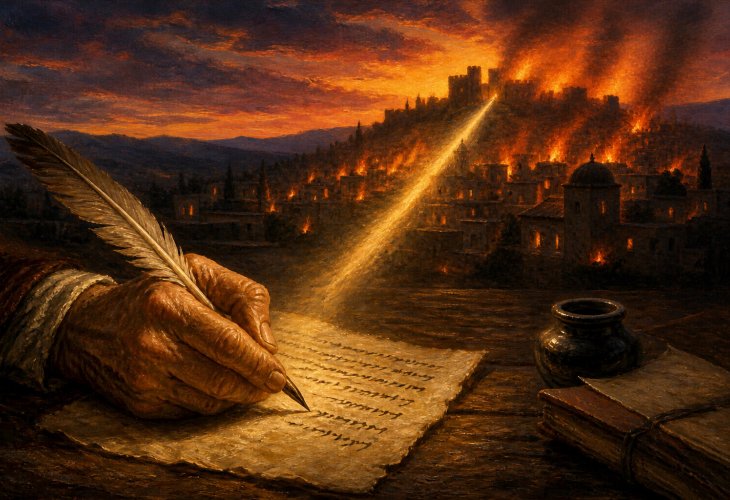
In the margins of a Book of Psalms preserved at the Austrian National Library, a handwritten lament records a devastating personal tragedy. In 1298, a Jewish scribe named Avrzush was copying the Psalms when a wave of violence swept through the Jewish communities of Germany, claiming the lives of his wife and children.
Overcome with grief, he composed a lament in their memory at the end of the manuscript, concluding with the words: "And I have written this as an everlasting remembrance before Hashem." His testimony offers a deeply personal glimpse into one of the most devastating waves of anti-Jewish violence in medieval Europe: the Rintfleisch massacres of 1298.
How the Rintfleisch Massacres Began
The massacres take their name from Rintfleisch, the leader of one of the murderous mobs that attacked Jewish communities across the German region of Franconia. The violence began on April 20, 1298, in the town of Röttingen, located in the Tauber Valley. Local Jews were accused of desecrating a consecrated Christian communion wafer, an accusation that became the pretext for their murder. Twenty-one Jews were killed in the town, marking the beginning of a wave of persecution that would spread across the region.
Within months, the violence reached major Jewish communities in Würzburg, Rothenburg ob der Tauber, and Nuremberg, as well as numerous smaller towns and villages. The accusation of desecrating the Christian Eucharist was not new. Similar allegations had circulated in Europe for years. Around 1290, a story spread in Paris claiming that a Jew had obtained a consecrated wafer and damaged it, supposedly causing it to bleed.
In Franconia, however, this antisemitic accusation became the justification for something far more extensive. Allegations initially directed at particular individuals were used to legitimize the slaughter of entire Jewish communities. At the forefront of the violence stood Rintfleisch, a butcher by profession who became the leader of a campaign of mass murder.
The Destruction of Rothenburg's Jewish Community
Rothenburg ob der Tauber was home to a prominent Jewish community closely associated with one of the greatest Torah scholars of medieval Ashkenaz, Rabbi Meir ben Baruch, known as the Maharam of Rothenburg. For many years, the Maharam had lived and taught in the city, where he headed a respected yeshiva. He died in captivity five years before the massacres, but the community that had flourished under his influence would soon experience a terrible tragedy.
During the summer of 1298, hundreds of Jews were murdered in Rothenburg. Among the victims was Rabbi Meir of Rothenburg, also known as Rabbi Meir HaKohen, the author of Hagahot Maimoniyot, a major halachic commentary on the Rambam's Mishneh Torah.
Shortly after the massacre, a Hebrew memorial inscription was carved into a stone commemorating the victims. The stone was placed in the Jewish cemetery of Worms, which survives to this day. A fragment of the original memorial stone was eventually rediscovered. According to the Rothenburg Museum, it came to light in 1980 after having been used as the base of a German eagle emblem, apparently during the Nazi era. The fragment was transferred to the museum, and in 1998, seven centuries after the massacre, a new memorial stone bearing the text of the lament was erected in Rothenburg.
The Massacre in Nuremberg
The Jewish community of Nuremberg also suffered devastating losses. As the murderous mobs approached, local Jews sought refuge in the city's fortress. Some non-Jewish residents helped them defend their position, but the attackers eventually broke through. On August 1, 1298, more than 700 Jews were murdered.
Among the victims was Rabbi Mordechai ben Hillel HaKohen, a distinguished student of the Maharam of Rothenburg and author of the influential halachic work Sefer HaMordechai. He was killed along with members of his family.
Rabbi Mordechai's work collected the laws and customs transmitted by the Torah scholars of Germany and France, organizing them according to the structure of the halachic writings of Rabbi Yitzchak Alfasi, known as the Rif. Despite its author's tragic death, Sefer HaMordechai continued to be studied and copied throughout the generations. The surviving manuscripts and their textual variations reflect the different study halls in which his teachings were preserved. His name also appears on page 33 of an edition of the Nuremberg Memorial Book, among the city's recorded martyrs.
Thousands of Victims, Their Names Preserved
The Nuremberg Memorial Book provides one of the most important surviving records of the scale of the tragedy. It preserves the names of 3,441 Jewish victims from 44 locations. This figure represents those whose identities were recorded in the surviving lists, rather than the full number of people murdered. Historical estimates place the overall death toll at approximately 5,000 Jews.
In his lament, the grieving scribe Avrzush referred to 146 communities and settlements affected by the violence, demonstrating how widely the massacres had spread. His own place of residence remains uncertain.
These records preserve more than statistics. They offer a glimpse into communities that once sustained vibrant Jewish life, families whose lives were abruptly destroyed, and Torah scholars whose teachings continued to shape Jewish learning long after their deaths.
The End of the Massacres
The violence finally came to an end in the early winter of the Hebrew year 5059, corresponding to late 1298, after Rintfleisch was arrested and executed by beheading on the orders of Albert of Austria, who feared that the unrest was spiraling beyond the control of the authorities.
But the intervention came far too late for the thousands of Jews who had already been murdered. For the families and communities devastated by the massacres, the damage was irreversible. Yet through memorial books, surviving inscriptions, and the writings of those who witnessed the tragedy, their memory endured.
Among those testimonies is the lament of Avrzush, the grieving scribe whose work on the Book of Psalms became inseparable from his personal loss. More than seven centuries later, his handwritten words remain a reminder of the lives destroyed during the Rintfleisch massacres and of the determination to preserve their memory.
"And I have written this as an everlasting remembrance before Hashem."
 History and ArchaeologyOn This Day in Jewish History: The Imprisonment of the Maharam of Rothenburg
 History and ArchaeologyHow Rabbi Jonathan Eybeschutz Saved Prague’s Jews from Disaster
 History and ArchaeologyRescued by a Miracle: The Story of Rabbi Berechiah of Lincoln
 History and ArchaeologyThe Mendel Beilis Trial: Uncovering the Truth Behind a Historical Accusation

