Jewish Law
Why Is Turkey Kosher? The Surprising Halachic History Behind Its Acceptance
Turkey originated in the Americas, where no ancient Jewish tradition could establish its kosher status. Discover how rabbinic authorities addressed the question and why centuries of Jewish custom matter
- Yosef Yaavetz
- | Updated
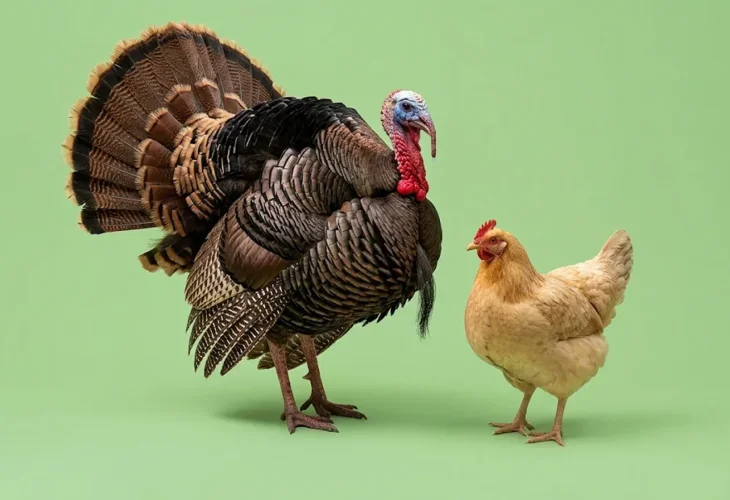
Turkey is a familiar sight on Jewish dinner tables, but its kosher status raises a fascinating halachic question. Unlike chickens, geese, and pigeons, which have been eaten by Jewish communities for generations, turkey originated in the Americas and was unknown to European Jews until the 16th century. How, then, did a bird with no established Jewish tradition become widely accepted as kosher?
The answer involves an important discussion in Jewish law about identifying kosher birds, the role of tradition, and the authority of established communal practice.
How Does the Torah Identify Kosher Birds?
The Torah lists 24 categories of prohibited birds in Parashat Shemini and Parashat Re'eh. In principle, birds not included in this list are permitted. The difficulty is identifying precisely which species the Torah names, a challenge recognized by the early halachic authorities.
To help distinguish kosher from non-kosher birds, the Sages provided several identifying characteristics. The Mishnah in Chullin discusses four signs: whether a bird is predatory (dores), possesses an extra toe, has a crop (zefek), and has a gizzard (kurkevan) whose inner lining can be peeled away. The extra toe refers to a backward-facing toe on the bird's foot, while the crop is part of its digestive system where food is temporarily stored. The gizzard is examined to determine whether its inner membrane can be separated from the surrounding flesh.
Even the definition of a predatory bird is subject to halachic discussion. The early commentators consider behaviors such as grasping prey with the talons or eating another animal while it is still alive. A domestic chicken, for example, may eat live insects without being classified as a predatory bird under these laws.
Why Is a Tradition Required?
The Gemara in Chullin 63b quotes Rabbi Yitzchak as saying, “A kosher bird may be eaten on the basis of tradition.” It further explains that an experienced hunter may transmit such a tradition if he received it from a teacher knowledgeable about birds and their identification.
But the Gemara also relates an incident that demonstrates the danger of relying solely on appearances. A bird known as tarnegolta d'agma, or marsh chicken, was initially considered kosher. Later, however, it was observed behaving as a predatory bird, prompting the Sage Marimar to prohibit its consumption.
Rashi drew an important conclusion from this episode: because our knowledge of bird species is limited, an unfamiliar bird may eventually display characteristics that establish it as non-kosher. He therefore ruled, “We eat no bird except on the basis of tradition.”
Other early authorities permitted greater reliance on physical characteristics under certain conditions. The Tur, for example, cites a tradition attributed to the Baal HaMaor that a broad beak and wide feet resembling those of a goose indicate that a bird is not predatory. The Rosh accepted these features when combined with the three physical signs associated with kosher birds.
The Shulchan Aruch (Yoreh De'ah 82) presents the different approaches, while the Rema endorses the stricter custom requiring an established tradition, concluding, “And this is our custom, and it should not be changed.” This became the accepted Ashkenazi practice: an unfamiliar bird cannot be permitted based solely on its physical characteristics.
Can a Tradition Be Trusted?
The reliability of tradition itself also became a subject of discussion. Bird names vary between countries and languages, and a name once associated with one species may eventually be applied to another. Some authorities therefore emphasized the need to examine identifying characteristics alongside inherited knowledge.
The Shach, however, maintained that a reliable tradition could be accepted without repeating the entire examination, provided no evidence subsequently emerged that the bird was prohibited.
The Shulchan Aruch also discusses whether traditions can be transferred between communities. A visitor from a community unfamiliar with a particular bird may eat it in a place where a reliable tradition exists. Similarly, someone who possesses such a tradition may continue eating the bird while visiting another community. Whether an entire community may adopt another community's tradition is more complicated, and the Shulchan Aruch records a disagreement requiring caution.
A related question concerns new varieties of familiar kosher birds. Differences in size alone may not require a separate tradition, but substantial changes in appearance or anatomy have generated halachic debate. These questions became especially significant with the arrival of a previously unknown bird: the turkey.
The Arrival of Turkey in Europe
Turkeys reached Europe following the exploration of the Americas in the 16th century. Large, meaty, and well suited to farming, they quickly became popular. The bird possessed several identifying characteristics associated with kosher species, including a crop, an extra toe, and a peelable gizzard. Nevertheless, it differed considerably from the familiar domestic chicken.
European Jews had longstanding traditions concerning chickens, geese, and pigeons, but no comparable tradition for turkey. Under the Rema's ruling, this appeared to present a serious obstacle to permitting it. Yet turkey gradually became an accepted food in Jewish communities, slaughtered in kosher slaughterhouses, served at Shabbat meals, and discussed by halachic authorities as a bird commonly eaten in accordance with Jewish law.
The question was not simply whether turkey possessed the physical signs of a kosher bird, but how the custom of eating it had begun.
Was Turkey Originally Permitted Because of a Mistake?
One possible explanation involves the bird's name. In Hebrew, turkey is called tarnegol hodu, literally “Indian chicken.” This reflects the geographical confusion that followed Christopher Columbus's voyages. Believing he had reached the Indies, Columbus helped perpetuate the mistaken association between the newly encountered American continent and India.
Could Jewish communities have assumed that turkey originated in India and that Indian Jews already possessed a tradition permitting it?
The difficulty with this explanation is that turkeys actually came from the Americas, where no established Jewish community could have passed down an ancient tradition concerning them. This raised an uncomfortable possibility: perhaps turkey originally entered Jewish kitchens because of a misunderstanding.
The Netziv and the Authority of Established Custom
Rabbi Naftali Tzvi Yehuda Berlin of Volozhin, known as the Netziv, addressed the question in his responsa Meishiv Davar (Part II, Section 22). Referring to the turkey as hindek, he acknowledged that some Jews had refrained from eating it after discovering that it originated in a region without an established Jewish tradition.
Nevertheless, the Netziv rejected the need to abandon its consumption, writing: “Nevertheless, the custom has already been established to permit it, and no one objects.” His response gives considerable halachic weight to the fact that Jewish communities had already accepted turkey as kosher. But this leaves one important question: How could an established custom overcome the original uncertainty surrounding the bird?
How Turkey Became an Accepted Kosher Bird
An intriguing explanation appears in Arugot HaBosem (Part II, Section 16). The author suggests that even if turkey was originally accepted because of a mistaken assumption, the concern underlying the requirement for tradition must be understood in context.
As demonstrated by the Gemara's account of the marsh chicken, a bird that initially appears harmless may eventually be observed behaving as a predator. This uncertainty justifies caution when encountering an unfamiliar species. However, the concern becomes less compelling after centuries of observation. If a bird has been raised and eaten for generations without displaying the behavior that would render it non-kosher, the original fear is significantly diminished.
By that reasoning, the longstanding Jewish practice of eating turkey was not merely an accidental custom. Generations of familiarity with the bird's characteristics and behavior had helped establish its accepted status.
The turkey thus provides a fascinating illustration of the relationship between halachic sources, inherited tradition, practical experience, and communal custom. What began as a question about an unfamiliar bird ultimately became a lesson in the enduring authority of minhag Yisrael—the established customs of the Jewish people.