

Torah Personalities
"I Was Disappointed by Rabbi Kanievsky's Blessing, Then Suddenly Felt a Strong Pat on the Back"
Musician Liran Elkobi started exploring Judaism at just 17 and a half due to a question from a religious man. Now he is married and a father of five. An exclusive interview.
- Yasika Akuka
- | Updated
I conduct the phone interview with Liran Elkobi late at night, while he is on the road. These are the best hours to speak with Elkobi, as his days are packed with activity. He wakes up early for the Shacharit prayer and learns with his chavrusa until 9:00. After that, he goes down to his private studio beneath his home and begins working. At 13:00, he prays Mincha, and his afternoons are dedicated to his job as an instructor at a special education hostel in Rekhasim. In the evening, he prays Maariv and then plunges back into his studio until the late hours of the night.
Liran Elkobi (34) grew up in Rekhasim when it was still predominantly secular, and he was educated within secular frameworks. “I was a good kid but mischievous,” he recalls, “the one who made everyone laugh, the class clown.”
His journey toward Judaism began at age seventeen and a half, when a religious man approached him and asked whether he knew why he fasted on Yom Kippur. “The truth is, I didn’t exactly know why, and I answered something like, ‘It atones, doesn’t it?’ He replied, ‘It elevates, but what good is it if you then return to the same deeds?’ I answered him, ‘And do you think I’ll ever look like you, dressed in black, with tzitzit and a beard?’ Then he suggested I take on an easy mitzvah, praying in the synagogue on Friday night. I was convinced, since it didn’t take very long.”
“I decided to try and see what prayer was all about, and when I went, it was very nice. I loved being greeted with a hello, after being accustomed in secular society to needing to know someone for at least half an hour before anyone says hello. I began coming every Friday evening, praying, and leaving. After some time, I discovered a new invention, Shabbat morning prayer. I decided to try that as well, and thus there was a period in which I prayed but continued to violate Shabbat, until I eventually decided to fully observe Shabbat.”
What caused the transition from partial observance to full commitment to mitzvot?
“The Charedim, who until then appeared to me through the media as strange people who sway, completely surprised me. I discovered that they talk, and that they are people with feelings, manners, and respect. Today, there is some openness between secular Jews and Charedim that did not exist back then. I would sit with them, inquire, ask questions, and show interest.”
After some time, Liran felt he should progress further and begin observing the holidays as well. While the thought was still only an idea, he had a performance scheduled at a club. It was Shavuot, and the band members arrived prepared and ready to perform. To their astonishment, the club was closed. It turned out the performance was actually scheduled for two days later, on Friday night.
“At that point, I couldn’t take it anymore. I was furious that because of them, I was about to violate the holiday. I looked completely secular, and my friend didn’t understand at all why I was upset about violating a holiday. I officially informed him that I was canceling the performance scheduled for two days later and that I no longer perform on Shabbat. The funniest and saddest part was that his wife didn’t understand what the problem was,” he recalls. “She suggested I perform on Shabbat and donate the money to a rabbi on Sunday as charity. We went home, and I immediately went to the synagogue for Shavuot night study. From that point on, they assigned me a rabbi who taught me halachot.”
Liran took some time to learn the basic halachot, and along the way, he made innocent mistakes, the kind Hashem loves most from those new to repentance. “We learned the laws of ma’aser, and I thought throwing things in the trash was wasteful. So whenever my parents bought something, I would take a piece and throw it in the trash, without even reciting the blessings for tithes. Then we learned the laws of borer. At eighteen and a half, when I moved to Ohr Somayach Yeshiva in Jerusalem, I wanted them to think someone serious had arrived. One day, during a central meal in the dining hall, while everyone was listening, I suddenly called out to a friend, ‘I think I did borer!’ I saw many astonished looks and realized I had said something wrong. My friend ran over to me and explained my mistake, and only then did I understand that the laws of borer apply only on Shabbat. Some time ago, at a wedding, someone came up to me and asked, ‘How’s it going, borer?’ It turns out I’m not the only one who remembers that incident,” Liran laughs.
How did those around you react to this change?
“My parents opposed it very strongly. My mother told me I was a good person and not a criminal, so I didn’t need to become observant. There was a lot of drama at home. My mother wasn’t feeling well, and I was very afraid that something might happen, G-d forbid, seemingly because of me.”
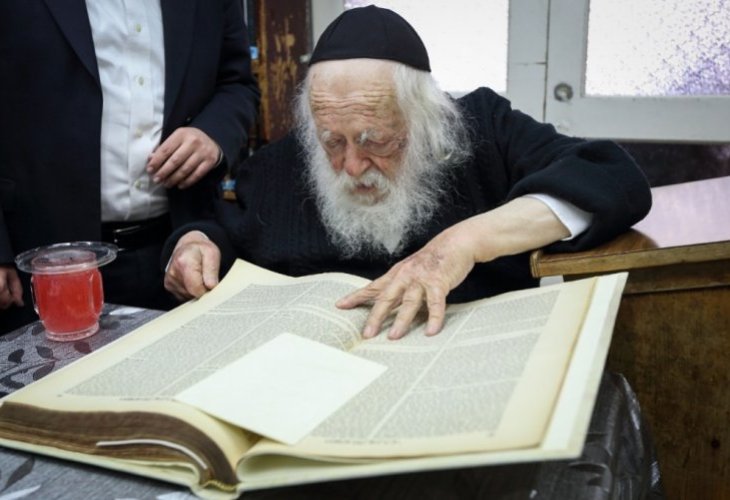
“When the time came to get married, I was very worried. My mother was deeply depressed by the situation. They took me to Rabbi Kanievsky. I wanted reassurance that nothing would happen, and I wasn’t willing to settle for just a blessing. Nevertheless, he blessed me with ‘blessing and success, good tidings.’ I waited to hear more, and when I realized he wouldn’t say anything else, I felt deeply disappointed.
“As I was leaving, already standing at the door, I suddenly felt a strong pat on my back. I turned around to see who had hit me and saw the rabbi still seated, with an angelic smile on his face. He motioned for me to come closer and said, ‘Not only will nothing happen, they will derive much pleasure from you.’ To this day, I don’t know how that pat on the back happened or who was responsible for it.”
How is your relationship with your parents today?
“Today we have an excellent relationship, and everything is fine, thank G-d. We have five wonderful and special children, Baruch Hashem, aged six to thirteen.”
Today, Elkobi is a respected musician and producer. He studied piano from a young age and pursued music studies at the conservatory. Later, he studied mixing and mastering, and today he arranges, writes, and composes in his private studio, while also serving as a music teacher. “But first and foremost,” he emphasizes, “Baruch Hashem, I set fixed times for Torah study.”
“I thank Hashem for allowing me to reach this point,” Liran concludes, “and may He continue to bestow His abundant goodness upon me, in the hope that we will all unite in love. Through love without reason, the righteous redeemer will come and redeem us speedily, amen.”

