

History and Archaeology
The Extraordinary Life of Ben Ferencz: From Liberating Camps to Prosecuting Nazi Killers
How the last surviving Nuremberg prosecutor turned trauma, law, and moral courage into a lifelong mission of justice and peace
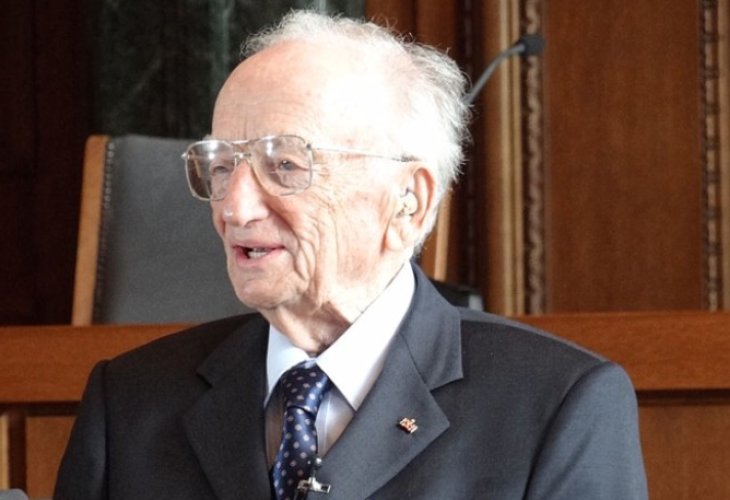 Benjamin Ferencz
Ben Ferencz was an American-Jewish lawyer, and the last surviving prosecutor at the Nuremberg trials. He died in April 2023.
Early Life: From a Hut in Transylvania to Harvard Law School
Ferencz was born in Transylvania, a region that today belongs to Romania. His first months were spent in a small hut in a tiny village. But when he was ten months old, his family immigrated to the United States.
As he grew older, he studied law at the prestigious Harvard Law School. “I had to excel in something to compensate for being so small,” he joked.
Military Service and Assignment to Investigate Nazi Crimes
In 1943, Ferencz completed his studies and enlisted in the U.S. Army. He served primarily in the Third Army under General George Patton, which participated in the Normandy invasion, the liberation of France, and the occupation of Germany.
In 1945, he was transferred to the Third Army headquarters and joined a team tasked with collecting evidence and investigating Nazi war crimes. This position sent him to concentration camps newly liberated by American forces.
In December 1945, he was discharged with the rank of sergeant and returned to New York. But only weeks later, Brigadier General Telford Taylor — the chief prosecutor of the Nuremberg Trials, decided to recruit Ferencz again to join the prosecution team.
“Taylor, who later became my boss in civilian life, told me that my military file said I sometimes disobey orders. I told him it wasn’t ‘sometimes’ — it was usually. I refuse to carry out stupid or illegal orders,” Ferencz recalled.
Leading the Prosecution Against the Einsatzgruppen
Ferencz’s primary work in Nuremberg was leading the prosecution of the Einsatzgruppen commanders — the mobile Nazi killing units responsible for murdering more than a million people, most of them Jews.
Ferencz convinced the other prosecutors that these commanders had to be tried. They agreed — on the condition that he serve as the chief prosecutor. Ben Ferencz was only 27 years old, and this was his first-ever trial.
He presented exactly one witness, whose testimony was more than enough: a Nazi official who had produced the documents that meticulously recorded the murders of Jews and other “undesirable” groups.
“They were so sure they were going to win, the Germans,” Ferencz explained. “And they were excellent record-keepers.”
From the prosecutor’s podium, he described the Einsatzgruppen commanders as men for whom: “Death was their tool of trade, and life was a toy to them… If these men enjoy immunity, the law has lost all meaning, and human beings will live in fear.”
Two days later, the judges convicted all 22 defendants. Four were sentenced to death. The tension was so intense that when the verdict was announced, Ferencz experienced the worst headache of his life.
The Limits of Justice: “We Couldn’t Try Them All”
Despite his successful prosecution, Ferencz left Nuremberg with only partial satisfaction. He knew that only a small fraction of Nazi criminals — a representative sample, had stood trial.
“The rest went on with their lives as usual,” he said. “We didn’t even have a place to try them all.”
After the War: Compensation for Survivors and the Fight for International Justice
Following the war, Ferencz dedicated himself to legal battles for compensation for thousands of Holocaust survivors. He also participated in the negotiations that led to the 1952 Reparations Agreement between West Germany and Israel, and in shaping the German Restitution Law (1953) for restoring lost property and compensating survivors.
In 1970, influenced by the atrocities he had witnessed and by the Vietnam War, he left his law firm and began focusing on international law and the creation of an international court for war crimes.
This court — the International Criminal Court (ICC), was finally established in 2002. In its first trial, against Congolese war criminal Thomas Lubanga Dyilo, Ferencz delivered the prosecution’s closing statement.
He was frustrated that terrorists like Osama bin Laden were killed rather than put on trial, which he believed would have created greater deterrence.
Haunted by the Camps: “Try Being There”
His memories of the horrors he saw accompanied him every day. As a sergeant in Patton’s Third Army, Ferencz witnessed the liberation of several concentration camps:
Buchenwald
Mauthausen
Flossenbürg
Ebensee
“It was the same story in every camp,” he said. “Prisoners worked to death. Conditions that were horrifying, indescribable, and unforgettable. Guards fleeing.”
For more than seven decades he shared the terrifying scenes he witnessed. “In one camp, I saw prisoners beating a captured Nazi guard and then burning him alive — slowly,” he recounted. “I can still see that scene before my eyes. Could I have stopped them? No. Did I try? No. Should I have tried? Also no. You try being there.”
Continuing the Fight: “Never Again” Must Mean Action
“My hope is that people won’t just look at the past, say ‘never again,’ and then do nothing,” he said. “That’s why I take real action to prevent it from happening again.”
He donated one million dollars to the International Justice Initiative of the U.S. Holocaust Memorial Museum and intended to renew this donation every year for ten years, reaching a total of ten million dollars.
“I am determined to give everything I have back, out of gratitude for the opportunity I had in the United States. All my life I have tried to create a more peaceful and humane world, and I want the money to go toward that purpose.”
“I saved most of the money I earned in my life and invested it well,” Ferencz said plainly. “Now I want to give it away. I came into the world a poor boy — and that’s how I want to leave it.”

