

History and Archaeology
From Siberia to the Exodus Ship: The Remarkable Life Journey of Holocaust Survivor Mordechai Lump
Memories of Siberia, the Exodus struggle, and a lifetime of courage passed on to future generations
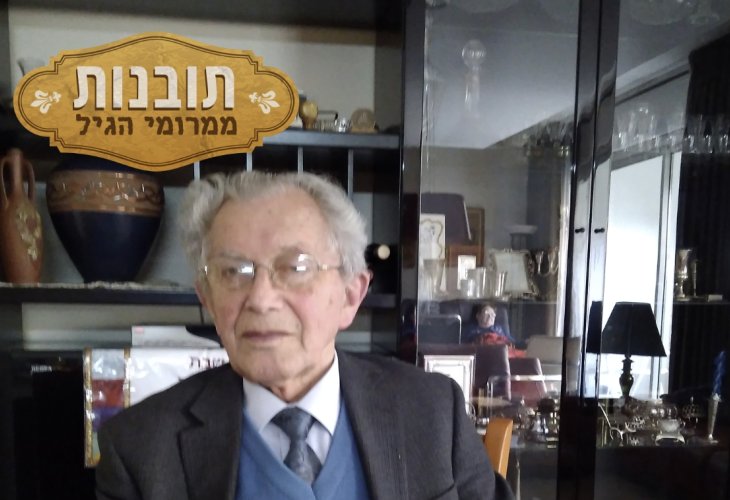 Mordechai Lump (Photo: Private Album)
Mordechai Lump was born in Galicia, Poland. During the Holocaust his family wandered through Poland, later moved to Russia, and was exiled to Siberia. At the end of the war the family returned to Germany, from where Mordechai attempted to immigrate to Israel on the “Exodus” immigration ship. The ship was seized by the British and sent back to Germany, where Mordechai was forcibly removed from it. About a year later, with the establishment of the State of Israel, he was finally able to immigrate. Over the years he lived in Jerusalem and worked as a beloved and respected mathematics teacher.
An event that left a deep mark on me
“While we were in Siberia, Passover of 1941 arrived. My father managed to obtain from one of the Jews a small package containing three matzot. He informed us that he and my older brother would eat them, and the rest of the family would have to eat chametz. In truth, we barely even had chametz — but we all burst into tears and said we would not do it.
“That Seder night in Siberia — when I was also sick, was the happiest night I can remember in my life. We had no wine, not even tea, yet we sang the entire Haggadah joyfully throughout the night.
“The next day, a non-Jewish woman appeared near our home and brought us a bucket of potatoes — something of tremendous value in our situation. My sister promised her a dress she had sewn before the war and asked if she could bring more. The woman returned the next day with another bucket of potatoes. My sister then asked whether she could also bring us flour — and to our astonishment, she did.
“We removed a gear wheel from an old clock we had, and during Chol HaMoed we baked matzot from the flour she brought us, perforating them according to halacha. To me, this was a great miracle — and when I tell this story to my grandchildren and great-grandchildren, I tell them that I am certain that this woman was Elijah the Prophet.”
Something I am grateful to have done in my life
“The privilege of immigrating to the Land of Israel and living in a country where Jews live.
“When the war broke out, we suffered terrible persecutions — as only Jews in exile knew. I still remember the German soldier who rode into our town on a bicycle and announced that Poland had fallen into German hands. We were ordered to gather in the town square and sign that we were leaving voluntarily. All the Jews were expelled, and along the journey our belongings were plundered. First by the Germans who took valuables — then by Polish bandits who attacked us on the road.
“We reached an area that belonged to no government — and there too the Poles attacked us. At that point my father cut off my payot (sidelocks) so that the non-Jews would not do it with cruelty. My brothers were taken to do degrading labor, and we were never able to return home. From there we crossed to the Russian-controlled part of Poland — and from there we were deported to Siberia, which in hindsight actually saved us from the horrors of the Holocaust.
“Years later, when I was asked whether I wished to visit Poland, I replied: I would do so only if they allow me to beat the ‘shkotzim’ who once pulled my payot.”
Something I regret
“I do not regret anything. On the contrary, it is precisely the difficult experiences that shaped our lives.
“Especially on the Exodus ship we felt that we were helping establish the State of Israel. We suffered hunger and hardship there, but the worldwide public response created by our determined stand against the British was one of the steps that advanced the founding of the state — and I am proud of that.”
A life lesson I learned
“To always cling to one’s principles and never surrender — and to do so with faith.
“This reminds me of Rosh Hashanah in Siberia, 1941. The men then worked felling trees, and the women were assigned to burn the branches. When the holy day arrived, not a single Jew went to work — and we children did not go to school. The work supervisors came immediately to demand that we continue working as usual.
“I saw one of the soldiers leave the barracks in tears — overwhelmed that there were still Jews who, despite the communist regime, remained faithful to their beliefs.
“In the evening NKVD personnel arrived on horseback to investigate. They questioned everyone — even the children, to find out who organized the ‘protest’ that caused no one to report to work. When they asked me, I replied that Rosh Hashanah occurs every year — no one needs to inform me of it.
“We explained that just as Russians celebrate May 1st, the day of the Revolution — we too, as Jews, have our holidays. Beyond that, they could do little to us — after all, we were already in Siberia. Only my uncle was arrested for a few days, after which he was released.
“There, I learned what it means to stand firm for our Judaism despite everything.”
A person who left a powerful impression on me
“Mordechai Rosman, the leader of the Exodus immigration ship.
“When the ship set sail toward the Land of Israel, I was on board with my brother and younger sister. As we approached the coast, six British destroyers surrounded us. We hoped to reach Israel’s territorial waters — where the destroyers could not follow.
“But as time passed it became clear they would not relent. The order was given that those who could jump into the water should try to swim, and those who could not, should fight.
“When the British boarded, fierce battles broke out. Many were injured and three of our people were killed. We had no choice but to surrender. We were taken to Haifa and from there to three British deportation ships. We lay on the iron floors and refused to eat the non-kosher food.
“To our shock we were taken back to France and asked to disembark — but Mordechai, whom we admired greatly, declared that we would disembark only in Haifa.
“His unwavering stance left a deep mark on me. For weeks we resisted with all our strength so that we would be allowed to reach the Land of Israel. Our steadfastness stirred the entire world and became another step that pushed the British regime back.
“In the end we were forcibly removed in Germany — and a year later, with the establishment of the state, we merited to immigrate.”
What I wish to leave behind
“I would like to leave future generations the story of my life — so that they absorb it and learn from it.”

