

Personal Stories
From Hidden Child to Matriarch: The Remarkable Holocaust Survival Journey of Gisele Guttel
From a Jewish orphanage in wartime France to rebuilding a large, loving family in Israel
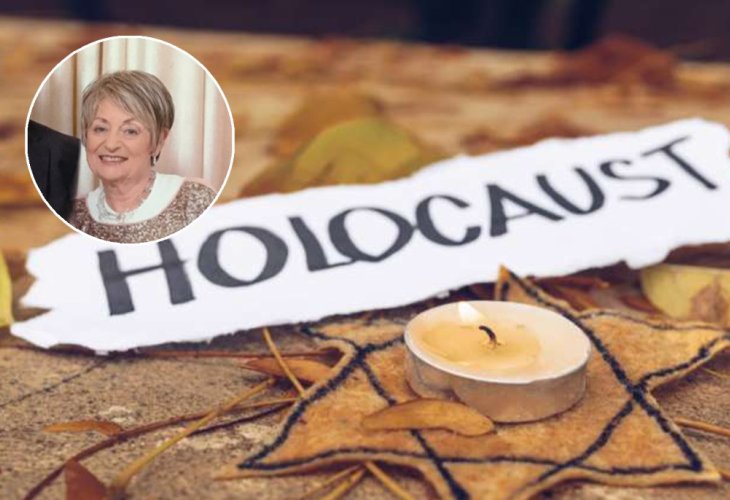 (Photo: shutterstock) Inset: Giselle Guttel
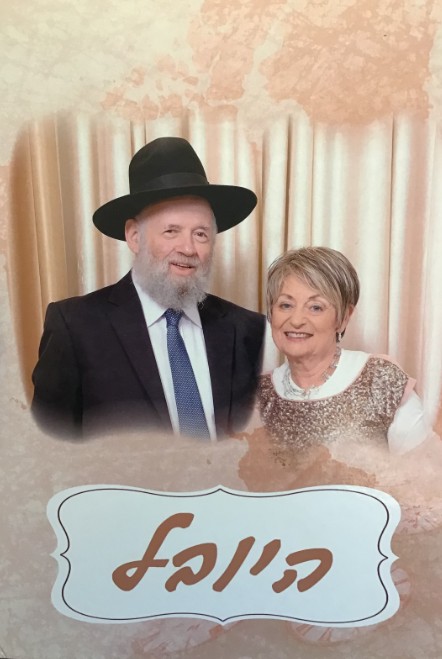
The home of Mrs. Gisele Guttel is a warm, welcoming place; I can feel it from the very first moment I step inside. The walls are filled with photos of children, grandchildren, and great-grandchildren. Holy books stand prominently on the living-room shelves.
“We have a spacious apartment, a beautiful view, wonderful children and grandchildren — what more could we ask for? I thank God every single day,” she says. “Who could have imagined that the little girl who grew up in a farmer’s home during World War II would one day merit to build a home and a family?” she adds emotionally.
“The Earth Was Burning”
Mrs. Guttel begins her story: “I was born in 1941 in Paris, France. My sister Liz is two years older than me — we are only two girls in the family. My father was born in 1900 in Istanbul, Turkey, and moved to Paris with his family at age 12. My mother was born in 1905 in Lublin, Poland. Her older sisters raised her after her mother passed away when she was young.
“My mother’s sisters moved to Paris for work, and when my mother was 25 she joined them, because she did not get along with her stepmother after her father remarried. Times were difficult between the two world wars. Immigrants — including Jews, worked simple jobs and lived in poor neighborhoods, because French Jews did not accept them. My parents both worked as tailors.
“In 1939 the war broke out. France surrendered quickly, and in early 1940 the Germans arrived. In 1942, the pro-German French police decided to cooperate with the Nazis and began rounding up as many Jews as possible. One night, thousands of Jews were gathered into a huge stadium in Paris under horrific conditions — with no food, water, or air, and from there they were sent to Auschwitz. That night became known as the Vel d’Hiv roundup.
“Life in Paris became unbearable. People didn’t know whom to trust. Some non-Jews informed on Jews — and tragically, sometimes Jews informed on other Jews. That is where the story of my life truly begins.”
Unanswered Questions
“In 1943 my father was taken to Auschwitz. I was two-and-a-half at the time. My mother struggled terribly to care for two small girls without food and under harsh conditions. She turned to a Jewish organization in France called OSE, which arranged for Jewish children to be hidden in Christian homes.
“My sister and I were sent to live with a family in a village in central France. The father was a prisoner of war, so we lived with the mother, grandmother, and children. We arrived there in complete shock. Other hidden Jewish children also lived in that village — some were treated kindly, while others were abused and turned into servants.”
 (צילום: shutterstock)
Do you remember any of this?
“No — nothing. My sister remembers a little. The OSE workers visited us and wrote in their records that we were treated well, although during the woman’s pregnancy we were a bit neglected… It also said that my sister had difficulty parting from the cross.”
Reunited — But Strangers
“We stayed there for two years. Near the end of the war, my mother found us sitting on the steps outside the house — I was six, Liz was eight. My mother spoke Yiddish, we spoke only French, so our conversations were shallow.
“She herself nearly died of hunger and cold, but somehow survived. People slowly began returning to Paris, and information about the camps and the Holocaust spread. Every week we went with my mother to check the lists in the synagogues and municipal offices, hoping to see my father’s name — but he never came back.”
“No Mother to Kiss You Goodnight”
“After the war, OSE gathered orphaned children into state-leased estates that became Jewish orphanages. We were almost the only ones who still had a mother. From age six to eighteen I lived in an orphanage near Paris.
“The conditions were harsh. We were ten girls in a room with no privacy. Some nights I woke up terrified with no one to comfort me. There was no mother to kiss you.
“If a child wet the bed — and I was among them, she was punished. I had to wash the sheets outside at dawn in the cold by the lake, alone. Eventually they stopped this punishment when they realized it didn’t help. Only years later I understood that they meant well, but there was no warmth or love.”
What helped you continue?
“My dreams. I was a dreamy child — my imagination helped me survive. I had one constant dream: ‘I will grow up, marry, become wealthy, and help children who suffer.’
“On the long walk to school each morning, I would imagine returning to the orphanage and seeing my father waiting in a fancy car to take us home as a united family.”
Leaving the Orphanage at 18
“At 18 they simply said ‘goodbye’ and sent us to manage on our own. Moving back to live with our mother, whom we barely knew, was complicated. We lived in a poor neighborhood of Paris, with shared bathrooms for the entire building.
“I studied sewing in the orphanage and later worked in a prestigious Paris fashion house. Liz immigrated to Israel, to Kibbutz Sde Eliyahu, where she later married.”
Marriage and a New Life in Israel
“I did not attend her wedding as I was going through a very dark period. A year later I came to help her before she gave birth. My husband, originally from France, had come to study in Israel. We met at the kibbutz, decided to marry, and moved there.”
What helped you remain emotionally stable after everything you experienced?
“My mother’s boundless love and her deep desire that we have a better life — even though she herself could not guide us.”
Building a Family — The Greatest Victory
“My mother later moved with us to Israel and felt at home with the language and people. We lived in Jerusalem, worked hard, and slowly built our life.
“We had no idea how to raise children — I had never even seen how a baby is cared for — but God gave me the instincts I needed. Over the years we became stronger spiritually and more observant. Today, thank God, we have seven children — all married with beautiful families.
“Every time I think about it, I am moved all over again: we came out of the war — my mother, my sister, and I — and today, thank God, we are a large, united family. That is our joy. That is our victory.”

