 עברית
עברית

"I Want to Laugh More": Golan Azulai in an Interview on His New Show on Hidakbruk, "Golan with the People"
During the pandemic, he opened a nut shop, now he's studying to become a rabbi for officiating weddings, but above all, Golan Azulai is still a soulful actor. He is now starring in a comedic series produced by Hidakbruk Digital. "Sometimes there's a sense that depth and lightness can't go together, and that's a big mistake," says Azulai.
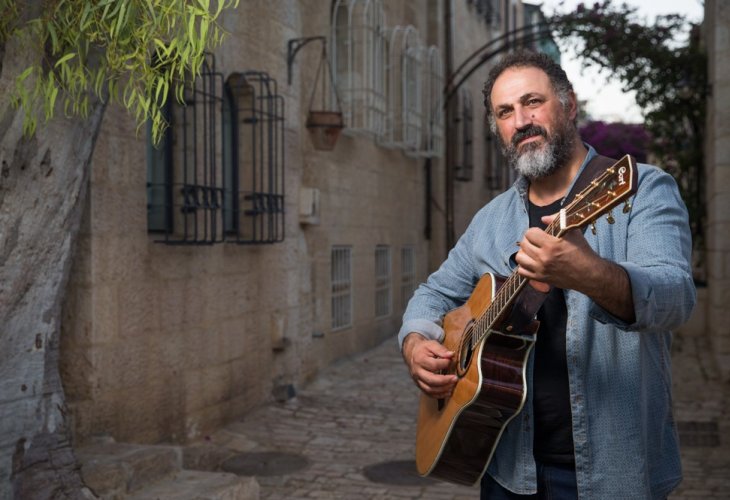 (Photo: Yonatan Sindel / Flash 90)
There are those who pray for well-known Israeli artists (celebrities in secular terms) to have their hearts opened. One such person is Golan Azulai. He is on this globe to light it up through performances, creations, and broadcasts, but an integral part of his light is his prayers. "There are some well-known artists I pray for, and they don't even know I'm praying for them," he tells me with a smile. "Every Jew should believe that prayers are heard and work. If not, why pray?"
In our cynical world, he wants to tell this story to prove that the business of prayer still works as usual. "I acted in a series, and there was one actor there, whom I won't name, who spoke coldly against settlers and religion. He jabbed at me with his words, and I felt inside me, to be honest, that I couldn't stand him. I asked myself: what will I do during the shoot? Aren't I commanded to 'love your neighbor as yourself,' because I am Hashem? That is the continuation of the verse, 'Love your neighbor as yourself' – 'because I am Hashem.' The essence of loving others is Hashem. To understand that this is what he asks of you: to love, to draw closer to others.
"I didn't know the name of this actor's mother, but I wanted to start praying for his heart to be opened, so I asked him: what did you say your mother's name is, Shoshana? And he tells me: what Shoshana?! And then he gave me his mother's real name."
Your brother came with deceit and took your mother's name.
"Yes," laughs Golan. "That's how I got the name out of him, and I began to pray for him for a few days during the Amida, in the prayer asking Hashem to open his heart, to bring us closer. We met again after that on another filming day, and you see a completely different person. He tells me: I thought about you on Shabbat and realized I appreciate the hard journey you're making.
"Suddenly he tells me about his family in Gush Etzion and how he is connected to them. We didn't become best friends, but the tension ended, and we lived in peace during the filming days. This is called finding a good point. It's hard work, but this is what needs to be done."
Give Us Humor
Golan Azulai (54), married and father of five, lives in Jerusalem, is an actor and multidisciplinary creator who manages to reinvent himself every time: in his popular show 'Dancing Between Two Worlds' which he has been running for many years (about a thousand performances), in his songs and personal creations, in his roles as a presenter, screen actor, and stage actor, in his broadcasts on 'Kan Heritage' and more.
I have accompanied him for many years through interviews on various platforms, and now we are at his new station: a program on the Hidakbruk channel, where he hosts figures for a deep conversation that includes a nice dose of humor.
"As a presenter, I did a lot of documentary series: I hosted the daily Rambam study, I created the connecting thread, where three baalei teshuvah sit for a chat, but this time we decided to make a more entertaining program," he tells with enthusiasm. "The format of the interview is more comedic. I feel like laughing more, yes. The heart of the interview is deep and emotional, but around it, there's a good atmosphere."
In the show, 'Golan with the People', Golan met a variety of figures, from Meni Assayag to Uri Zaki (a political activist from the left and partner of Tamar Zandberg), Hatsel, Yuval the Confused, and Moshe Abutbul (a member of Shas).
In an interview with Abutbul, Golan jokingly asked him to get him into politics. "If Tchelansky can become president as an actor, then I can too," was Golan's approach. "I asked Abutbul to arrange a spokesman position for me," laughs Golan. Not all viewers understood it was a joke, and afterwards, the channel decided to add a caption to clarify that these were comedic sections made with the interviewee's consent and certainly not at his expense, as is customary in the melting pots of jesting.
"In the interview with Yuval the Confused, I brought my 11-year-old son. We pretended I arranged a fun day with Yuval the Confused for him and staged it as if Yuval didn't like children. Also, in this program, we didn't manage to put a caption that it's humorous and with the interviewee's consent, and the audience pointed out that it wasn't fitting."
And what did Golan give Uri Zaki from the left? "First of all, we discovered that he himself puts on tefillin even though he is the partner of Tamar Zandberg, who was at the center of the tefillin storm. Besides, we added a funny segment where during the interview someone brings in a tefillin station," laughs Golan. "As if we're trying to turn him into a tefillin presenter." The laughs continue at the expense of Hatsel's tattoos and the ridiculous monetary offer to scriptwriter Meni Assayag.
All in all, the humor is never at the guest's expense, and perhaps this is the main message that can be taken from between the lines of this program, which brings humor through the main door of the Hidakbruk site and manages not to get its head stuck in the beams of jesting.
"In general, my way over the years is to combine humor," says Golan. "In my shows I tell emotional stories with deep insights, but stand-up has always been part of me. Emotion and humor come to me together, in the same dance. Sometimes there's a sense that depth and lightness can't go together, and that's a big mistake. Because Judaism is joy, and within it, there's fun. It's not jesting and not cynicism, and it's a shame that people get confused between humor and jesting or cynicism."
We Want to Live
The coronavirus period caught Golan just in time. "You can find the good eye even in this period," he says. "For example, I had pain in my feet. Heel spur resulted from many performances. Standing for two hours every evening caused it," he says.
"I needed a two- or three-month break, and my prayer was answered. The coronavirus didn't happen ‘because of me’, but it helped me, and I recovered by the grace of Hashem. This coronavirus break helped me a lot.
"Now the market has reopened, and people are thirsty to be at a good show, to laugh, to sing, to dance. I feel that people no longer have the energy for all those fears again, when talking about whether the coronavirus is coming back or not, what can I tell you? I respect those who go back to the masks, you have to be careful, but live. Enough."
What did you do during that freeze period?
"I opened a nut shop."
What?!
"Yes. Remember when there were lockdowns and only food shops were open? So during that time, my friends, who own the Afula seeds chain, talked to me and offered me to open a branch. I liked the idea. I said: maybe I'll get a pension fund from this. So I opened a branch, managed it. I wasn't the seller, I was just a co-owner. I was happy to explore this commercial space because, after all, I'm also a merchant who sells my shows through my production company, and it interested me. But that's it, I sold the branch."
Why?
"I realized it required too much of me. I can't be an active partner. I don't have time for it, but it was interesting. I learned many things, including about myself: that I'm an artist who must have free time for art, for performances. I need to do my mission."
The Precise Messenger
Soon, Golan will also be, G-d willing, a kind of official rabbi who organizes weddings and blessings. He studies at a kollel twice a week to pass rabbinic exams and get the specific license to officiate weddings. Musically, of course. Like he knows.
Actor, presenter, musician, broadcaster, or wedding officiant? So, Golan's mission is indefinable even if you try it at home and bring a perfect list. "What do definitions matter?" he wonders and smiles, getting up for a moment. "I am above definitions. I don't like them. Even in my dress, I am undefined. I am Golan. Why should I limit myself? I do what I feel like."
Currently, he wants to portray the character of the late Rabbi Ovadia Yosef with a play produced by Hillel Productions. "We are a team of six actors telling the life story of Rabbi Ovadia from his childhood moments until his death, including the announcement of his passing. I even acted wearing the original robes and hat of Rabbi Ovadia, that's a privilege.
"On the other hand, there are things I find don't belong to me, and they are not accurate for me, so I remove them from my schedule."
What did you choose to give up?
"I worked in an organization that approached youth in schools. It would bring them a lesson of Jewish-Israeli identity. I found it was wearing me out. I didn't have the patience for it. I felt it limited me, so I stopped. With Hashem's help, I can choose. My main livelihood is from performances that include a direct encounter with humor, stand-up, emotion, and also songs. A personal encounter."
What do you think is the secret of your successful show?
"I think what speaks to the audience is my connection to authenticity, which I was privileged to attain through the teachings of Yemima. I learned through her to be more simple, with an open heart, with more flowing emotion towards the audience. The personal sharing touches people."
And what about creating music solely as a musical artist? Does that interest you?
"I do what I love and release songs, and if someone joins in, great. But it's hard for me to think like artists who try to target a wide audience. I respect them for that, but that's not my line. I do what I need, and I don't know where it will take me. I look at it this way: there's someone who spends money on holidays abroad twice a year, right? So I go and record some songs. If something comes out of it, great. It heals me and makes me happy. Joy heals."
What do you connect with that is played today?
"I love Aharon Razel. He moves, creates, changes."
Who Needs Awards When There's Light in the Heart
With whom would you collaborate?
"I don't have such a desire," Golan throws after a long thought, then asks me back: "Do you know what my desire is? To do a new show that wouldn't just be a regular show but a workshop performance. Like training. A show built on insights from Yemima's teachings. When a person comes to the show, he will sit, laugh, and gain tools to go home and be a better person. A show of sketches and situations on stage and a few songs. Three hours, four hours of a show."
What worries you about the world that drives you to try to illuminate it with all your might?
"I don't want to fix the world. I want to add my light. I must give it. For 21 years I've been studying Yemima, learning about personal correction, and I have to bring it forward."
What bothers you most about our people?
"The polarization, the distance from the roots. Unfortunately, some young people are distant from the roots, from our ancestors and mothers. When you come close, you discover that the ancestors and mothers are not far. You discover that your parents' home hangs on our ancestors and mothers. It's embedded in our DNA. I discovered this when I returned to observance. I started learning Yemima because I wanted to save my home. Thanks to the learning, I came closer to my wife. To correct my ways, I continued learning Yemima, and from this, I also came to keeping mitzvot."
Do you have professional personal ambitions?
"I would like to play meaningful roles that do good. By Hashem's grace, I have appreciation both from the street and my fellow artists. Do I need awards? I don't know. I'd prefer not to receive an award. Today when someone gets an award, all sorts of skeletons come out of the closet," laughs Golan, "so why bother?"
Published in the weekly "Olam Katan"

