עברית
עברית

Magazine
When Two Worlds Unite: A Unique Wedding in Be’eri
Discover the captivating story of a wedding that brought together a religious family from the Shomron and a secular family from Kibbutz Be’eri, as Hadar Bachar reflects on the journey, resilience, and courage that bind them.
- Moriah Luz
- |Updated
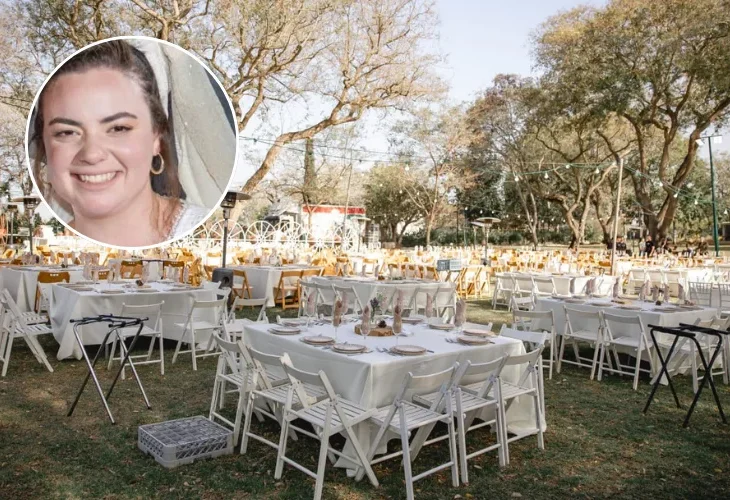 The wedding on the lawn in Kibbutz Be'eri. Inset: Hadar Bachar at her wedding (Photos: Ilan Magen)
If someone had told Hadar Idels, the daughter of a religious family from Samaria, that one day she would marry a man from Kibbutz Be’eri, she would likely have responded with a skeptical smile. Hadar was born and raised in Har Bracha, a close-knit religious community. Her roots run deep in the settlement movement. Her grandfather, Rabbi Dov Lior, is among the senior Torah scholars of religious Zionism and formerly served as the rabbi of Kiryat Arba–Hebron. Her other grandfather, Rabbi Tzvi Idels, was among the first settlers of Hebron.
A few months ago, Hadar married Nadav Bachar. Nadav was born and raised in Be’eri, a secular kibbutz near the Gaza border, and later became religious. He comes from a family with a prominent military background. His father, Major General Yossi Bachar, serves as deputy commander of the Southern Command in the reserves and has been among those leading the war in Gaza for nearly two years.
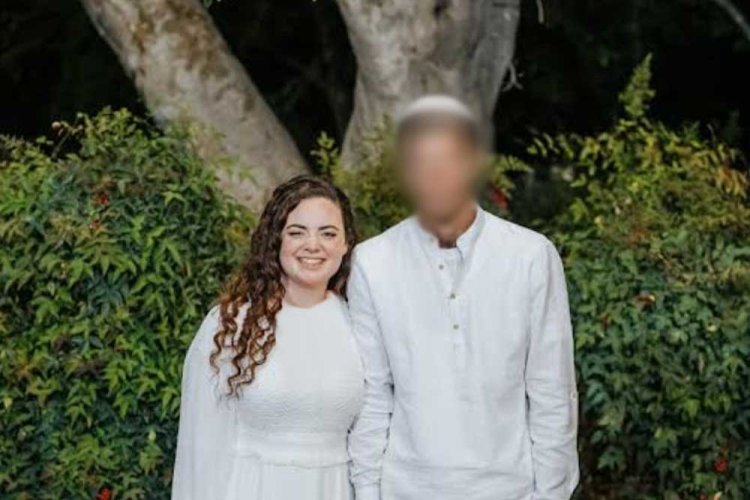 Nadav and Hadar at their wedding.
“Adding Subtitles to the Film”
“Nadav comes from a very values-driven family,” Hadar explains. “As a teenager, he studied at Adam Ve’Adama High School, which combines agricultural work with academic studies. The school includes students from traditional and religious homes, and his homeroom teacher was an observant Jew. For Nadav, this was his first close exposure to that world.”
Gradually, his interest deepened. He was invited to spend Shabbat with religious friends and began learning Jewish concepts more seriously. “Today he likes to say that his life was like a movie, and the Torah added subtitles,” Hadar says. “The Torah helped him resolve many of the questions and dilemmas that arose along the way.”
The next stage was structured learning at the Bruchin Yeshiva in Samaria. The head of the yeshiva, Rabbi Chaim Baruch, guided him closely through the process of returning to religious observance. During that period, Nadav also spent many Shabbatot with a religious family in Jerusalem. “He refers to them as my spiritual parents,” Hadar notes.
After yeshiva, Nadav enlisted in the IDF and today serves as an officer in the Golani Reconnaissance Unit. Due to the intensity of his role, he was unable to participate in the interview, and Hadar spoke on his behalf.
Kibbutz Be’eri endured a horrific massacre on Simchat Torah. Where was Nadav at the time?
“On Simchat Torah, as every year, the kibbutz was marking its anniversary,” Hadar explains. “Nadav, however, wanted to observe the holiday in its Torah dimension. He was then in officers training and had received a day off, choosing to stay in Samaria with a friend from yeshiva.”
In the early morning hours of October 7th, as reports of an unusual incident near Gaza began circulating, Nadav immediately checked whether he had been called up. Seeing desperate cries for help flooding the Be’eri WhatsApp groups, he set out at once to hitchhike south.
His final ride dropped him off in Kfar Maimon. Nadav knocked on the door of a nearby home, urgently asked to borrow the family’s car, and drove toward Be’eri. “Security cameras later showed the vehicle entering the kibbutz safely through the gate,” Hadar says. “This was a tremendous miracle that was even investigated by the army, with no explanation found. At that point, the kibbutz was already swarming with terrorists, and members of an elite IDF unit who had tried to enter through the same gate shortly before him were shot and killed. Later, it was discovered that the car Nadav was driving was riddled with bullet holes.”
Nadav joined several kibbutz members and was among the few security forces fighting there in the early hours. Hadar shares that he saved a brother and sister after identifying terrorists breaking into their home and, with Divine assistance, neutralizing them with precise gunfire.
When Shaldag forces later arrived, Nadav’s familiarity with the kibbutz layout, access routes, and vulnerable points, combined with his military training, helped guide the incoming forces.
Hadar adds that Nadav’s father, Major General Yossi Bachar, was also fighting at the same time, neutralizing more than fifteen terrorists and saving many lives.
“For Nadav’s immediate family, there was another great miracle,” she says. “At a certain point, the terrorists began setting houses on fire one by one and murdering their occupants. Entire streets were left blackened. When they approached the Bachar family home, they suddenly changed tactics and began burning every other house. Their home was left untouched. Nadav often says that a home that observes Shabbat has special protection.”
“Sadly, Nadav’s grandmother was murdered in the massacre,” Hadar adds. “She was at home with his grandfather and cousin. When they realized through WhatsApp that the terrorists were approaching, she asked each of them to hide in a different place. She said she would hide in a closet, but instead sat on the couch. When the terrorists entered, she told them she was alone in the house. She was murdered in cold blood. The grandfather and cousin survived.”
“Adding Life Where It Was Cut Short”
Hadar explains that the match between her and Nadav came about through a family with whom he would spend Shabbat. “One of their sons is Nadav’s friend from the army, and one of their daughters is a friend of mine. She was the one who suggested the match.”
The relationship developed while Nadav was serving in an intense wartime role. “It wasn’t simple. A lot of time passed between meetings. There was a period when Nadav was deployed in Lebanon for two months and was barely available even by phone.”
Their shared commitment extended beyond the dating period. “The wedding was held in southern Israel, partly because Nadav was supposed to return to the army the next day. We wanted it close to Gaza,” Hadar says. “In the end, his return was postponed again and again, and we ended up celebrating most of the Sheva Brachot together.”
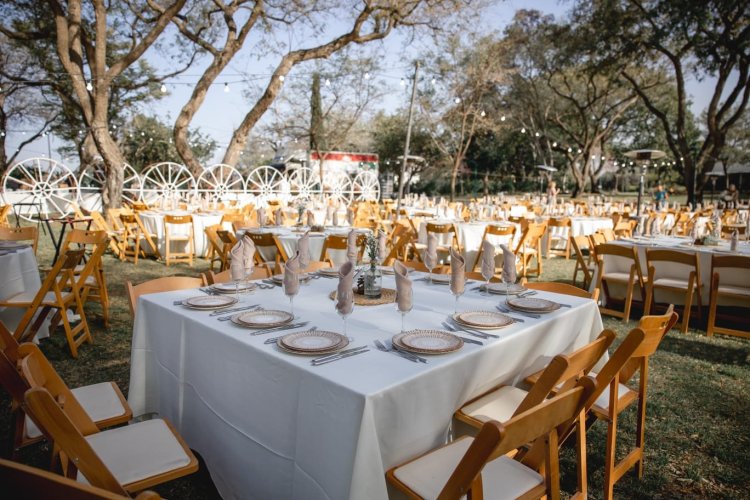 The wedding on the lawn at Kibbutz Be’eri (Photo: Ilan Magen)
You come from very different worlds. What was the first meeting between your families like?
“The first meeting was at my parents’ home in Har Bracha. We didn’t call it a vort, since that term was unfamiliar to Nadav’s family. We explained it as a meeting between the families and a shared meal. Thanks to Hashem, it was an excellent meeting, with immediate warmth on both sides.”
She describes Nadav’s family as warm and welcoming. “Even when Nadav is in the army, I sometimes go there alone to see him near Gaza, and I truly feel at home. I sit for coffee with his sisters, and the conversation flows naturally.”
They have spent several Shabbatot together in the Bachar family home. “The experience was very positive, though it required planning. Nadav has his own cabinet with cooking utensils, we use disposable dishes, and we bring our own food. His parents are wonderful and make sure to treat us with kosher items, such as store-bought cakes.”
“The family makes kiddush on Friday night. On Shabbat morning, we eat on our own, though sometimes others join us. As for prayers, there is no minyan in Be’eri, so Nadav walks to a nearby community.”
When Nadav and Hadar decided to marry, the question of where to hold the wedding arose. “As a son of Be’eri, it was very important to Nadav to be married in the kibbutz, and I agreed. We saw it as an opportunity to add life where life had been cut short.”
As plans progressed, they realized it would not be simple. “Questions arose about how a wedding with separation could take place in Be’eri. It was clear to us that we could not marry in a way that was not halachic, so the idea was raised to hold the wedding near Be’eri rather than inside the kibbutz.”
Eventually, it was agreed that the wedding would take place on the central lawn of the kibbutz. “That lawn is where the bodies of those murdered in the massacre were laid out,” Hadar notes quietly.
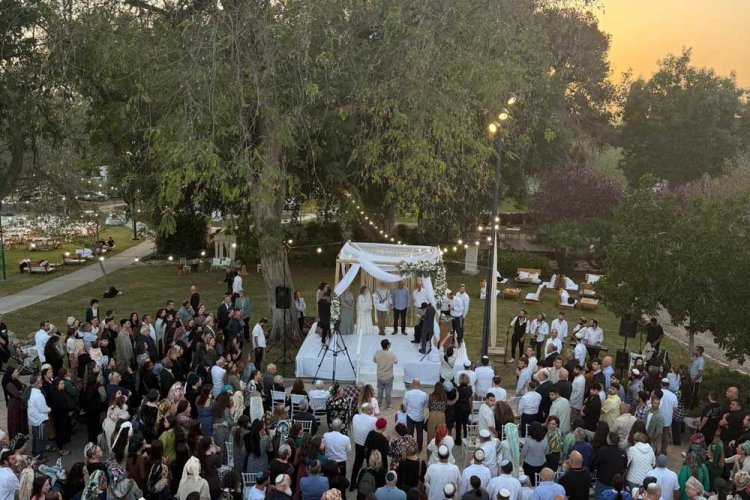 The wedding on the kibbutz lawn (Photo: Ilan Magen)
How were the reactions?
Hadar describes a deeply moving wedding. “There were about 750 guests, and the atmosphere was incredibly joyful. For many, it was the first time they had ever experienced a traditional Jewish wedding, and we received very enthusiastic responses.”
As the conversation draws to a close, Hadar reflects: “I am very firm in my views, and my relationship with Nadav’s beloved family did not change them. On the contrary, there are things I believe in even more strongly as a result. But this personal encounter opened a window for me to discover additional beautiful shades within the Jewish people.”