עברית
עברית

Magazine
Finding Family: A Journey of Love and Resilience
How Omer Glander turned a childhood shaped by foster care and disability into a life of purpose
- Tamar Schneider
- |Updated
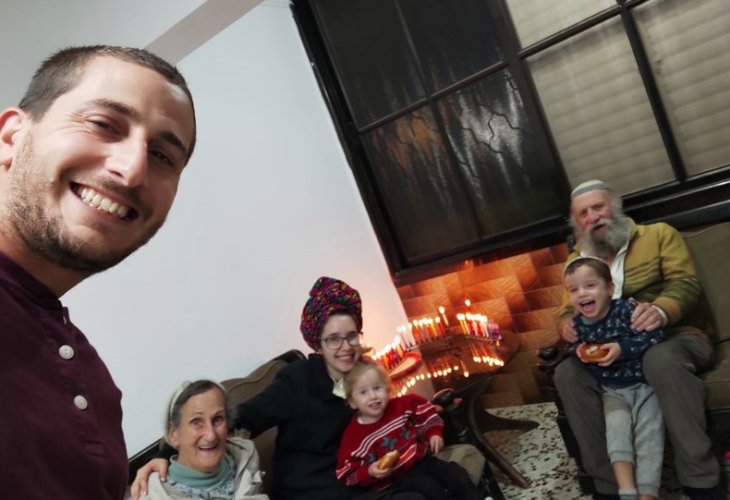 The family during Chanukah
Omer Glander was born to parents with borderline intellectual functioning — a condition that lies between typical cognitive ability and intellectual disability.
“When I was a baby,” he recalls, “my mother wanted to put turpentine somewhere out of reach, so she placed it under the kitchen table. She didn’t understand that that was exactly where I could reach. Of course, I drank the interesting-looking liquid and was rushed straight to the hospital for a stomach pump.”
Omer’s parents loved him and his sister, Mira, deeply, but they were unable to raise them over time. As a result, Omer was sent to a boarding school in early childhood and later placed with a foster family. The boy who sometimes felt embarrassed by his parents, who longed not to divide his life between two homes, and who still does not know whether the genetic impairment runs in him as well — grew up to build a family of his own. Today, he maintains a close, loving relationship with his parents and dedicates his life to helping people who live with the very same condition.
Limited Ability, Endless Love
The home Omer grew up in was never an ordinary one. “My parents were a bit unusual,” he explains, “but back then people didn’t really know how to define them as having special needs.”
His mother was diagnosed with schizophrenia at the age of eighteen. While some people manage to live functional lives with the illness, in her case it was accompanied by a general decline in functioning. She was not always stable and experienced long hospitalizations, during which Omer’s father could not properly care for the children.
“Still,” Omer says, “from my perspective, we had a good childhood. I remember my mother telling us stories, lying with us in bed, surrounding us with warmth and love. And when it mattered, she fought for us like a lioness.”
He recalls one incident vividly: his mother had stepped off a bus before the children, and the driver closed the doors. Despite her small, fragile frame, she threw herself against the doors with all her strength, forced them open, and got her children off safely.
Even when Omer began to realize that his parents were not like other adults, it didn’t trouble him much at the time. “There was a day my father played chess with my friends and me. At some point he got angry because one of my friends mixed up the pieces. Another time, he helped us light a Lag BaOmer bonfire — and ended up setting a nearby tree on fire. He couldn’t understand what the problem was. As a child, I actually found it spectacular. I didn’t grasp the danger, and there was no responsible adult to explain it.”
![Grandparents with the grandchildren]() Grandparents with the grandchildren
Grandparents with the grandchildren
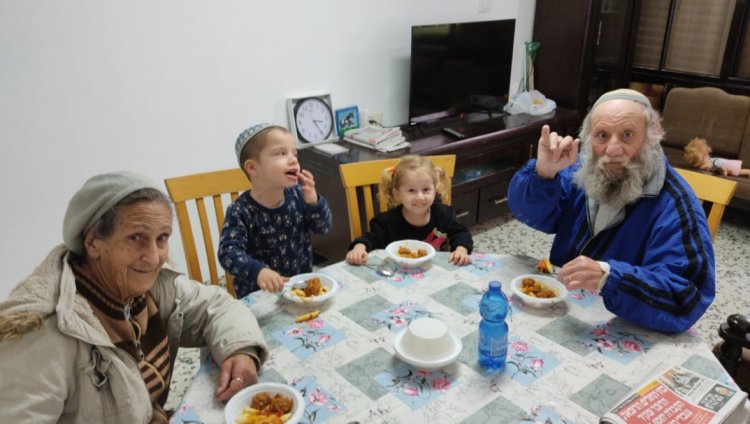 Grandparents with the grandchildren
Leaving Home at Seven
After a particularly long hospitalization of his mother and his father’s inability to care for the children, welfare authorities felt they had no choice.
“When I was seven, my sister Mira and I were sent to a boarding school,” Omer remembers.
“We got into a taxi. My mother screamed and resisted, and we drove away while she remained behind.”
The first days were hard, but he adapted quickly. “I missed my parents, but they visited whenever they could. And because all the children at the boarding school were in similar situations, it made things easier. I tried to run away once, but overall I didn’t know anything else, so many of my memories from there are actually positive.”
At the same time, he had a host family he visited on weekends and holidays. Two years later, when the boarding school closed, ten-year-old Omer moved permanently into the home of his host family — the Yaakobi family in Psagot.
The Pain of Belonging
Ironically, the move to a foster family was even more emotionally destabilizing.
“I was already older, and it took me much longer to bond,” he says. “The hardest part was belonging. I didn’t know if I was really their son or not. Was I truly a brother to my new siblings, or was it all temporary?”
He speaks with deep gratitude toward his foster parents, who constantly reassured him that he was their son and did everything possible to make him feel at home. “But I listened very carefully when they spoke to others — did they say they had nine children or ten? When they said nine, that feeling of not belonging washed over me again.”
At thirteen, he hid the fact that he was in foster care from his friends. When classmates searched for the surname “Glander” in the phonebook in Psagot and couldn’t find it, he had no idea what to say. Later, in ninth grade, he even tried changing his last name to “Yaakobi.” For a while it worked — until people who knew him before became confused. “It didn’t really succeed,” he admits.
During his army service, Omer finally confronted the issue head-on. “Even filling out basic forms was confusing. I didn’t know which name or which home to write. I realized I had to stop running from it.” He returned to his biological surname, accepting the complexity that came with it.
Did you ever question God about your life journey?
“I had questions, but not from a place of anger or rebellion. I wanted to understand. I asked why everything had to be so complicated for me.”
He also worried about genetics. “If my parents and my sister are like this, what does that mean about me? Am I carrying the same genes? Can I build a family?”
With time, he came to see that his unusual life path shaped him into who he is. “A social worker who knew me as a child later asked me to mentor another foster child in our yeshiva. Who could understand him better than me?”
Not long ago, Omer shared his story publicly. Afterward, a teenage girl in foster care approached him and said how much his journey helped her. “That’s when I realized that I was chosen to walk this path so I could turn it into something good. In the end, the question isn’t where you came from, but where you choose to go.”
Turning Pain into Purpose
One place Omer chose to go was social work. Today he works at Sdeh Chemed, a residential housing framework for people with borderline intellectual functioning — individuals like his parents and sister.
“I didn’t plan it,” he says. “But God led me to the place where I could give the most from my experience.”
His relationship with his parents today is strong and loving. “I speak to my mother every day. We visit them often in Jerusalem, and they come to us for Shabbat.”
At one point, he and his wife even rented an apartment near them, hoping they would move closer. They declined — and in hindsight, Omer believes it was for the best, given the complexity of the neighborhood and his parents’ difficulty understanding danger.
Isn’t it hard to maintain such close contact with parents who don’t function on the same intellectual level?
“I love talking to them. I never felt it was ‘beneath’ me. And not everything needs words. Listening to music together, walking down the street — shared experiences create connection.”
His mother loves buying gifts for her grandchildren. “I guide her so it’s something appropriate. It matters to me that there’s real giving and receiving. She’s overjoyed when she sees the kids happy.”
“Financially, my mother worked for years and receives a pension, so that’s not an issue. In other ways, I don’t feel like I’m missing anything. I’m grateful for what I have. Seeing the half-full cup is a choice.”
Marriage and Acceptance
One of the hardest challenges came during shidduchim.
“Things seemed to be progressing with a girl, but after her parents were consulted, she ended it. They said not to ‘enter a sick bed.’ Hearing that about myself felt like a punch in the stomach.”
Eventually, Omer met the woman who became his wife. From early on, he laid everything on the table. It wasn’t easy for her or her parents, but today, there are no regrets.
“She cares for my parents even better than I do,” he says with emotion. “So do her parents. We celebrate holidays together. During COVID, we even lived close to each other for weeks — it was a dream.”
Choosing Gratitude
Acceptance didn’t come naturally. “It was a muscle I needed to exercise again and again. But if shame once dominated my life, today it barely exists. Where I once didn’t want my parents to show up, now they come everywhere with us.”
He pauses, then adds: “My parents are different. But they love us, and we love them. Every time I see them, I’m still moved. That bond — for me, is a dream fulfilled.”