

Israel News
U.S. Begins Visible Military Positioning Toward Middle East
Carrier movement and fighter jet deployment signal a shift from warnings to readiness as Washington prepares for potential escalation with Iran
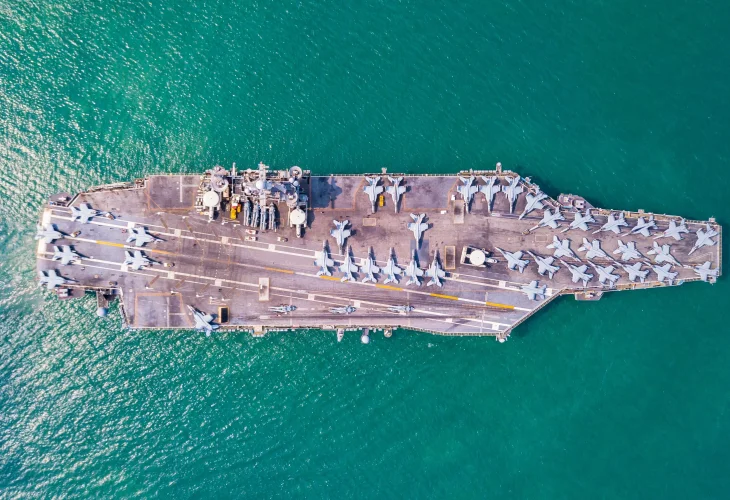 USS Abraham Lincoln (Shutterstock)
The United States has begun visibly expanding its military presence in the Middle East, moving to positioning of air and naval forces as tensions with Iran continue to simmer.
Over the past 24 hours, U.S. military aircraft and naval assets have been observed relocating toward the region, a development that shows heightened readiness and preparation for a range of possible operational scenarios.
According to flight tracking data, the U.S. Air Force has begun moving 12 F-15E Strike Eagle fighter jets from Britain toward Jordan, placing them closer to potential hotspots across the Middle East. The F-15E is a long-range combat aircraft designed to carry out both air-to-air and ground-attack missions, allowing it to strike targets while also defending airspace.
The deployment was supported by a U.S. Air Force C-17 transport aircraft, which carried equipment and personnel needed to sustain the fighter jets after their arrival, ensuring that fighter aircraft arriving in the region can be maintained and operated for extended periods if needed.
In addition, four KC-135 aerial refueling aircraft took part in the operation, flying from the UK. These tanker planes refuel fighter jets mid-air, allowing combat aircraft to travel long distances without landing and remain operational once deployed.
Alongside the air activity, significant movement has also been recorded at sea. The U.S. Navy aircraft carrier USS Abraham Lincoln was observed in recent days transiting the Strait of Malacca near Malaysia, heading west toward the Indian Ocean and ultimately the Middle East. The narrow strait is a major global shipping route and serves as a gateway between the Pacific and Indian Oceans. The aircraft carrier is effectively a floating airbase, carrying dozens of fighter jets, surveillance aircraft, and support helicopters. Its arrival in the region would give Washington immediate and flexible military options, allowing aircraft to operate without relying on regional bases.
Taken together, the air and naval movements suggest a coordinated effort by Washington to ensure that credible military forces are in place, should tensions with Iran escalate further. U.S. officials have not announced any decision to carry out military action, and no formal Pentagon statement has detailed the deployments. However, the visible movement of assets signals preparation rather than rhetoric.

