

World News
Israel–US Launch Historic Strike on Iran’s Leadership; Indications Khamenei Eliminated — Full Roundup
Largest air assault in Israeli history targets regime and missile infrastructure as Iran retaliates across Israel and Gulf states; Trump says Khamenei was killed
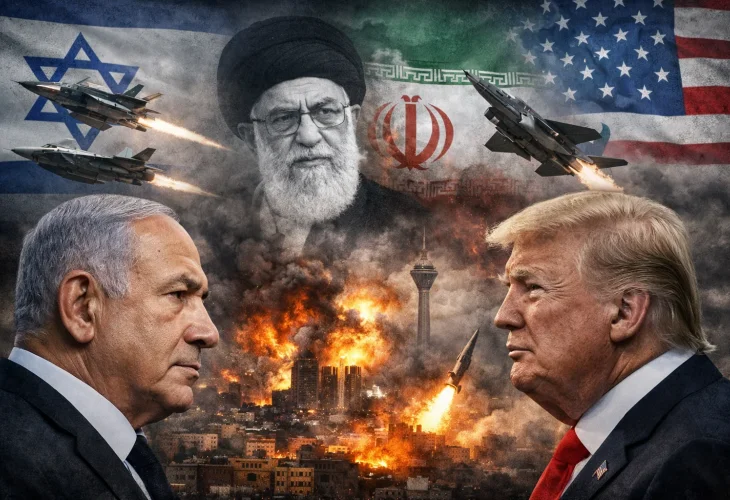
Inside the Strike on Iran’s Supreme Leader
Israel and the United States launched a large-scale assault on Iran Saturday in the largest air campaign in Israeli history, striking regime leadership compounds and key military infrastructure across the country. Israeli officials said there are indications Supreme Leader Ali Khamenei was killed in the opening hours of the operation, a view publicly supported by U.S. President Donald Trump, though Iranian authorities have not issued independent confirmation.
The strikes were launched early Saturday morning under the name “Operation Roaring Lion.” U.S. forces participated under what American officials called “Operation Epic Fury.” Israeli officials said the initial wave focused heavily on regime leadership compounds and strategic military infrastructure, including locations where senior figures were believed to be present.
Prime Minister Benjamin Netanyahu declared, “This war will lead to true peace. The plan to destroy Israel is no more, and there are many signs that the tyrant Khamenei is no more.” Iranian authorities denied the claim, there was no independent confirmation of Khamenei’s fate.
President Donald Trump addressed the American public overnight, saying, “The objective is to defend the American people by eliminating imminent threats from the Iranian regime.” He added, “Iran can never have a nuclear weapon.” In a warning directed at Iranian security forces, he said, “Lay down your arms or face certain death.” Trump also told the Iranian public, “When we are finished, take over your government.”
Among the leadership targets were the presidential palace in Tehran, army headquarters, the Defense Ministry, and command centers of the Islamic Revolutionary Guard Corps. A bunker compound associated with Khamenei was also struck. Israeli officials said there were indications that additional senior security officials may have been killed, but stressed that those reports remained under assessment.
Status of Ayatollah Khamenei
President Donald Trump declared in an emphatic Truth Social post that “Khamenei, one of the most evil people in History, is dead,” calling the strike not only “Justice for the people of Iran,” but for “all Great Americans” and others killed by what he described as Khamenei’s “bloodthirsty THUGS.”
Trump said U.S. intelligence and tracking systems ensured there was “not a thing he, or the other leaders that have been killed along with him, could do,” and described the moment as “the single greatest chance for the Iranian people to take back their Country.”
As of Saturday night, Iranian authorities had not independently confirmed Khamenei’s death. State media continued regular broadcasts and had not formally announced a leadership transition.
If verified, the killing of Iran’s Supreme Leader would represent the most significant decapitation strike in the Islamic Republic’s history and could trigger an immediate internal power struggle.
Scope of the Israeli–US Assault
According to the IDF, approximately 200 fighter jets struck roughly 500 targets across western and central Iran.
“Since this morning, about 200 fighter jets, guided by Military Intelligence and the Air Force, completed a broad strike against the missile array and defense systems of the Iranian terror regime in western and central Iran. This is the largest strike flight in the history of the Israeli Air Force,” an IDF spokesperson said.
The strikes first targeted Iran’s air defense network, allowing aircraft to expand operational freedom over Iranian airspace. Surface-to-surface missile launchers, underground missile storage facilities, and command-and-control centers were then hit. A major missile complex near Tabriz in western Iran, which Israeli officials said was used to prepare dozens of launches toward Israel’s home front, was among the key sites attacked.
Iranian Casualties
Iranian authorities reported that at least 201 people were killed and 747 injured nationwide in the strikes. They did not provide a breakdown between civilians and combatants.
Iranian officials also said a girls’ elementary school in Minab, in Hormozgan province, was struck, killing 85 pupils and injuring dozens more. Israel has not confirmed details of that incident.
Iran’s Missile Retaliation on Israel
Tehran responded with multiple missile barrages throughout the day, referring to its retaliation as “Promise of Truth 4.” Iranian military assessments said around 150 ballistic missiles were launched toward Israel in several waves, followed by additional unmanned aerial vehicles. Sirens sounded across central and northern Israel as air defense systems intercepted many of the incoming projectiles.
Emergency services reported a direct hit on a residential building in northern Israel. Missile shrapnel struck a 20-story building in Tirat Hacarmel, penetrating the 17th floor. A 17-year-old was lightly injured, and paramedics treated approximately 89 people for mostly minor injuries or anxiety. The IDF said more than 10 Iranian UAVs were shot down.
Strikes Across the Gulf and U.S. Response
Iran also launched attacks toward U.S.-linked targets across the Gulf, including Saudi Arabia, Jordan, Bahrain, Qatar and the United Arab Emirates.
Explosions were reported in Abu Dhabi and Manama, with one fatality reported in the UAE. Bahrain, home to the U.S. Fifth Fleet headquarters, was among the locations reportedly targeted. Jordanian authorities said they intercepted dozens of drones and missiles passing through their airspace.
Reports also emerged of Iranian Revolutionary Guard warnings regarding shipping in the Strait of Hormuz, raising concerns about potential disruption to global oil traffic.
Israeli Home Front Measures and What Comes Next
Inside Israel, authorities declared a state of emergency, closed schools and restricted public gatherings. Airspace controls were tightened, and parts of the country’s natural gas infrastructure, including the Leviathan field, were temporarily shut as a precaution.
Foreign Minister Gideon Sa’ar held conversations with 17 foreign ministers throughout the day to explain Israel’s objectives, while the U.S. State Department issued a global security alert urging Americans worldwide to exercise caution.
IDF Chief of Staff Eyal Zamir described the campaign as unprecedented. “We are facing a significant, fateful and unprecedented campaign to destroy the capabilities of the Iranian terror regime, capabilities that pose a continuous existential threat to the State of Israel,” he said. He cautioned, “There is no hermetic defense. We must not underestimate the enemy’s ability to harm us.”
Netanyahu framed the operation as a strategic turning point. “We will create the conditions for the Iranian people to replace this regime,” he said. “The risk of not acting is far greater.” In a direct appeal to Iranians, he declared, “Help has arrived.”
Questions & Answers
+Who would replace Khamenei if he is killed?
+Why is the Strait of Hormuz important in this conflict?
+Who could lead Iran if the current regime falls?

