

Personal Stories
From Hiding in the Netherlands to Hunting Nazis: A Family Story of Holocaust Survival
A reflection on life after the Holocaust, enduring antisemitism, and the responsibility of future generations to preserve the memory of those who perished
- Shiri Priant
- | Updated
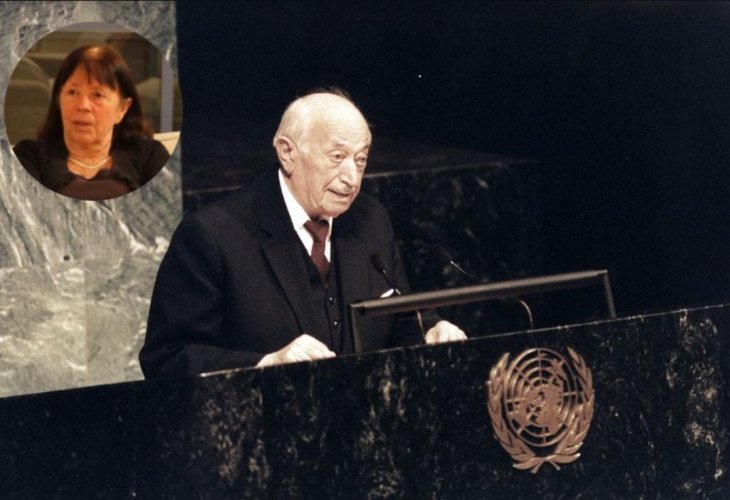 Nazi Hunter Simon Wiesenthal (Inset: His Daughter Paulinka Kreysberg)
He is a survivor of the Holocaust in the Netherlands, where about 75 percent of the country’s Jews were murdered. She is the daughter of the famed Nazi hunter Simon Wiesenthal, who devoted his life to tracking down Nazi war criminals and bringing them to justice. He belongs to the first generation after the Holocaust. She belongs to the second.
To mark Holocaust Remembrance Day, Gerard and Paulinka Kreisberg sat down for a moving joint interview in their home in Ramot Naftali. Together they reflected on life after the Holocaust, on the antisemitism that persisted long after the war, and on the responsibility of the younger generation to preserve the memory of those who were murdered.
A Childhood Without a Father
Gerard Kreisberg was born in the Netherlands after his parents fled Austria following the German invasion. A clinical psychologist by profession, he was only one year old when the war began. Until the age of five, he did not even know he was Jewish, nor did he know his father.
“From 1943 until the end of the war, we lived with a very elderly Dutch woman,” he recalls. “I do not remember what she looked like, but she was not especially kind. I assume my parents paid her to hide us. It was in Zeist, a small town near Utrecht. My father was living there too, but I did not see him during that entire period. There was a room under the ground in the house, and he hid there for two years.”
Did you know he was there?
“Not at all. I did not know I even had a father. I remember once seeing some strange man in the house, so I asked my mother who he was. My mother was a very strong woman. She told me it was just a relative who had come to visit and had already left, but I had no idea there was a father in the picture at all.”
Why did he hide separately from you?
“My mother was a very beautiful woman, blonde like the Dutch, with a great deal of personal charm. She spoke German effortlessly because she had grown up in Austria. The Germans in the Netherlands went from house to house looking for men to work for them. Of course, if they found Jews, they would send them to extermination camps, but mainly they were looking for laborers.
“My mother was stronger than my father, and when the Germans came and knocked on the door, she told them that her husband was not there because he had already been taken to work in Germany. I remember that when they came, they came noisily, closed off the street, and carried weapons. My mother sent me across the street to the neighbors because she did not want me there during that situation.
“In fact, I was a major problem for my parents. I did not look Dutch. I was not blonde with blue eyes. I was dark. People in the neighborhood called me a gypsy. They thought I looked strange, but luckily nothing happened. My father looked like that too, but no one saw him because he was underground.”
A Mother’s Instinct
In the Netherlands, antisemitism developed gradually. At first, restrictions were imposed on Jews, and only later did matters become worse. At the stage Gerard describes, had his parents already understood that Jews were being murdered?
“I think not, at least not in the beginning. One day the Germans came looking for people to relocate to Poland. My father was a very decent man, and he said to my mother, ‘All right, the Germans do not like us very much, they do not want us here, but they are not going to harm us.’ Of course, who could even imagine such a thing? My mother told him that if he wanted to go to Poland, he could go without her and without me. That was the difference between them. My father believed they would not do anything to us. My mother saw things very differently.”
Her instincts proved correct.
When Gerard was a child, she sent him to a boarding school run by two non Jewish sisters.
“I remember crying terribly and wanting to come home, but my mother refused,” Gerard says. “I understand her. It was much safer for me there. Years later, I was told that after a few days at the boarding school, my mother had a bad feeling and took me out. My father tried to convince her to leave me there, but she insisted. Two days later, the Germans came and took all the Jewish children from that place. Of course, none of them returned. One of the directors insisted on accompanying the children, and she too was murdered in the Holocaust. It was a very sad story that has stayed with me ever since.”
It is hard to believe that they murdered even children without remorse.
“You say it is hard to believe. I say that at least once a week,” Gerard answers. “What they did, what they took upon themselves, is beyond comprehension. It was impossible to predict their moves. They could tell you to go left and then shoot you for going. As a psychologist, I see it today in photographs, especially in pictures where Germans and Jews appear together. You can see that they enjoyed being cruel. It screams out from the photographs.”
Not Angry at the Dutch
Throughout the interview, Gerard repeatedly says that his mother was a strong woman. When asked why, he tells how she dragged him to witness the Nazi surrender.
“I have a very strong memory of her from the end of the war. Near the town where we lived ran the main road, and when the war was ending, Canadian and British forces arrived in the area and the German soldiers withdrew. My mother insisted that I come with her to watch the Germans surrender. Do you think my father came? Absolutely not. He was afraid, and it was not hard to be afraid of them.
“I remember all of us standing there, dressed in orange and waving flags. Just as the forces were leaving, the last German soldier shouted, ‘I do not want to see those flags.’ We were all frightened and immediately left. For many years, I thought I had dreamed it or remembered it incorrectly. About twenty years ago, I met someone through work who turned out to have been there too. He told exactly the same story about that same German soldier.”
Discovering He Was Jewish
For the first five years of his life, Gerard thought he was Catholic. He discovered his Jewish identity in an unusual way.
“A year before the war ended, my mother and I were invited by the Dutch resistance to a gathering. It was the Hunger Winter, a very difficult period, and they served us eel. I kept asking my mother when we would eat that again, and she kept saying, ‘Not now.’ When the war ended, I asked again, and she told me that we do not eat things like that because we are Jews. That was the first time I discovered I was Jewish.”
Along with that discovery, Gerard also learned that he had a father.
“I do not remember what that did to me because I really did not know him. He seemed to me like a strange and unfamiliar person. I had not seen him for two years, so I did not know what to do with that information.”
What happened in the years after the war?
“My parents were already afraid to be Jewish. They did not speak about the Holocaust, and they worked very hard to earn a living. They were very successful. My mother’s parents had fled during the war to Israel, then Palestine, and her mother died here. People said it was because she could not bear the distance from her daughter, my mother.
“My mother’s father, who had grown up in a religious home, came to live with us after the war, and my mother slowly began returning to tradition. I remember our home as a very Jewish home. For me too, being Jewish is the most important thing. I am not religious, but I go to synagogue and I feel at home there. I feel that is where I belong, that I am completely Jewish.”
What about life in the Netherlands after the war? There has been criticism that the Dutch did not do enough to help the Jews.
“I do not think the criticism is justified, because the Dutch truly did not know. In fact, the Jews in the Netherlands did not know what the Germans were doing either. That is why my father told my mother that they would not do anything to us.”
There are still Holocaust deniers, unfortunately. What can you say to them as someone from the first generation after the Holocaust?
“I do not know what one can say to them. It is like antisemitism. Jean Paul Sartre wrote that Jews will never be good enough to prevent antisemitism. That says it all.”
“We Said We Were Jewish, and the Principal Said, ‘I Thought There Were None Left’”
Paulinka Wiesenthal Kreisberg, Gerard’s 74 year old wife, is the daughter of the famous Nazi hunter Simon Wiesenthal and his wife Cyla. Wiesenthal, himself a Holocaust survivor, dedicated his life to collecting evidence on Nazi war criminals. He succeeded in helping bring more than 1,100 war criminals to justice, men responsible for mass murder during the Holocaust. He also played a role in the search for Adolf Eichmann, a case that made him world famous.
Wiesenthal grew up in Buczacz, now part of Ukraine, in a traditional Jewish environment deeply shaped by Hasidic culture. During the war he was separated from his wife Cyla and came close to death many times. He was convinced she had perished in Warsaw, but she survived as a forced laborer in Germany, and the two were reunited after the war.
In 1946, their only daughter, Paulinka, was born in a displaced persons camp for Holocaust survivors.
“Austria was divided into four sectors, and we were in the American sector,” Paulinka says. “In the camp there were Jews who had survived the Mauthausen concentration camp, which was quite nearby, along with other refugees from other camps. We lived there for at least three years. My first memory of the place is the sight of the American soldiers. They seemed so enormous to me. I looked at them as if they were from another world.
“Another thing I remember is that my father used to take me walking in various places. One day I saw a huge pit and asked him what it was. It was from the bombardments there.”
Did you understand what that meant?
“No. I grew up in a place and atmosphere that seemed natural to me. I did not know anything else. For me, that was simply the reality into which I was born, just as you are born into a certain reality. I remember that people constantly used the word ‘camp.’ They spoke many languages there, but that word was always said in German. When they saw me, they stopped saying it.”
When did you begin to understand the scale of the disaster?
“It is hard for me to say. I had an unusual childhood that I cannot compare to any other. What I saw and what I felt were different. We lived in a place with almost no Jews. There were only elderly Jews whom I saw in synagogue on Rosh Hashanah and Yom Kippur, and even there they cried. That was all. I knew we were unusual.
“When my mother enrolled me in school, the principal asked my name and my religion. When my mother answered, ‘Jewish,’ the principal said, ‘I thought there were none left.’ At the time it seemed normal, but today I look back on it as a completely different world.”
Paulinka says she grew up very simply, and that her father was almost always away from home, busy searching for Nazi criminals. That was his work.
“There was a very clear separation between work and home. My father never spoke about his work.”
Did you ever wonder why he did it?
“It was so completely obvious. I could not imagine him getting up in the morning and doing anything else. What else could he have done? It was so central to his life, so natural, so deeply his. He could not leave it behind. He was driven by purpose and did what had to be done. If it had been up to him, he would have continued forever.”
And indeed he did continue. Only at the age of 94 did Simon Wiesenthal announce that he had completed his work and was retiring. In his words: “I found the mass murderers I was looking for, and I lived longer than they did. If any of them remain, they are now too old to stand trial. My work is done.”
“Without My Mother, the House Would Have Collapsed”
Paulinka grew up in Austria, not far from the camp where she was born. She recalls that in 1956, refugees from the Hungarian uprising arrived, and there she encountered Jews very different from any she had known.
“They were truly ultra Orthodox, even more than the Haredim in Israel. It was very strange to me. My father was active in so many causes, and he helped them too. He built them mikvaot, arranged courses for them, and helped train them.”
What is your strongest memory of your mother?
“My mother was at home. I think that without her, everything would have collapsed. She was a quiet woman, and she made sure there would be a normal home in the middle of all that madness around us. She did not like living in antisemitic Austria, but because of my father’s work, we could not immigrate to Israel. Austria was the center of his activity. But she did not like being different, not belonging.”
Simon Wiesenthal died in his home in Vienna fifteen years ago and, according to his wishes, was buried in Israel.
Working With the Living
Paulinka, a psychologist by profession, devoted her life to helping Holocaust survivors. For the last ten years she has served as chairwoman of an organization that assists Holocaust survivors living in Israel.
“We both dealt with the Holocaust, but in different ways. He dealt with the dead. I deal with the living. He dealt with the past, and I deal with the present. When I speak with survivors, I am completely with them. I put myself aside and feel close to them.”
How can Holocaust memory be preserved as the number of survivors steadily declines?
“Although it was difficult for me to organize Holocaust Remembrance Day last year, there is one thing I took with me: as long as we speak about them, they are still here. If we do not forget them, we continue them. A great deal depends on the next generation preserving their memory.
“There are many films, testimonies, and enough material. We simply need to know how to convey it properly to people who do not know what happened there. Yad Vashem once had a very strong impact. Today, in the newer structure, there is a great deal of information, but it has become a little more distant. It does not bleed, it does not hurt, but it still carries a message.”
No Memorial Can Replace a Living Testimony
From personal experience, I can say that no monument can replace the testimony of a living person when it comes to conveying the message of the Holocaust.
Gerard agrees.
“You are right. It is very hard to pass on the message when Holocaust survivors are becoming fewer and fewer. That is why the Sages said, ‘In every generation, a person must see himself as though he personally came out of Egypt.’ And that is the mission here as well.”
