

Israel News
Israel Strikes Hezbollah Targets in Beirut After Massive Overnight Rocket Barrage
More than 200 rockets fired toward northern Israel as Hezbollah launches “Devoured Straw” operation and Iran confirms coordinated attack
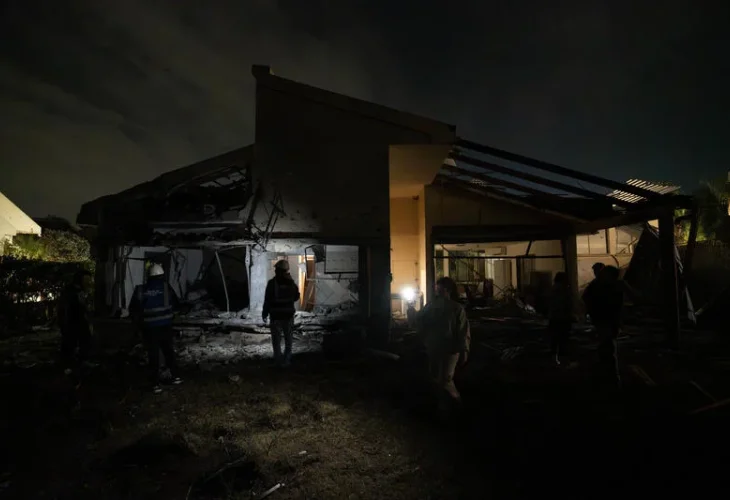 People stand at the scene where a house was hit by a missile fired toward Israel in Moshav Hani’el, March 12, 2026. Photo by Chen Leopold/Flash90
Israel launched strikes on Hezbollah targets in the Dahiyeh district of Beirut overnight after Hezbollah fired more than 200 rockets toward northern Israel in a massive barrage. Sirens sounded across northern communities for hours as emergency crews responded to rocket impacts and injuries.
Hezbollah launched the sustained barrage over several hours, sending rockets toward communities across the Galilee and the Golan Heights. Air raid sirens forced roughly two million residents in northern Israel to remain near or inside protected spaces as the attacks unfolded through the night.
The escalation marked a significant intensification of fighting along Israel’s northern front. Hezbollah announced the attack as part of a new operation it called “Devoured Straw,” while Iranian officials later confirmed the barrage had been carried out in coordination with the terrorist group.
One rocket struck a home in the Upper Galilee, injuring five people, most of whom suffered minor wounds or anxiety-related symptoms, according to emergency responders. Additional rocket and shrapnel impacts were reported in northern communities, and debris from one strike ignited a forest fire that firefighters worked to contain.
Iran’s IRGC later confirmed the attack had been coordinated with Hezbollah as part of a joint operation targeting Israel. “The operation included coordinated missile and drone launches targeting more than 50 sites across Israel,” the Iranian statement said. Iranian officials added that the barrage was planned to sustain fire for about five hours and involved several types of missiles, including Qadr, Emad, Kheibar-Shekan, and Fattah.
In response to the attacks, Israeli aircraft carried out strikes against Hezbollah infrastructure in Dahiyeh, a southern suburb of Beirut that serves as the organization’s central stronghold. According to Israeli reports, the strikes targeted Hezbollah command centers and intelligence facilities used by the terrorist group.
Israeli officials warned that the response could expand if Hezbollah continues firing rockets into Israeli territory. A Saudi media report citing an Israeli source said the United States could potentially join airstrikes against Hezbollah targets in Baalbek and the Bekaa Valley if the escalation deepens. Israeli leaders are also discussing the possibility of seizing territory in southern Lebanon to expand the security buffer along Israel’s northern border if the fighting continues.
Israeli officials say the intensified rocket fire may be part of Hezbollah’s broader strategy to shift pressure away from Iran while strengthening its leverage ahead of potential negotiations over a future ceasefire along the northern border. According to Israeli assessments, the escalation could be aimed at forcing renewed talks over the terms of previous arrangements and easing enforcement measures imposed on Hezbollah in southern Lebanon.
At the same time, Hebrew media reports suggested Israeli intelligence had identified preparations for the Hezbollah barrage in advance and debated launching a preemptive strike. Some reports claimed such an operation was blocked to protect an intelligence source, but the IDF denied the allegation and said the description of events was inaccurate.
Questions & Answers
+What is Hezbollah and who supports it?

