

World News
“It Will Be the President’s Decision”: Hegseth Says Iran War Ends When Trump Decides
Statements Thursday from U.S. and Iranian officials offered conflicting signals about how long the war could last
- Brian Racer
- | Updated
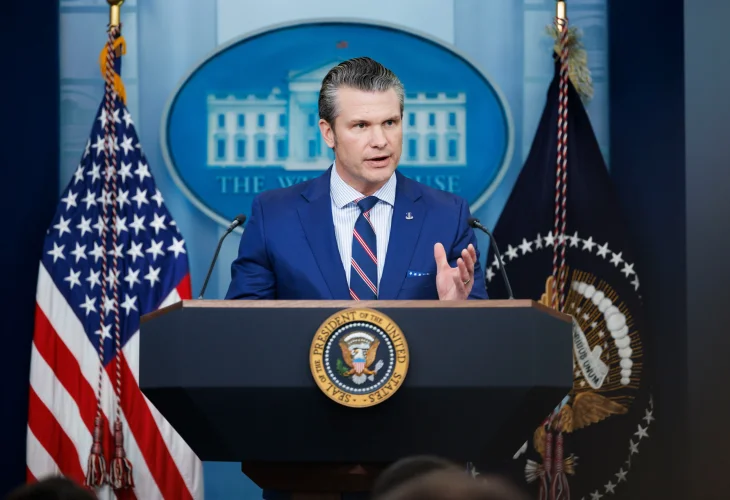 Pete Hegseth (Shutterstock)
U.S. Defense Secretary Pete Hegseth said Thursday that there is no fixed timeline for the end of the war with Iran, declaring that the decision will ultimately rest with President Donald Trump as the conflict entered its nineteenth day.
“Ultimately, it will be the president’s decision when we say, ‘We’ve achieved what we need to on behalf of the American people to ensure our security,’” Hegseth said during a Pentagon briefing, addressing growing questions about how long the conflict could continue.
The remarks came as officials in Washington and Tehran issued new statements suggesting sharply different expectations about how the war might end, with each side signaling that the fighting will continue until its strategic objectives are achieved.
Hegseth said U.S. forces have already struck more than 7,000 targets across Iran and its military infrastructure since the campaign began. The Pentagon chief also indicated that operations were continuing to intensify rather than wind down. “We wouldn’t want to set a definitive time frame on that,” Hegseth said when asked how long the war could last. “We’re winning decisively, and on our terms.”
Gen. Dan Caine, a senior U.S. commander overseeing the campaign, reinforced that message, saying the pace of operations is increasing. “We will continue major combat operations,” Caine said. “We continue to get busier.”
At the same time, testifying before the House Intelligence Committee on Thursday, Director of National Intelligence Tulsi Gabbard said Israeli operations appear focused on disabling Iran’s leadership, while the United States has prioritized degrading Iran’s military capabilities. “The objectives that have been laid out by the president are different from the objectives that have been laid out by the Israeli government,” Gabbard said. According to Gabbard, U.S. objectives include destroying Iran’s ballistic missile launch capability, dismantling its missile production capacity, and weakening the Iranian navy.
Iranian officials on Thursday signaled that they also see no near-term end to the conflict and warned that the fighting could escalate further. Foreign Minister Abbas Araghchi said any resolution of the war must address damage inflicted on Iran’s civilian infrastructure. “Any end to this war must address damage to our civilian sites,” Araghchi said.
Ebrahim Zolfaqari, a spokesman for Iran’s unified military command, said the attacks on Iranian energy infrastructure marked what he described as a new phase in the conflict. “If strikes on Iran’s energy infrastructure happen again, further attacks on your energy infrastructure and that of your allies will not stop until it is completely destroyed,” Zolfaqari warned, adding that Iran’s response would become “much more severe.”
An adviser to the commander of Iran’s Islamic Revolutionary Guard Corps echoed that position in comments to Al-Jazeera, saying Tehran would not accept outside pressure to halt the war. “The war was forced on us and no one can demand that we stop it,” the adviser said.
Trump himself previously suggested the conflict might end quickly, saying earlier in the campaign that he could bring the war to a close whenever he chooses. “Any time I want it to end, it will end,” Trump said.
The debate over the war’s duration intensified this week after Israel carried out a strike on Iran’s South Pars natural gas field, part of the world’s largest gas reserve. Iranian retaliation targeted energy infrastructure in several Gulf states, widening concerns that attacks on strategic economic assets could prolong the conflict.

