

Behind the News
Trump, Netanyahu Split on Iran War Endgame
U.S. pushes toward a rapid deal as Israel accelerates strikes fearing U.S. may end the war early
- Brian Racer
- | Updated
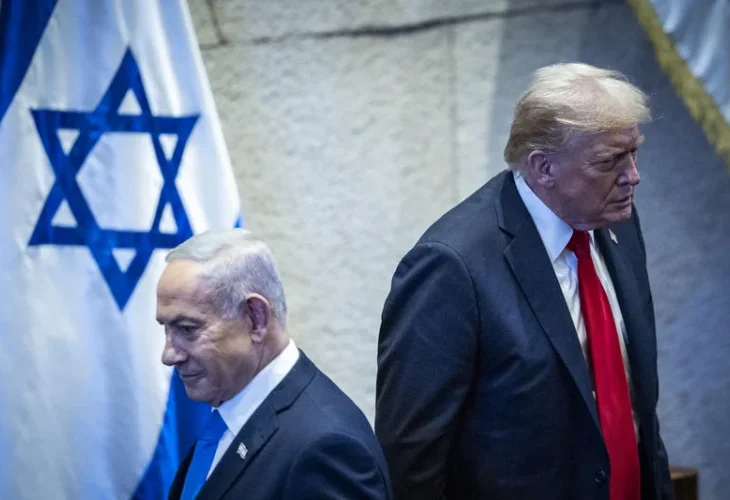 Donald Trump and Benjamin Netanyahu (Yonatan Sindel/Flash90)
U.S. President Donald Trump said Wednesday that Iran is negotiating with his administration and “badly” wants a deal, as the White House signaled the war is nearing its objectives, while Israel accelerated strikes due to concern Washington could end the conflict early, highlighting a growing gap over how the war should end.
According to a report by The Wall Street Journal on Wednesday night, Trump is seeking to end the war within weeks and aims to conclude it before a planned mid-May meeting with Chinese President Xi Jinping. The report said Trump is wary of a prolonged conflict and is working to avoid a ground invasion, instead favoring a limited campaign followed by a negotiated settlement.
That timeline was echoed by White House Press Secretary Karoline Leavitt on Wednesday, who said U.S. operations are running ahead of schedule. “From the outset,” she said, Trump and the Pentagon “estimated it would take approximately four to six weeks to achieve this critical mission,” adding that “We are very close to meeting the core objectives of Operation Epic Fury.”
Later that day, Trump told a Republican fundraising event that Iranian officials are quietly seeking a deal. “They want to make a deal so badly, but they’re afraid to say it, because they figure they’ll be killed by their own people. They’re also afraid they’ll be killed by us,” he said.
In contrast, Israel appears to be preparing for a longer and more expansive campaign. A report by The New York Times on Wednesday said Israeli leaders have accelerated strikes on Iranian targets due to concern that Trump could move to end the war abruptly, with Israeli Prime Minister Benjamin Netanyahu saying the campaign was “continuing at full force, despite what is reported in the media.” Netanyahu has instructed the military to intensify attacks on Iran’s arms infrastructure in a concentrated push, according to officials cited in the report.
Israeli officials have also continued operations against Hezbollah in Lebanon, with Netanyahu emphasizing efforts to dismantle the group’s capabilities. Security assessments cited in Israeli reporting indicate that the initial plan envisioned a shorter campaign, but that objective has shifted as leaders seek to secure more lasting gains before any diplomatic conclusion.
The differences are most visible in how the two sides view the possibility of regime destabilization in Iran. According to U.S. officials and an Israeli source, Netanyahu proposed issuing a joint call with Washington urging Iranians to take to the streets. Trump rejected the idea, warning of the risks. “Why the hell should we tell people to take to the streets when they'll just get mowed down,” he said, according to a U.S. official briefed on the conversation.
U.S. officials have described regime change as a possible outcome but not a core objective, while Israeli officials have framed internal pressure on the regime as part of a broader strategy to weaken it.
Additional signals suggest Washington is exploring diplomatic openings even as fighting continues. The Wall Street Journal also reported that the United States and Israel temporarily removed Iranian Foreign Minister Abbas Araghchi and Parliament Speaker Mohammad Baqer Qalibaf from a list of potential targets for several days in an effort to encourage talks.
Iran, for its part, has signaled it is not prepared to accept a narrow ceasefire, with Reuters reporting Wednesday that Tehran told intermediaries as early as mid-March any agreement must include a halt to Israel’s offensive against Hezbollah in Lebanon, while Iran’s state broadcaster Press TV cited an official saying any deal must end the war not only on Iran but also on “resistance groups” across the region, indicating that negotiations are aimed at securing broader regional terms rather than simply pausing the fighting.
As the war approaches the end of its first month, the direction of the conflict may hinge on whether these competing visions can be reconciled. The United States is signaling a push toward a time-bound conclusion, Israel is seeking to extend military pressure to secure deeper gains, and Iran is attempting to tie any agreement to its regional posture, leaving the final outcome dependent on decisions in Washington in the coming weeks.

